

Drawings and documents
USPTO scan
The patent as scanned by the USPTO
-
 Page 1
-
 Page 2
-
 Page 3


U.S. Patent and Trademark Office · Google Patents
Show the transcription Hide (506 words)
Machine transcription (LightOnOCR) of the pages as scanned by the USPTO, most of them the handwritten copies made when the records were restored after the 1836 fire. Not checked; it can misread handwriting, so compare it with the scan.
Page 1.
UNITED STATES PATENT OFFICE
PTO – BOYERS, PA DUTY STATION
PAGE NOT AVAILABLE
PATENT NUMBER X5056 FOR THE ISSUE DATE 4/5/1928 HAS BEEN SCANNED/LOADED, BUT WITH MISSING PAGE(S). UPON RECEIPT OF THE MISSING PAGE(S), THE ENTIRE DOCUMENT WILL BE RESCANNED. THIS NOTICE IS FOR THE MISSING PAGE CONTAINING:
Missing All Drawings
DATA CONVERSION OPERATION
BOYERS, PA
Page 2.
X5058 4-5-1828
Sickley Hunter.
Issued Patent, June 5th, April 1828.
The schedule referred to in these Letters Patent, and making partly the same, containing a description in the words of the said Sickley Hunter, himself of his improvement in making ferro-magnetic teeth.
Still this improvement, a small or two small pieces of Platinum, were inserted into the teeth at the moment of their fabrication which much weakened the teeth, and were, often caused them to split in the taking or in the rotating and more often came out or separated itself from the teeth when in use, all these great disadvantages are obviated by not inserting any Platinum into the teeth at the moment of their fabrication, and instead of it, to make with a machine a hole through the teeth, which after the taking is stopped or filled with Silver, gold or platinum wire and after being melted on with a crucible or pick, the added more to the strength of the teeth and they are lighter by not using Platinum. Teeth made so of a good material are still break no separate themselves from the hold, nor the hold from the plate, which brings the art of dentistry to its perfection for artificial teeth. Then to be secure to myself the advantages which are a valuable society from this improvement, I, the inventor, the common practice of infringing patent rights, I will specify, that porcelain teeth may be well secured to a plate if the small hole is made to the teeth, without, passing entirely through, and a wire of silver or gold, after the taking is introduced into the hole and gold solder melted into it, which makes a perfect hold, if at the time of the fabrication of the teeth, the said Platinum made a little larger at the bottom than at the top, this mode would be still better, but perhaps not as secure as the other.
Page 3.
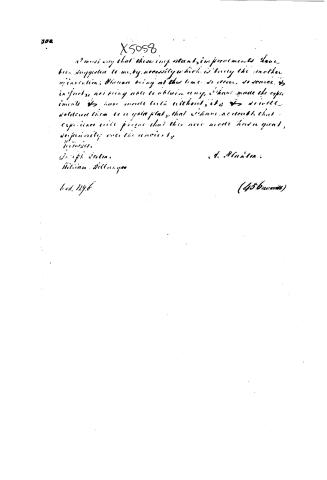
I must say that these important improvements have been suggested to me by necessity which is truly the mother of invention; there being at this time so dear, so scarce, & in fact, not being able to obtain any, I have made the experiments & have made tests without it; & so well satisfied them to a great part, that I have no doubt that experience will prove that this new mode has a great superiority over the ancient principles.
Joseph Selden.
William Willoughby
6th. 1796.
(456 words)
Published accounts: journal notice
Notice in the monthly list of patents
Journal of the Franklin Institute, vol. 6 (1828), p. 139 · View the page
In making terro metallic teeth; Anthony Plantou, Philadelphia, April 5.
Published accounts: journal notice
Notice in the monthly list of patents, with remarks
Journal of the Franklin Institute, new ser., vol. 3 (1829), p. 344 · View the page
The well was 25 feet deep. It delivers, when the pulley is made to revolve 60 times a minute, 30 gallons. A boy or girl 10 or 12 years old, can work it with tolerable ease. I do not confine myself to the particular mode of making these machines described above, or to any dimensions. The materials also might be varied; leather bands, &c. and wooden buckets, &c. might be substituted. Though I am of opinion that tinned copper plates would answer better, as being more durable than any other material. The pulley beam may 1 PLANTOU'S Terra-Metallic Teeth. be made of cast-iron, without arms or axles. A mere ring with flanches to keep the band from coming off, or an immoveable circular guide, may be substituted in the manner of the modern chain pumps which have no wheel at the bottom of the well. These pumps are peculiarly adapted to deep wells, or shafts of mines several hundred feet deep. JOSEPH EVE. Specification of a patent for Terra-Metallic Teeth, called also Porcelain Teeth, which are so made as to admit of soldering to them a plate of silver, gold, or platina. Granted to Anthony Plantou, Surgeon Dentist, Philadelphia, Penn. April 5, 1828.
Remarks. TILL this important improvement, one or two small pieces of platina, were inserted into the teeth at the time of their fabrication, which much weakened the teeth, and very often caused them to split in the baking, or in the soldering, and more often came out or separated itself from the teeth when in use; all these great disadvantages are obviated by not inserting any platina into the teeth at the time of their fabrication, and instead of it, to make, with a small wire, a hole through the teeth, which, after the baking, is stopped or filled up with silver, gold, or platina wire, and gold solder melted on both extremities of it; this adds inuch to the strength of the teeth, and they are lighter by not using platina. Teeth so made, and of a good material, never will break, or separate themselves from the wire, nor the wire from the plate; which brings the art of the dentist to its perfection, for artificial teeth. In order to secure to myself the advantages which are to result to society from this improvement, and to prevent the common practice of infringing patent rights, I also specify that porcelain teeth may be well secured to a plate, if the small hole is made in the teeth, without passing entirely through them, and after the baking, a wire of silver, or gold, is introduced into the hole, and gold solder melted into it, which makes a perfect hold, if at the time of the fabrication of the teeth, the said holds are made a little larger at the bottom than at the top; this mode would be still neater, but, perhaps, not so secure as the other.
About this record
- Patentee
- DATAMP
- Date
- the Name and Date index of patents, DATAMP, USPTO records
- Invention
- DATAMP
- Listed in
- the Name and Date index of patents, DATAMP, USPTO records, Jim Shaw's X-patent list, the Journal of the Franklin Institute, the Mirror of the Patent Office (1828), S. A. Elliot's printed list of patents, Burke's List of Patents (1847)
- The Mirror of the Patent Office's supplementary list gives the same patent.
- S. A. Elliot's printed list of patents gives the same name and date.
- Burke's 1847 Patent Office list gives the same patent.