

Drawings and documents
USPTO scan
The patent as scanned by the USPTO
-
 Page 1
-
 Page 2
-
 Page 3
-
 Page 4
-
 Page 5


U.S. Patent and Trademark Office · Google Patents
Show the transcription Hide (1,309 words)
Machine transcription (LightOnOCR) of the pages as scanned by the USPTO, most of them the handwritten copies made when the records were restored after the 1836 fire. Not checked; it can misread handwriting, so compare it with the scan.
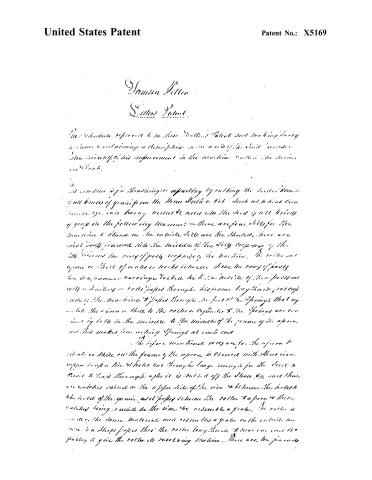
Page 2.
United States Patent
Patent No.: X5169
Samuel Allen
Letters Patent
The invention referred to in these Letters Patent and making party to same containing a description in more of the said invention than necessary of his improvement in the machine called the "Sawing Machine."
A machine is for threshing or separating by rubbing the seeds from all kinds of grain from the straw stalks etc. Such as wheat, corn, barley, etc. can barley, millet, etc. and also the seed of all kinds of grass in the following manner:—There are four sticks for the machine to stand on. The outside sticks are the shortest, there are eight posts joined into the middle of the four top-rings of the sticks. There are rows of posts opposite of the machine. The rolls are open or short of one or more between these two rows of posts. There is a frame or carriage locked to the middle of the posts and with a handle or rods passes through this frame lengthwise, passing under the machine & passes through the feet of the springs that support the frame or slide to the rolls or cylinder & the springs are connected by bolts in the machine to the middle of the frame of the apron. This makes four acting springs at each end.
The above mentioned rolls are for the apron to slide or slide on the frame of the apron is covered with short iron, copper or other like & holes cut through large enough for the seed to travel to traps through after it is rubbed off the straw etc. and there are catches raised on the upper side of the iron & between the holes to take hold of the grain, as it passes between the roller & apron & these catches being raised in the iron & the roller a grate. The roller is made of the same material and resembles a grate on the outside and is a short passes thru the roller lengthwise & near one end is a pulley to give the roller its revolving motion. There are two journals
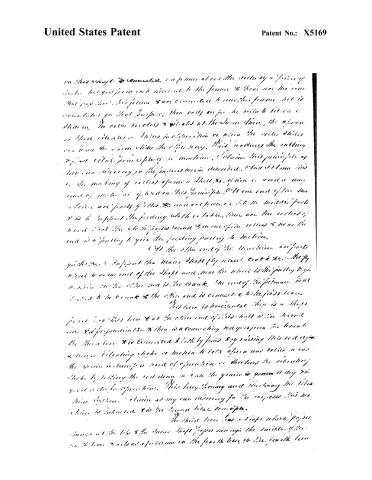
Page 3.
United States Patent
Patent No.: X5169
on this shaft & connected in a plane above the rolls by a piece of
metal, but you join each journal to the frame. There are two rows
that pass their frame & are connected to another frame that is
rotated for their purpose; then only one of the rolls is driven or
driven. The rolls revolve & rotate at the same time, the process
of their rotation is shown in opposition or when the rolls strike
one row the other rolls the other way. This produces the cutting
& first vital principle of the machine. I claim this principle as
my own discovery for the purpose herein described. And I claim this
in the making of rolls upon a sheet, &c, of iron or wood or any
kind of material if used on this principle. At one end of the
machine are posts & the main frame & to the middle post
& is to support the feeding roller & later, there are the rolls of
wood & not the elastic paper round & on one of the rolls & near the
end is a pinion to give the feeding motion to the rolls.
At the other end of the machine are posts
& to support the main shaft fly wheel, crank &c. — the fly
wheel is on an end of the shaft and near the wheel is the pinion to give
motion to the other end is the crank. The end of the frame is at
right to the crank & the other end is connected to the posts &c.
This beam is horizontal. There is a shaft
joins two this beam & at the other end of this shaft is the second
beam & is perpendicular & then is a connecting rod you join the beam to
the third beam & is connected & held by pins & by means this rod gives
a longer vibrating shake or motion to both of the two rolls in case
the grain is wrong or kind of operation or shortens the vibrating
shakes by letting the rod down in case the grain is wrong or any way
you set it to for operation. This lengthening and shortening the vibration
time &c. I claim as my own discovery for the purpose this machine
is intended & is the second vital principle.
The third beam has a single return paper
runner at the top & the same shaft passes through the middle of the
fourth beam & acts as a fulcrum to the fourth beam & the fourth beam
Page 4.
United States Patent
Patent No.: X5169
This paper is written in cursive script and contains several paragraphs describing a mechanical device or process. The text is somewhat difficult to decipher due to the handwriting style and potential smudging or fading.
First Paragraph:
> ...the paper is attached to the top end of the fourth line to the roller. It is fastened by a pin and there is a connecting rod attached to the bottom end of the fourth line and to the apron or sheet. By the fourth line acting on a wheel at the middle it causes the rolling of both apron and sheet when in operation. The first sheet to give the whole motion to the machine is connected to an upright piece of iron and used as a lighter.
Second Paragraph:
> The lower paper round this wheel and then round a pulley on the main shaft and then round the pulley that is on the shaft of the roller and then round the pulley that gives motion to the feeding cloth. Then back under the extra pulleys that are under the apron and back to where it first began. Then the machine being put in motion, the grain is spread on the feeding cloth and is carried to the roller then revolving, carrying the grain between it and the apron; then both roller and apron having been turned, or vibrating the apron and rubbing motion the grain is rubbed to make the roller and apron and the feed a forward motion off or apron but then the grain sticks to. The feed then passes over the holes in the apron and falls down to the side board or inclined plane and so paper will enter that part of the machine the grain then passes down the chute and out of the machine to another place.
Third Paragraph:
> The particular properties or principles of claim as any one invention or description and I lay claim to the exclusive right to the same. First principle is the revolving of rollers and vibrating of rollers and apron, or sheets at the same time producing the rubbing principle before stated to rub the feed or round off the straw stalks. Second principle is the keeping the vibrating stroke or motion of the rollers and apron or sheets, etc. in case the grain is clumped or hard of operation or of hindering the vibrating stroke or motion in the grain being very wet or good order for operation. Third principle is the general form, position and construction of the whole machine to use the two first principles mentioned.
Final Sentence:
> All of the above specified apparatus I claim.
Page 5.
United States Patent
Patent No.: X5169
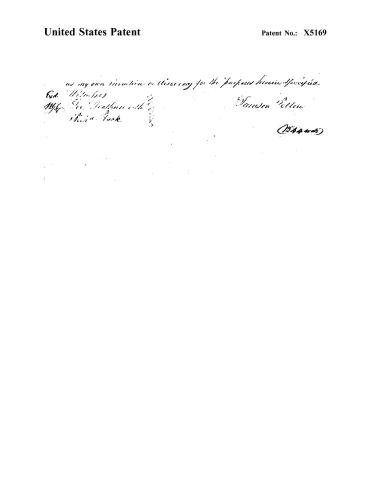
as my own invention & discovery for the purposes herein specified.
Evd. Williams
M.G. The Heathenville
Philadelphia.
Samson Allen
(1844 and 5)
Published accounts: journal notice
Notice in the monthly list of patents, with remarks
Journal of the Franklin Institute, vol. 6 (1828), p. 213 · View the page
A machine called the universal drub,' for thrashing, or separating, by rubbing, the seed or kernel of all kinds of grain from the straw; Samson Felton, Killbuck township, Holmes County, Ohio, July 22.
Remarks. The grain is placed upon an apron, and is carried between a cуlinder, and a case where the seed is rubbed out. The cylinder is of metal, punched from the inside, like a grater. The case is perforated with holes, through which the seed passes, whilst the straw is carried off, and delivered from another part of the machine. The patentee claims, 1st. The simultaneous revolving and vibrating motion of the roller and case, producing the necessary rubbing. 2nd. The mode of increasing the vibration when the grain is damp, and vice versa. 3d. The general arrangement as it contributes to these ends.
About this record
- Patentee
- DATAMP
- Date
- the Name and Date index of patents, DATAMP, USPTO records
- Invention
- DATAMP
- Listed in
- the Name and Date index of patents, DATAMP, USPTO records, Jim Shaw's X-patent list, the Journal of the Franklin Institute, the Mirror of the Patent Office (1828), Burke's List of Patents (1847)
- The Mirror of the Patent Office's supplementary list gives the same patent.
- Burke's 1847 Patent Office list gives the same patent.