

Drawings and documents
National Archives restored drawings: drawing
R. Winan's Patent Drawing for Railway Carriages

National Archives, Restored Patent Drawings (Record Group 241) · Full-size scan at the National Archives · Catalog record
Show the text on the drawing Hide (122 words)
Words on the drawing as machine-read by the National Archives; not checked. Useful mainly for searching.
106. RAILWAYS. / 3. E to it Mountings & Fielngs. / [122] Trushu / 5247.+ / Trucks Aute Trie What / R WINANS / Patented 11ᵗʰOct"18"18" / Railway Carriages / Two Wheeled carriage sechonthrougAxle / Carriage section through late / Side / Section thro / Po / a. Peices to sustain body of Carrage / L.B. Main avle primary Wheel / c Staple / d. Secondary Whoels / e. Split shaft / A. / A Primary Wheels / B. Carrage frame / c. Secondary Wheels suspende / D. Main atxles / Plan / E. Rail Track / Pl a 72 of carriage / Two wheeled Carrage / Patent Office april 30. 1841 / Made under the direction of the Commissioner of natures / land Del / in conformity with act of 3 "March 1537- / ML Ellmooth / Commissioner of Patents
USPTO scan
The patent as scanned by the USPTO
-
 Page 1
-
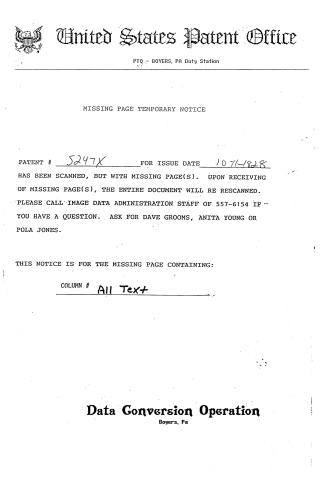 Page 2


U.S. Patent and Trademark Office · Google Patents
Show the transcription Hide (139 words)
Machine transcription (LightOnOCR) of the pages as scanned by the USPTO, most of them the handwritten copies made when the records were restored after the 1836 fire. Not checked; it can misread handwriting, so compare it with the scan.
Page 1.
No Printed Specification Available
5247X
R. WINANS.
Car Truck.
Patented Oct. 11, 1828.

AM. PHOTO-LITHO. CO. N.Y. (OSBORNE'S PROCESS.)
Page 2.
United States Patent Office
PTO - BOYERS, PA Duty Station
MISSING PAGE TEMPORARY NOTICE
PATENT # 5247X FOR ISSUE DATE 10/1/828
HAS BEEN SCANNED, BUT WITH MISSING PAGE(S). UPON RECEIVING OF MISSING PAGE(S), THE ENTIRE DOCUMENT WILL BE RESCANNED.
PLEASE CALL IMAGE DATA ADMINISTRATION STAFF OF 557-6154 IF YOU HAVE A QUESTION. ASK FOR DAVE GROOMS, ANITA YOUNG OR POLA JONES.
THIS NOTICE IS FOR THE MISSING PAGE CONTAINING:
COLUMN # All Text
Data Conversion Operation
Boyers, Pa
Published accounts: journal notice
Notice in the monthly list of patents, with remarks
Journal of the Franklin Institute, new ser., vol. 3 (1829), p. 56 · View the page
27. An improvement in Rail-way, and other Carriages, denominated "Winans' Friction-saving Rail-way Carriage;" Ross Winans, Vernon, Sussex county, New Jersey, October 11.
Remarks. In the various drawings which accompany the specification of Mr. Winans' invention, several different methods of applying friction rollers, or secondary wheels, as he denominates them, are exhibited. For a common carriage, or gig, a friction wheel is placed on the upper side of the shaft, or in a mortise within it, its axis turning in brasses, properly secured, one of them being fixed over each end of the main axle, just within the nave of the wheel. The axles are retained in their places, under the centres of the friction wheels, by staples, in which they turn freely, and which staples are, sometimes, to be lined with brass. Sometimes two lateral friction wheels are substituted for the staples, so that the main axle is supported by three friction wheels, or rollers. Sometimes two friction rollers are so placed, that their peripheries intersect each other, and in this intersection the axle runs; most of our mechanical readers are familiar with the use of such rollers, in supporting the axes of fly, and other wheels, used in machinery. For rail-way carriages, the friction wheels are made with a rim, projecting inwards, like the rim on the side of a crown wheel. The ends of the axles of the main wheels, pass within, and rest against these rims. In this case, it is evident that the centre of the friction wheel, will be below the carriage axle. There are brass boxes, or staples, which embrace the main axles, to check that too free lateral motion which would take place, were they confined only by their bearing within the rims of the friction wheels. In the single-rail-way, as proposed by Mr. Palmer, in England, the load is to be divided into two portions, and suspended in carriages below the wheels; Mr. Winans has given a drawing of the mode in which he proposes to adapt to such carriages, his last described secondary wheels, with a projecting rim. After discussing at some length the merits of the modes of construction proposed in the specification, the patentee concludes as follows:"And I declare the principle of my improvement, machine, or carriage, as aforesaid, and described, to consist in the employment of secondary wheels, bearing the loading on their axles, the peripheries of which secondary wheels, are turned by the revolution of the axle of the primary, or travelling wheels, the main axle thereof, by its gudgeons, or journals, rolling on, or in, the said peripheries when the carriage is moved, thus changing the usual rubbing motion of the main axle to a rolling one, and thus, conveniently, and greatly, increasing the relative leverage between the diameter of the travelling wheels and the axles immediately bearing the load, and thus increasing, greatly, the comparative slowness of the rubbing motion at the bearing axle, compared with the motion of the periphery of the travelling wheels, or progressive motion of the carriage." American Patents for October, with Remarks.
About this record
- Patentee
- DATAMP
- Date
- the Name and Date index of patents, DATAMP, USPTO records
- Invention
- DATAMP
- Listed in
- the Name and Date index of patents, DATAMP, USPTO records, Jim Shaw's X-patent list, the Journal of the Franklin Institute, Burke's List of Patents (1847)
- Burke's 1847 Patent Office list gives the same patent.