

Drawings and documents
USPTO scan
The patent as scanned by the USPTO
-
 Page 1
-
 Page 2
-
 Page 3
-
 Page 4
-
 Page 5
-
 Page 6
-
 Page 7
-
 Page 8
-
 Page 9
-
 Page 10
-
 Page 11
-
 Page 12
-
 Page 13
-
 Page 14


U.S. Patent and Trademark Office · Google Patents
Show the transcription Hide (5,637 words)
Machine transcription (LightOnOCR) of the pages as scanned by the USPTO, most of them the handwritten copies made when the records were restored after the 1836 fire. Not checked; it can misread handwriting, so compare it with the scan.
Page 2.
United States Patent
Patent No.: X5369
Joseph B. Manning
Letters Patent
The Schedule referred to, in these Letters Patent & making part of the same, containing a description in the words of the said Joseph B. Manning, himself, of his improvement in the art of alphabetical writing called Lektography.
The object of this improvement is to supply what is wanting in the analysis, classification, & representation, of the elementary sounds of English pronunciation, for pronouncing dictionaries, & for all the uses to which an equivalent, or uniform orthography may be applied — to supply these deficiencies of system, distinctness, simplicity, consistency, usage & analogy, using the letters of the Roman or common alphabet, with due conformity to their ancient & continued powers, and thus to form an exact, consistent & practical notation, which may be as perfectly exclusive of marks not found in the alphabet, as the English orthography would be, were it reformed on the original plan of its own usages & analogies, & the correspondent usages of other languages. The letters employed for this object, being referred to the general pronunciation of known words in several of the modern languages, may be distinctly significant of the sounds intended by them; may form a general alphabet & system of usages, suited to the similar & equivalent usages of orthography, & the habits of ear & eye, to which readers of the English & French languages are accustomed.
The term Lektography, (represented as lektographie) is invented for this manner of representing the sounds of words. Every modern scheme of notation, whatever are its peculiarities, is in part selected from some common usages. The term now employed for such representations of words is alike significant of selected usages of writing, & written distinctions of pronunciation.
2. The many methods of notation which have been devised for representing the sounds of words more certainly & uniformly than they are expressed by the orthography of the words themselves in the English or French language, show the propriety of establishing, if possible, some more exact & more general expression of sounds, & how desirable it is for certain purposes to render those methods practically useful for the purposes of their formation, to the nations
Page 3.
United States Patent
Patent No.: X5369
for which they are intended, they are nearly conformable to the usages of their languages. The principal differences in the systems intended for the same nation are their different degrees of this conformity, which extends from the orthography itself, made to denote its pronunciation by many additional marks, to the adoption of such part of its usages only as "approaches to perfection," measured by the standard of scholastic prosody, the Italian school manner of reading Latin. These extremes have their several inconveniences. But the usages which may be adopted with less of inconvenience, are not all equally eligible.
So those of the English language, which have been prepared for being most markedly peculiar, or most numerous, susceptible of rules, additional marks are added in the systems formed of them. In the great variety of silent letters, so called which have place in the orthography of the English, French & Greek languages, it is manifest that some signs of distinction were always necessary to the best expression of the vowels. Equally evident that other regulations, analogies, were formerly more cultivated than those which are thus preferred which thus require additions to mark their varieties of value.
The regulations of the early writers, by which they fortify the usages now found in the English language, cannot perhaps be exactly pointed out; nor is it desirable to resume all the reasons of their orthography. It will be sufficient for the purposes of this description, to point out some of the sources of the common usages of orthography in the English & other European languages. Their convenience and classical superiority may then be better estimated.
3. The mute e, as in plane, is employed by English orthographers to mark the a of plain &o. &a) in sole, to mark the e of eil &c. The Russian, French & English languages employ the mute e in nearly the same manner. It was originally an initial letter. It was placed after consonants to show that their inherent vowel sound is not then used. This employment of the mute e may be explained by the manner of using the Japanese consonants; as described by Mr. J. S. Raffles. Each of these consonants is a syllable ending in the sound of aue in place of the signs & sounds of better usage. Hence by this device, three characters are made necessary to express be like B b E; four to express bet. bit. but (ambiguously) like B b T b; five to express bit or beet. like B b E T b; & so other combinations, in which for the sake of a few short expressions, many
Page 4.
United States Patent
Patent No.: X5369
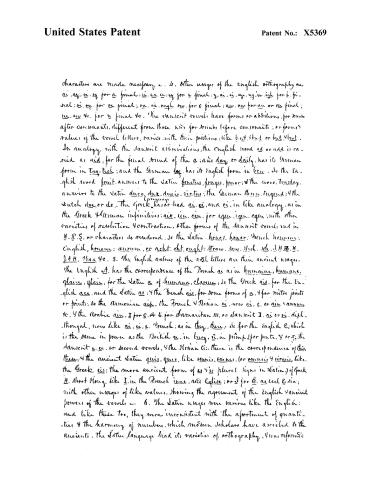
characters are made necessary. 4. Other usages of the English orthography are: ai, ay, ei, ey for a final; ee, ea, ee, ey for e final; y, ai, ei, ey, ng, ie, igh for i final; oi, oy, for oe final; oa, oe, ough, ow, for o final; aw, ow for au or oe final; ue, ew, ye, for u final etc. The Sanscrit vowels have forms or additions, for sounds after consonants, different from those used for sounds before consonants; or forms? values of the vowel letters, varies with their positions; like b-ut, th-ut or but, th-ut. In analogy with the Sanscrit abbreviations, the English word ad or add is varied as aid, for the final sound of the a; and day, or daily, has its German form in Tag, tich; and the German tag, has its English form in tea. So the English word fruit, answers to the Latin fructus, fruges, fructus; and the word, Tuesday, answers to the Latin die, dus, duis, virtus; the German thur, turgend; and the Dutch doe, or do. The Greek has or had ai, ei, and oi, in like analogy, as in the Greek & German infinitives; aire, ein, ein, for egen, igen, agen; with other varieties of resolution & contraction. Other forms of the Sanscrit vowels, and in N.P.S. or characters so rendered, so the Latin, hores, honor; French, honneur; English, honour; Armenian, or achit, oht, ought; Straw, saw, Wick, ich, J.H.B.H, J.A.H. Baar ye. 5. The English values of the vowel letters are their ancient usages. The English A, has the correspondence of the French ai as in humaine, humaine, glaise, glaise, for the Latin a of humana, clarum; so the Greek ais, for the English ace, and the Latin as; and the French ais, for some forms of a, and for mitre joints or points; so the Armenian ais, the French & Persian ai, new ai, e, or ain, annus etc. and the Arabic ain, I for e, or e, for Samaritan III, or Sanscrit I, ai or ei, dipth. though, now like ai, ei, e. French; as in they, there, ie for the English E; which is the same in power as the British ae, in bury, ie, in pimp, (for pinte, V or s; the Sanscrit e, ee, or second vowels, and the Persian E: there is the correspondence of this, there; and the ancient Latin quis, quos, like emnis, emnes, (or emnei, & virgis, like the Greek eis; the more ancient form of es & is plural signs in Latin,) of Greek H. short long, like I, in the French inne, and Eglise; or I for E, as eel & sia; with other usages of like values, showing the agreement of the English & ancient powers of the vowels — 6. The Latin usages were various like the English; and like these too, they were inconsistent with the apportionment of quantities & the harmony of numbers, which modern scholars have ascribed to the ancient. The Latin language had its varieties of orthography, & was reformed
Page 5.
United States Patent
Patent No.: X5369
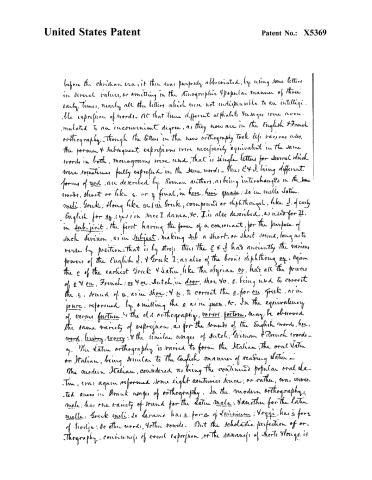
before the christian era, it then was purposely abbreviated, by using some letters in several values, or omitting in the stenographic & popular manner of those early times, nearly all the letters which were not indispensable to an intelligible expression of words. At that time different alphabets & usages were accommodated to an inconvenient degree, as they now are in the English & French orthography. Though the letters in the new orthography took less various uses, the former & subsequent expressions were necessarily equivalent in the same words in both, monograms were used, that is single letters for several which were sometimes fully expressed in the same word. Thus E & I, being different forms of yod, are described by Roman authors, as being interchanged in the same words, short or like e, or y final, in here, here quae; so in mille Latin. mille. Greek; long like ue, in Greek, compound or diphthongal, like I. of early English for ay. (yes) in mee I dance, ye. I, is also described, as used for II, in sub-jicit, the first having the force of a consonant, for the purpose of such division, as in Subject, making Sub a short, or short sound, long as to verse by position; that is by stress. Thus the E & I had anciently the various powers of the English I, & Greek I; as also of the broad diphthong ay. Again the e of the earliest Greek & Latin, like the oblique oo, had all the powers of o & ou. French: oo & oe. Dutch, in door, shoe ye. e, being used to correct the e, sound of u, as in shoe; & u, to correct the e, for ou Greek, as in jure, reformed by omitting the o as in jure. So in the equivalency of versus, fortunae. & the old orthography, versus, fortunae, may be observed the same variety of expression, as for the sounds of the English words, here, word, hurry, worry; & the similar usages of Dutch, German & French words. The Latin orthography is varied to form the Italian; the oral Latin or Italian, being similar to the English manner of reading Latin. The modern Italian, considered as being the continued popular oral Latin, was again reformed some eight centuries since; or rather, was invested anew in Frank usages of orthography. In the modern orthography, mille, has one variety of sound for the Latin mala; & another for the Latin melle; Greek mille; so levano has e, for a of Latinium; Voggi, has i for e of hodie; so other words, & other vowels. But the scholastic perfection of orthography, convenience of vowel expression, or the sameness of shorts & longs, is
Page 6.
United States Patent
Patent No.: X5369
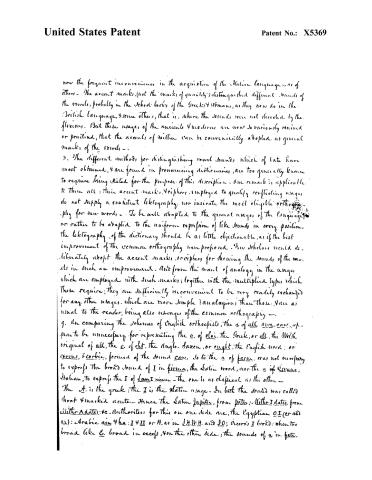
now the frequent inconvenience in the acquisition of the Italian language, as of others. The accent marks, (not the marks of quantity) distinguished different sounds of the vowels, probably in the school books of the Greeks & Romans, as they now do in the British language, & some others; that is, where the sounds were not directed by the flexions. But these usages of the ancients & moderns are now so variously received or practiced, that the accents of neither can be conveniently adopted as general marks of the vowels.
5. The different methods for distinguishing vowel sounds which of late have most obtained, & are found in pronouncing dictionaries, are too generally known to require being stated for the purpose of this description. One remark is applicable to them all: their accent marks, & ciphers, employed to qualify conflicting usages do not supply a consistent lexicography, nor indicate the most eligible orthography for new words. To be well adapted to the general usages of the language, or rather to be adapted to the uniform expression of like sounds in every position, the lexicography of the dictionary should be as little objectionable, as if the best improvement of the common orthography were proposed. New scholars would deliberately adopt the accent marks, & ciphers for showing the sounds of the vowels in such an improvement. And from the want of analogy in the usages which are employed with such marks; together with the multiplied types which these require; they are sufficiently inconvenient to be very readily exchanged for any other usages, which are more simple & analogous, than those. You are as usual to the reader, being also usages of the common orthography.
9. In comparing the schemes of English orthoepists, the a of all are, can, appear to be unnecessary for representing the a of olo, the Greek, or all, the Welsh original of all, the e of oht, the Anglo-Saxon, or ought, the English word; or corvus, & corbie, formed of the sound can, so to the a of farin, was not necessary to express the broad sound of I in firma, the Latin word, nor the a of ferme, Italian, to express the I of Iam I nimus — the one is as classical as the other — The A is the Greek; the I is the Latin usage. In both the sound was called short & unmarked acute. Hence the Latin Jupiter, from pater; Nether I dates, from Nether A dates; &c. Authorities for this on one side are, the Egyptian O.I (or and 11); Arabic ain & ha: I & II or H, as in I.H.W.H. and IO; Cicero’s I broad; when too broad like E. broad in excess, & on the other side; the sounds of a in pate,
Page 7.
United States Patent
Patent No.: X5369
fars, are a circumflex or long in the British orthography; the sounds of a in carry, & cart, being short or acute; as in yggdrase, for skirnir; a numberless for impersonal; so an for in Vm, &c. of other Latin derivations.
10. The British usages are the source of the like apportionment of the sounds of a in the system of Wallis, & thence in the scheme of Sheridan. But the objections of Parry, Walker & others to Sheridan’s want of a distinct mark for the a of cart, are not less applicable to their own want of separate marks for the a of cara, & for other letters. For instance; the a of but & hurry, is not an equivalent for the e of her, or the u of minimum — for in the general usage or the “common sound,” in her, Derby, &c. will marked like the e of merry. The e of mercy, though marked for a sound like ie of virge, French ie. of leer, (ie. Welsh & Roman) ie. of there, French or cyre, of they’re (ie. Tureen) — by the e of merry or met- is not in analogy with any one of these expressions nor is it English. And though it may be most usual to sound the letter n like en offend, or en of few; & nearly like the Scotch n in you; and as nearly like the French ie & it; it is not agreeable to the eye, nor is it necessary for the sake of usage & distinctness to read feud, rule, more, & the like, in the letters, fude, rool, moo, — But more, for more, is as easily read as due, quinn for dove, govern. And as in feud, & as in rule or true, fruit, are English usages & are necessary to preserve analogy; which is marked by oo of root, &c.
11. By this apportionment of the vowel sounds & letters, as in the common usage, which have been instanced, it is evident that one of the three sounds of each letter may be represented by the letter itself, without any mark over it: & the marks, or want of mark, may be made to designate, the same class of sounds, fate, theme &c. fat, them; &c. The sound of i in firm, like farm, (with farm for firm) not now being English, (though good usage in the Scotch dialect,) was the only difficulty in the way of this apportionment; all the other expressions appeared to be regular usages, as well as the sounds of the usual. tired expressions. This objection to the Scheme above suggested for simplifying the signs of the vowel sounds, has appeared to be most important, because of the classical, Augustan character, affixed to the a of farm, as the “Italian a.” To part with such an appendage, was deemed to be wholly irreconcilable to scholars; with whom the Italian method of reading
Page 8.
United States Patent
Patent No.: X5369
Latin, is the Latin—But the attention since given to this subject, has led to the discovery of the affinity of Greek, Syriac or Divine, & Latin usages, as of these & the usages of the modern languages; in other & more vicissitudinal relation, than those which are cultivated in the higher schools of Europe—
12. To refer the general usage of a in father, farm, to the I of Roman pronunciation, in firma, &c. though unusual to the scholars of the present time, may be less repugnant than on first impression, after considering the following note; (Hallam’s Middle Ages) “Germanus is sometimes called Germanicus, sometimes Warranus; the German W, is changed into q; the Italians, & occasionally, omitted, especially in Latinizing, for the sake of euphony, or purity.” “The Italian language contains many instances of a or a used in place of the Latin i; i, and e; the i & e being the same letter for various sounds—
In this instance of rendering the a into Latin by i, it appears that the scholars of the twelfth century were accustomed to this reciprocal exchange, as a Latin school usage for the Dutch & Italian a—The same use of i in Latin seems indicated by the Venetian Zarin—
13. An objection may here occur to the scholar like this; admitting these of the correspondence of Roman, Oriental, & modern usages to be correct, can the public be benefitted by simplifying comparative orthography in any conformity to these suggestions? In other words; are the common usages here selected less practical, because their simplicity, analogy, & classical origin, are commended to the scholar by appeals to his intelligence & learning?
Waiving the consideration of the condition in which the English principles of pronunciation are now involved; it is answered that the inconvenience of that cannot be much increased to the English reader by the addition of the few facts that are necessary to be known, such as above stated. And if the explanation of English usages can, in any considerable degree, be diverted of such condition by plain matters of fact, they will not be repudiated by the public; & cannot want utility. The English reader has found no great inconvenience in naming the a of all, the German a; the a of farm, the Italian a; nor the French reader in naming the y. Greek i; & in using the other names, to which he is accustomed for other usages—14. It is no less proper to distinguish other letters in the same manner—And much that is said beyond such limits, is
Page 9.
United States Patent
Patent No.: X5369
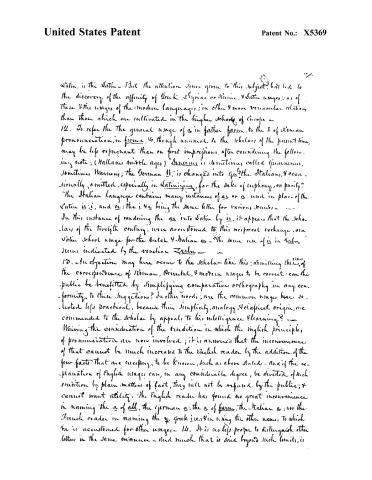
not admitted in what is considered to be adapted to the English school dictionary. Thus the u, of busy & utay where eta (eight) is so written, is the Welsh u, and k — The u & i are exchanged, in the Scotch ull for ill, linney for honey, &c. — the u had their values in some Anglo-Saxon words; & in some Latin words, as maximus, for maximus, Brundusium (Greek Brentesicon) now Brindisi, and the English orthography is indebted to the Welsh usages for f, in of, ff in off, dd, ck in tadder; g in get, and proper names; cc, ei for ke, ki, in proper names; to the Syriac naw for the o in do, yo, &c. Had some orthopists been apprised of such facts, so stated among the explanations of English usages, they might have curtailed many wanderings of theory. “Much inanity” of remark. Assisted by the foregoing observations, the advantages proposed by the new improvement in writing, which is to supply the deficiency of system in former schemes, & mark what is here regarded as most consistent, classical & practical, may be more directly appreciated —
15. The improvement called lekography is a new system of oral distinction; & a new systematic representation of oral distinctions & signs, adapted to a more exact analysis, & a more analogous classification & expression of the sounds of words, than is found in any one other theory or notation. It differs from all other schemes of pronunciation & writing now known, in distinguishing vowel sounds by classes & series, according to their general analogies; adding a third class, & its analogy, in defining these analogies & classes by means of the letter N, in uniforming the class signs, in using letters only for representing the sounds of the vowels, rejecting the employment of numeral ciphers & other additional marks, not now part of the orthography of English words; in showing the affinity & formation of the compound consonants by their letters; & in employing for these objects, the most simple & practical usages of the common orthography of the English & other languages in the Ottoman characters —
16. It distinguishes all the vowel sounds, & separately represents them by appropriate letters & class signs; without parting syllables or letters by hyphens, or accents for that purpose, though these may be so employed; and without double letters; & the mute e after consonants. It distinguishes by class notation, the sounds of vary, airy, carry, starry, her, heriot, hurry, &c., uniforming the signs of like sounds, in all, ought, nor, &c., & restores the analogy of ro,
Page 10.
United States Patent
Patent No.: X5369
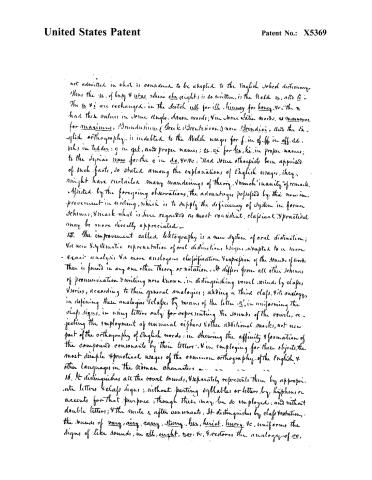
m, ye, long, fend, ye. 17. as a system of oral distinctions; it separates or distributes the vowel sounds, by three general analogies, into three classes, to be represented by distinct clap marks, exponents, or sorts of expression; and into a fourth class formed of leaving following sounds in the same syllable, usually called diphthongal sounds — These classes & general analogies are here exemplified by the following words; and other words of the same vowel sounds, or nearly the same, or such as are usually distinguished or named alike in the languages of Europe, by native or foreign writers, as being nearly equivalent in sound, are alike claimed to exemplify the same analogies of sound, & distinctions of the voice, similarly distributed, however expressed in orthography.
1st aid, eel, wisp, (Dutch) scriotoire, fruit; daily, key, why, bow (bog, German) threw; sac, (Scotch) see, die, doe, true; gain, (gegen, Ger.) signore (Ital.) sign. (roque, de, (dugend.) fate, theme, mine, note, rule; &c.
2d, shall, will, him, on, us; man, men, this, not, but, ye — — — — — —
3d, air, her, farm, nor, full; full, fare, fleen, (Fry) f.A.H. man, should, thine, word, girba, awe, worded; &c. 4th (e ilaylum,) fend, ay, annoy, (e Yoe Ene). loud, few, die (brods) void. lantia, (Ger, Eoe U Juy); cube, haul, (Welsh) — Slocqr, (Welsh) town, &c. 18. It defines the analogies, according to which the vowel sounds are classed, being clearly distinguished & exemplified in combinations of these classes with the letter R. as in they, & they're, see, see, high, hire, foe, fore, true, true; & the like sounds for the first class — as in carry, acid, merry, peril, mirror, myriad, morrow, moral, hurry, nourish, so, without stress in carry, eminent, irradiate, corrode, surreption: for the second class; and as in air (A Ha) traine, &c, (J R A He Re; her, surround, funtine (founhren, f bodem, HE R R E, VE He Re) farm, (J J R. Ha) Zarka (GJ R JI. J.) J A H (e H); nor, ought, (oht A B.) straw, stroke; Wore, etc., full; &c. for the third class — So this third class the R may be added without the perceptibly distinct half syllable heard in they're, see, hire, &c. of the first class; & the R may be dimmed after this class, as in J A H awe, full, &c, with some difference of sound; but not of the vowel sounds, so as to lose this class; just as the sounds they, see, high, &c. of the first class, are the same in they're, see &c. being added to, not altered by the R. The first & third classes are sounds, distinct from the consonants;
Page 11.
United States Patent
Patent No.: X5369
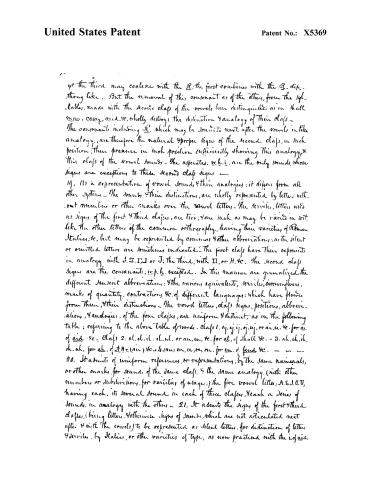
yet the third may coalesce with the R; the first combines with the R, dip. though like. But the removal of this consonant as of the others, from the syllables, made with the second class of the vowels, here distinguished as in shall, man, cany, mid, etc. wholly destroy the distinction & analogy of their class. The consonants including R, which may be sounded next after the vowels in like analogy, are therefore the natural & proper signs of the second class, in such position; their presence in such position sufficiently showing this analogy, & this class of the vowel sounds. The aspirates, w, h, i, are the only sounds whose signs are exceptions to these second class signs —
19. (1) a representation of vowel sounds & their analogies; it differs from all other systems — The sounds & their distinctions, are wholly represented by letters, without numbers or other marks over the vowel letters. The service, letters used as signs of the first & third classes, are two; & are such as may be varied in sort, like the other letters of the common orthography, having their varieties of Roman Italics, etc. but may be represented by common & other abbreviations; as the silent or omitted letters are sometimes indicated. The first class have their exponents in analogy with I, Z, T, J or J; the third, with II, or H, etc. The second class signs are the consonants; i.e. p, h, excepted. In this manner are generalized the different Sanscrit abbreviations; & the various equivalents, services, circumstances, marks of quantity, contractions, etc. of different languages, which have flowed from them, & their distinctions. The vowel letters, class signs, positions, abbreviations, & analogies, of the four classes, are uniform & distinct, as in the following table; referring to the above table of words. Class 1. a, e, i, o, u, or ai, ei, etc. for a, of aid, etc. Class 2. al, el, il, ol, ul, or au, eu, etc. for al, of shall, etc. — 3. ah, eh, ih, oh, uh, for ek, of ahr (air) etc. — 4. (au), en, ie, oe, ou, for en, of feed, etc. — — —
20. It admits of uniform references, or representations, by the same numerals, or other marks, for sounds of the same class, & the same analogy, (with other numbers or subdivisions, for varieties of usage;) the five vowel letters, A, E, I, O, U, having each, its several sound in each of three classes, & each a series of sounds, in analogy with the others — 21. It admits the signs of the first & third classes, (being letters, & otherwise signs of sounds, which are not articulated next after & with the vowels) to be represented as silent letters, for distinction of letters, & services, by Italics, or other varieties of type, as now practiced with the i, of aid.
Page 12.
United States Patent
Patent No.: X5369
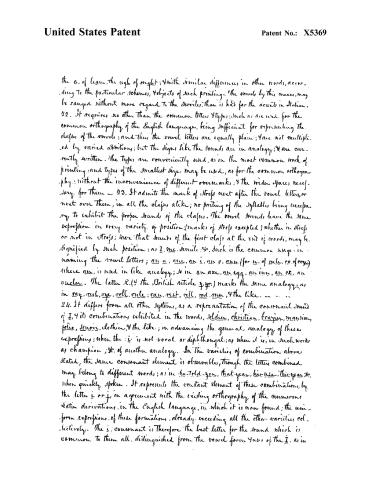
the a, of learn, the ugh of ought; with similar differences in other words, according to the particular schemes, objects of such printing. The vowels by this means, may be ranged without more regard to the services, than is had for the accents in Italian.
22. It requires no other than the common letters & types; such as are used for the common orthography of the English language, being sufficient for representing the classes of the vowels; and thus the vowel letters are equally plain; & are not multiplied by varied addition; but the signs like the sounds are in analogy; & are currently written. The types are conveniently used, as in the most common work of printing; and types of the smallest size may be used, as for the common orthography; without the inconvenience of different overmarks; & the wider spaces necessary for them — 23. It admits the mark of stress next after the vowel letters, or next over them, in all the classes alike; no parting of the syllables being necessary to exhibit the proper sounds of the classes. The vowel sounds have the same expression in every variety of position; (marks of stress excepted) whether in stress or not in stress; save that sounds of the first class at the end of words, may be signified by such position; as I, me, simile. So, such is the common usage in naming the vowel letters; an a, ane, an i, an o, ane (for u, of rule, so of soze) where ane, is used in like analogy; so in an axe, an egg, an in, an ox, an uncle. The latter R, (the British article y, yr.) marks the same analogy, as in ray, reel, rye, roll, rule; ran, rest, rill, rod, run, & the like. — — — 24. It differs from all other systems, as a representation of the consonant sound of I, & its combinations, exhibited in the words, soldier, christian, brazier, mansion, police, senoir, clothis, & the like; in advancing the general analogy of these expressions; when the i is not vocal or diphthongal; as when it is, in such words as champion; & of another analogy. In the varieties of combination above stated, the same consonant element is observable, though the letters combined may belong to different words; as in he-told-you, that-year, his-use, this-year, &c. when quickly spoken. It represents the constant element of these combinations, by the letter i or j, in agreement with the existing orthography of the numerous Latin derivations, in the English language, in which it is now found; the uniform expressions of these formations, already exceeding all the other varieties collectively. The i consonant is therefore the best letter for the sound which is common to them all, distinguished from the vowel form Y, & of the I, as in
Page 13.
United States Patent
Patent No.: X5369
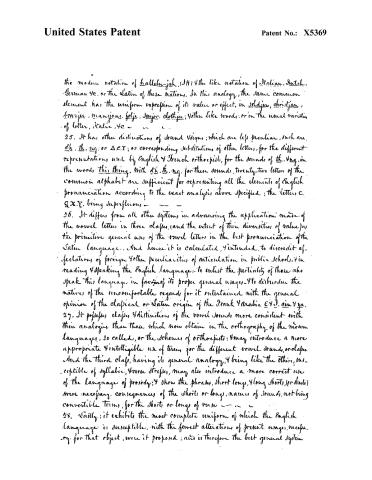
the modern notation of hallelu-jah, (JH) & the like notation of Italian, Dutch, German &c. or the Latin of these nations. In this analogy, the same common element has the uniform expression of its value or effect, in soldier, christian, bronze, manjous, folje, senior, clothing; & other like words; or in the usual variety of letter, italic, &c — — —
25. It has other distinctions of sound signs; which are less peculiar, such as, dh, th, ng; or Δεχ; or corresponding substitutions of other letters, for the different representations, used by English & French orthoepists, for the sounds of th, ng, in the words this, thing, with dh, th, ng, for these sounds, twenty-two letters of the common alphabet are sufficient for representing all the elements of English pronunciation according to the exact analysis above specified; the letters c, QX.Y, being superfluous — — —
26. It differs from all other systems, in advancing the application made of the vowel letters in three classes, (and the extent of their diversities of value,) in the primitive general use of the vowel letters in the best pronunciation of the Latin language. And hence it is calculated, & intended, to discredit affectations of foreign & other peculiarities of articulation in public schools, & in reading & speaking the English language; to enlist the partiality of those who speak this language, in favor of its proper general usages; & to disburden the nature of the uncomfortable regards for it entertained with the general opinion of the classical or Latin origin of the Frank & Arabic E.V.I., ain & ya.
27. It proposes classes & distinctions of the vowel sounds more consistent with their analogies, than those which now obtain in the orthography of the modern languages, so called, or the schemes of orthoepists; & may introduce a more appropriate & intelligible use of terms, for the different vowel sounds, or classes. And the third class, having its general analogy, & being like the others, susceptible of syllabic, & verse stresses, may also introduce a more correct use of the language of prosody; & show the phrases, short longs, & long shorts, (or shorts) more necessary consequences of the shorts or longs, names of sounds, not being convertible terms, for the shorts or longs of verse — — —
28. Visibly; it exhibits the most complete uniform of which the English language is susceptible, with the fewest alterations of present usages, necessary for that object, were it proposed; and is therefore the best general system
Page 14.
United States Patent
Patent No.: X5369
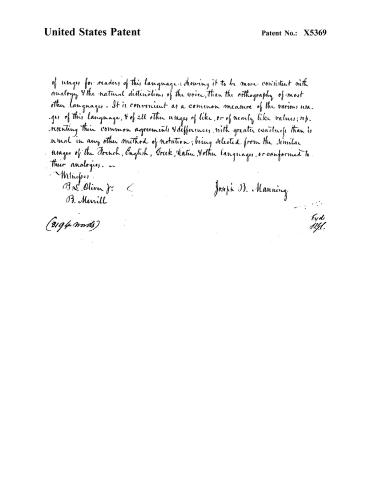
of usages for readers of this language; showing it to be more consistent with analogy & the natural distinctions of the voice, than the orthography of most other languages. It is convenient as a common measure of the various usages of this language, & of all other usages of like, or of nearly like values; representing their common agreements & differences, with greater exactness than is usual in any other method of notation; being selected from the similar usages of the French, English, Greek, Latin, & other languages, or conformed to their analogies.
Witnesses:
B. E. Oliver Jr.
B. Merrill
Joseph B. Manning
(8194 words)
Exd.
1/11/11.
Published accounts: journal notice
Notice in the monthly list of patents, with remarks
Journal of the Franklin Institute, new ser., vol. 3 (1829), p. 337 · View the page
[We will hereafter publish the specification of this patent, with an engraving of the stove.] 10. For an improvement in the art of Alphabetical Writing, called Lektography; J. B. Manning, Gloucester, Essex county, Massachusetts, February 16.
Remarks. The patentee commences by stating, that "The object of this improvement is to supply what is wanting in the analysis, classification, VOL. III.-No. 5.-MAY, 1829. 43 and representation of the elementary sounds of English pronunciation, for pronouncing dictionaries, and for all the uses to which an equivalent, or uniform orthography may be applied." The exemplification of the patentee's method of attaining this end, occupies sixteen well filled pages. The author has evidently thought deeply upon the subject, has formed a well digested system, so far as his own mind is concerned, and has expressed his views with much clearness. These are our impressions, from that hasty view which we have necessarily taken; but we do not pretend to have mastered in an hour, what has been, to the writer, the study of many years, especially, as we must confess, that if we have any fort it is not philology. The author is of opinion, that the government might advantageously apply his scheme of notation, to the illustration of the Indian languages, and thus promote the beneficent objects which it has in view, in regard to the aborigines of our country. Had he studied as closely, the nature and operation of that complex piece of machinery, called government, as he has his own particular system, his hopes of adding to it a new wheel, pinion, or lever, would have been faint. We do not think that he is likely to make this his punctum saliens, in giving life to his new system. With or without a patent, there is scarcely any task, (perpetual motion excepted,) more difficult, than to innovate on any of the established forms of language. In the present instance, we see no hope for the author, unless he will write a dictionary, using his own notation instead of that of Walker, and make the work as popular as that of this celebrated orthoepist.
About this record
- Patentee
- Jim Shaw's X-patent list
- Date
- the Name and Date index of patents, USPTO records, Jim Shaw's X-patent list
- Invention
- the Name and Date index of patents
- Listed in
- the Name and Date index of patents, USPTO records, Jim Shaw's X-patent list, the Journal of the Franklin Institute, Burke's List of Patents (1847)
- The residence comes from the Franklin Institute's journal.
- Burke's 1847 Patent Office list gives the same patent.