

Drawings and documents
National Archives restored drawings: drawing
David Wooster's Patent Drawing for a Brush

National Archives, Restored Patent Drawings (Record Group 241) · Full-size scan at the National Archives · Catalog record
Show the text on the drawing Hide (104 words)
Words on the drawing as machine-read by the National Archives; not checked. Useful mainly for searching.
pt / Vol.8.p.193. / 3. / 15. BRUSHES & BROOMS. / Lavid Hocster Chenio NY. / [22] Broom / Brush ge / Patented 16 Feb 1829 / 5371-+ / Fig.2. / Fig1 / Fight. / of / References, / Figi3. / Figst Broon complete. / Fig 2 Parls of broom head detatched / 7' / Fig3 / of ofwood by / Ing.4 cap with sides extended down / toform the clamp. a,a jaws, b.cap...b'sides / c.bolt. d. nut, e spring' to attatch it to handle / f. broom, / Patent Office / 1841 / Made under the dirution of the bommipian of Patents / in con formuty with Oct of bong rp 3. March 183% / MLCUMONT / Commissions of Patent
USPTO scan
The patent as scanned by the USPTO
-
 Page 1
-
 Page 2
-
 Page 3


U.S. Patent and Trademark Office · Google Patents
Show the transcription Hide (584 words)
Machine transcription (LightOnOCR) of the pages as scanned by the USPTO, most of them the handwritten copies made when the records were restored after the 1836 fire. Not checked; it can misread handwriting, so compare it with the scan.
Page 1.
D. Wooster.
Broom.
Patented Feb. 16, 1829.
5371X
Fig. 2
Fig. 1
Fig. 4
Fig. 3
H. PETERS, PHOTO-LITHOGRAPHER, WASHINGTON, D.C.
Page 2.
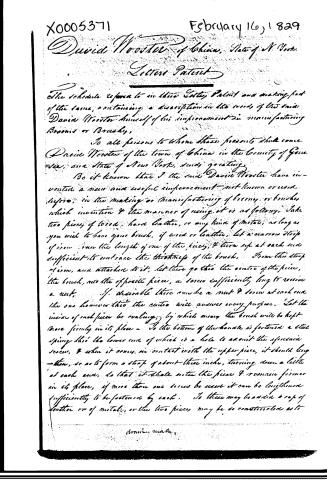
X0005371 February 16, 1829
David Wooster of China, State of N York.
Letters Patent
The schedule refers to in this Letter Patent and making part of the same, containing a description in the words of the said David Wooster himself of his improvement in manufacturing Brooms or Brushes.
To all persons to whom these presents shall come David Wooster of the town of China in the County of Genesee, and State of New York, sends greetings.
Be it known that I the said David Wooster have invented a new and useful improvement not known or used before, in the making or manufacturing of brooms or brushes which invention & the manner of using it is as follows: Take two pieces of wood, hard leather, or any kind of metal, as long as you wish to have your brush, if wood or leather, let a narrow strip of iron run the length of one of the pieces, & turn up at each end sufficient to embrace the thickness of the brush. From this strip of iron, and attached to it, let there go this the center of the piece, the brush, and the opposite piece, a screw sufficiently long to receive a nut. If desirable there can be a nut & screw at each end the one however this the center will answer every purpose. Let the inside of each piece be ovaling by which means the brush will be kept more firmly in its place. To the bottom of the handle is fastened a steel spring this the lower end of which is a hole to admit the aforesaid screw, & when it comes in contact with the upper piece, it should long then, so as to form a stop of about three inches, turning down a little at each end, so that it shall enter the piece & remain firmer in its place, if more than one screw be used it can be lengthened sufficiently to be fastened by each. To these may be added a cap of leather or of metal, or the two pieces may be so constructed as to
David Wooster
Page 3.
as to form a cap, & the cap may be so constructed as to supersede the necessity of the pieces or clamps. The pieces however are preferred as they unite economy & durability with simplicity.
These form the head of the broom or brush, & it will be perceived that it can be taken apart at pleasure. Therefore when ever a broom or brush is to be made, take the materials whether corn, flax, bristles or any other substance which can be used in making or manufacturing brooms or brushes, lay them upon the under piece then upon the upper piece & upon that fast the handles, then secure on the nut or mule, & the broom or brush is complete.
The benefit resulting from this invention is durability, economy, simplicity & in using the brooms or brushes arising from the elasticity occasioned by the spring.
In witness whereof I have hereunto subscribed my name this fourth day of December eighteen hundred and twenty eight.
Witnesses
Geo. W. Lay
Sam. Walker
David Horster
555 hbr
Published accounts: journal notice
Notice in the monthly list of patents, with remarks
Journal of the Franklin Institute, new ser., vol. 3 (1829), p. 338 · View the page
12. For an improved mode of making Brooms, or Brushes, whether of Corn, Splints, Bristles, or any other material; David Wooster, China, Genesee county, New York, February 16.
Remarks. The stock of the broom is to be divided into two parts; to the upper portion, the handle is to be attached; and the lower is to receive the bristles, &c. So far it would resemble a scrubbing brush fastened to a block and handle; but in this the lower part of the stock is to be fastened to the upper, by screws and nuts, attached to an iron strap. The broom handle is not to pass directly into the upper block, but American Patents for February, with Remarks. has a flat steel spring attached to its lower end, and connecting it with the upper block. "The benefits resulting from this invention, are, durability, economy, simplicity, and ease in using the brooms or brushes, arising from the elasticity occasioned by the spring." So says the patentee.
About this record
- Patentee
- DATAMP
- Date
- the Name and Date index of patents, DATAMP, USPTO records
- Invention
- DATAMP
- Listed in
- the Name and Date index of patents, DATAMP, USPTO records, Jim Shaw's X-patent list, the Journal of the Franklin Institute, Burke's List of Patents (1847)
- Burke's 1847 Patent Office list gives the same patent.