

Drawings and documents
National Archives restored drawings: drawing
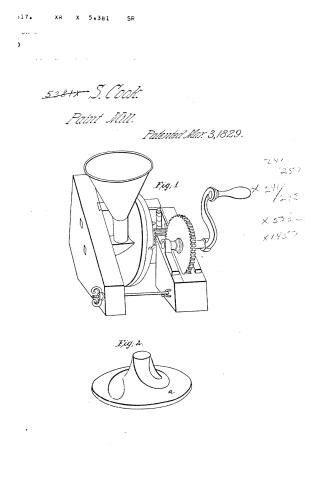
Samuel Cook's Patent Drawing for a Paint Mill

National Archives, Restored Patent Drawings (Record Group 241) · Full-size scan at the National Archives · Catalog record
Show the text on the drawing Hide (56 words)
Words on the drawing as machine-read by the National Archives; not checked. Useful mainly for searching.
83. MILLS. / [107] PaintMills. / $150 / Samul Lech / 5381-+ / Paint Mill. / Patented March 3. 1829. / Fig.1. / Fig. 2. / References, / Fig 1 Perspective view / Fig 2 Iner revolving plate,a, / Patent Office 8th yepst 1838. / Made under the direction of the Commipioner of Patents / m... inconformity with act 3. March 1837, / Comminism of
USPTO scan
The patent as scanned by the USPTO
-
 Page 1
-
 Page 2
-
 Page 3
-
 Page 4


U.S. Patent and Trademark Office · Google Patents
Show the transcription Hide (930 words)
Machine transcription (LightOnOCR) of the pages as scanned by the USPTO, most of them the handwritten copies made when the records were restored after the 1836 fire. Not checked; it can misread handwriting, so compare it with the scan.
Page 1.
>17. XR X 5,381 SR
5381x S. Cook.
Paint Mill.
Patented Mar. 3, 1829.
Fig. 1.
Fig. 2.
a
-241.
'257
x 241/273
x 573
x1457
Page 2.
X0005381 March 3, 1829
Letters Patent.
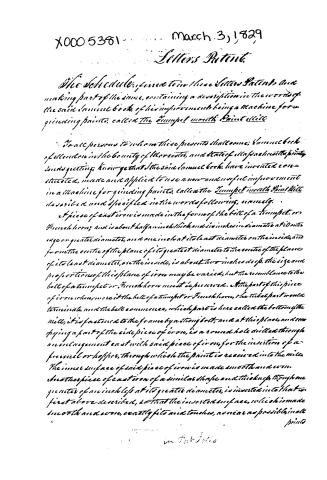
The specification annexed to these Letters Patent and making part of the same, containing a description in the words of the said Samuel Cook, of his improvement being a Machine for grinding paints, called the Trumpet mouth Paint Mill.
To all persons to whom these presents shall come, Samuel Cook of London in the county of Worcester, and state of Massachusetts, painter and grinding, know ye that the said Samuel Cook, have invented, constructed, made and applied to use a new and useful improvement in a Machine for grinding paints, called the Trumpet mouth Paint Mill described and specified in the words following, namely.
A piece of cast iron is made in the form of the bell of a trumpet or French horn; and is about half an inch thick and six inches in diameter at its outer edge or greater diameter, and one inch at its least diameter on the inside, and from the centre of the plane of its greatest diameter to the centre of the plane of its least diameter, on the inside, is about two inches deep. The size and properties of this piece of iron may be varied, but the resemblance to the bell of a trumpet or French horn must be preserved. At the part of this piece of iron where, near it the bell of a trumpet or French horn, the tubal part is to terminate, and the belt commence, which part is here called the bottom of the mill, it is fastened to the frame by a strong bolt, and at this place, and on a piece of the side piece of iron, is a round hole drilled through an enlargement cast with said piece of iron, for the insertion of a funnel or hopper, through which the paint is received into the mill. The inner surface of said piece of iron is made smooth and even. Another piece of cast iron of a similar shape and thickness, through one quarter of an inch less at its greatest diameter, is inserted into that in first above described, so that the inserted surface, which is made smooth and even, exactly fits and touches, as near as possible, the paint.
in Testis
Page 3.
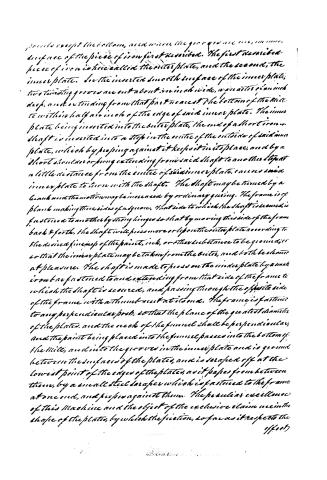
pounds except the bottom, and where the grooves are cut, in the surface of the piece of iron first described. The first described piece of iron is here called the outer plate, and the second, the inner plate. In the inserted smooth surface of the inner plate, two turning grooves are cut about an inch wide, a quarter of an inch deep, and extending from that part nearest the bottom of the mill to within half an inch of the edge of said inner plate. The inner plate being inserted into the outer plate, the end of a short iron shaft is inserted into a step in the centre of the outside of said inner plate, which by pressing against it keeps it in its place, and by a short shoulder or bar extending from said shaft to another step at a little distance from the centre of said inner plate, causes said inner plate to turn with the shaft. The shaft may be turned by a crank and the motion may be increased by ordinary gearing. The frame is of plank making three sides of a square, that side to which the shaft is secured is fastened to another by strong hinges so that by moving this side of the frame back & forth, the shaft will press more or less on the outer plate according to the desired fineness of the paint, ink, or other substance to be ground, so that the inner plate may be taken from the outer, and both be cleaned at pleasure. The shaft is made to press on the inner plate by a small iron bar fastened to and extending from that side of the frame to which the shaft is secured, and passing through the opposite side of the frame with a thumb-nut at its end. The frame is fastened to any perpendicular post, so that the plane of the greatest diameter of the plates, and the neck of the funnel shall be perpendicular, and the paint being placed into the funnel passes into the bottom of the mill, and into the grooves in the inner plate and is ground between the surfaces of the plates, and is scraped off at the lowest point of the edges of the plates, as it passes from between them, by a small steel scraper which is fastened to the frame at one end, and presses against them. The peculiar excellence of this Machine and the object of the exclusive claim are in the shape of the plates, by which the friction, so far as it respects the effect
Page 4.
effect on the mill, was at the same nearly the same at the left as at the greater diameter.
In testimony whereof, the said book have hereunto set my hand and seal on this 14 day of February, in the year of our Lord one thousand eight hundred and twenty nine.
Witnesses
Samuel L. Bishop
Thomas F. Carpenter
Samuel Cook
N.Y.C.
56 1.000 - (Patented March 3, 1829.)
Published accounts: journal notice
Notice in the monthly list of patents, with remarks
Journal of the Franklin Institute, new ser., vol. 3 (1829), p. 405 · View the page
With Remarks and Exemplifications, by the Editor, 1. For a machine for Grinding Paints, called the "Trumpet Mouthed Paint Mill;" Samuel Cook, Mendon, Worcester county, Massachusetts, March 3.
Remarks. This is altogether a very compact, neat, and simple machine, and one which appears likely to fulfil the intention of the inventor, in a very perfect manner. One of the mills, of the ordinary size, has been sent to the patent office as a model. The grinding is effected between rubbing surfaces of cast-iron. The mill receives its name from the form of one of these pieces of cast-iron, which exactly resembles that of the mouth of a trumpet, or French horn. This piece is about six inches in diameter, turned quite smooth within, and fixed to a frame, so that the plane of its edge shall stand vertically. The paint to be ground, is conducted to the centre of this piece, by means of a funnel, or hopper, which terminates in that part of it which would be the commencement of the tube, were it a trumpet. Into this hollow trumpet piece is fitted another circular piece of cast-iron, of nearly the same diameter, and which is made to touch the former, excepting at the centre, and in the spaces left for the reception and conducting of the paint; these spaces consist of two twisting grooves about an inch wide and a quarter of an inch deep, extending from the centre, to within half an inch of the outer edge, that part being left perfectly smooth. This second plate is made to revolve by means of a wheel and pinion, and there is, upon its lower edge, a spring scraper to remove the paint as it is ground. By means of a hinge, uniting the frame work of the mill, the two plates can be very readily separated from each other, for the purpose of cleaning them; and a thumb screw and nut secures them when together, and regulates their pressure. "The peculiar excellency of this machine, and the object of the exclusive claim, are, the shape of the plates, by which the friction, so far as respects the effect on the mill, wears them nearly the same at the less, as at the greater diameter."
About this record
- Patentee
- the Journal of the Franklin Institute, Journal
- Date
- the Name and Date index of patents, USPTO records, Jim Shaw's X-patent list
- Invention
- the Name and Date index of patents
- Listed in
- the Name and Date index of patents, USPTO records, Jim Shaw's X-patent list, the Journal of the Franklin Institute, Burke's List of Patents (1847)
- The patentee's full name comes from the Franklin Institute's journal.
- The residence comes from the Franklin Institute's journal.
- Burke's 1847 Patent Office list gives the same patent.