

Drawings and documents
USPTO scan
The patent as scanned by the USPTO
-
 Page 1
-
 Page 2
-
 Page 3


U.S. Patent and Trademark Office · Google Patents
Show the transcription Hide (752 words)
Machine transcription (LightOnOCR) of the pages as scanned by the USPTO, most of them the handwritten copies made when the records were restored after the 1836 fire. Not checked; it can misread handwriting, so compare it with the scan.
Page 1.
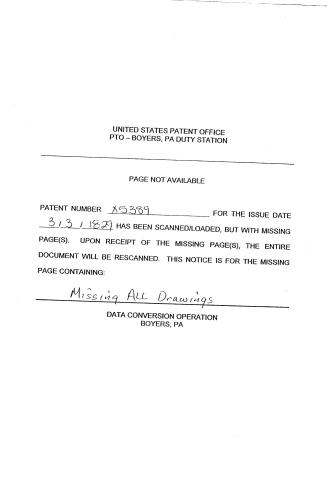
UNITED STATES PATENT OFFICE
PTO – BOYERS, PA DUTY STATION
PAGE NOT AVAILABLE
PATENT NUMBER X5389 FOR THE ISSUE DATE 3/3/1829 HAS BEEN SCANNED/LOADED, BUT WITH MISSING PAGE(S). UPON RECEIPT OF THE MISSING PAGE(S), THE ENTIRE DOCUMENT WILL BE RESCANNED. THIS NOTICE IS FOR THE MISSING PAGE CONTAINING:
Missing All Drawings
DATA CONVERSION OPERATION
BOYERS, PA
Page 2.
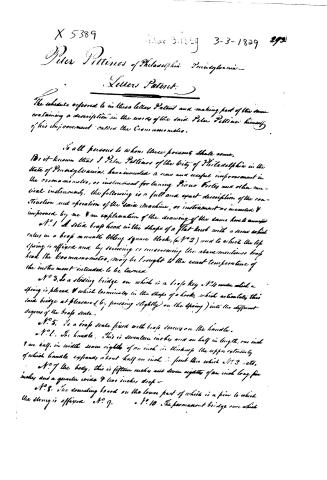
X 5389
Mar 3-1829 293
Peter Pettinos of Philadelphia Pennsylvania
Letters Patent.
The schedule offered to in this letter Patent and making part of this same containing a description in the words of the said Peter Pettinos himself of his improvement called the Cronamometer.
To all persons to whom these presents shall come,
Be it known that I Peter Pettinos of the city of Philadelphia in the state of Pennsylvania, have invented a new and useful improvement in the cronamometer, or instrument for tuning Piano Fortes and other musical instruments, the following is a full and exact description of the construction and operation of the said machine, or instrument as invented & improved by me & an explanation of the drawing of the same hereto annexed.
No. 1 A solid brass head in the shape of a flat knob with a screw which enters in a brass movable oblong square block, (No. 2) and to which the top spring is affixed and by screwing or unscrewing the above mentioned brass head the cronamometer may be brought to the exact temperature of the instrument intended to be tuned.
No. 3, Is a sliding bridge on which is a brass key No. 4 under which a spring is placed & which terminates in the shape of a hook, which articulates this said bridge at pleasure (by pressing slightly on the spring) into the different degrees of the brass scale.
No. 5. Is a brass scale fixed with brass screws on the handle.
No. 6. The handle. This is seventeen inches and an half in length, one inch & an half, in width seven eighths of an inch in thickness the upper extremity of which handle expands about half an inch in front then which No. 3 sets.
No. 7 the body, this is fifteen inches and seven eighths of an inch long five inches and a quarter wide & two inches deep.
No. 8. The sounding board on the lower part of which is a pin to which the string is affixed No. 9.
No. 10 The permanent bridge over which
Page 3.
the string is distended.
No. 11. I express proportion this which the hammer strikes the string in the same manner as an upright Piano forte with this difference, that the action of the latter is generally placed outside and the former inside of the body of the harmonium.
No. 12. The key of the instrument by touching which the harmonium acts, at once upon the string producing the proper tone by which we are to be guided in the tuning of instruments.
What I claim as new and as my own invention or discovery in the above described machine or instrument is for which I ask an exclusive privilege, is what is described in the foregoing specification, as No. 1 viz. a solid brass head in the shape of a flat knob which enters in a brass movable oblong square block, to which the string is affixed and by screwing or unscrewing which the harmonium may be brought to the exact temperature of the instrument intended to be tuned.
The utility of this improvement consists in the facility and correctness by which a single individual may tune a Piano or other instrument. The harmonium is placed on the Piano, and with one hand the person strikes simultaneously the key of the harmonium, and the Piano at the same time regulating the tone by means of the screw, or knob at the top until the proper temperature is ascertained, the movable bridge is then moved along the scale to each note in succession giving its proper tone without any further alteration of the string, when this is performed it remains only to tune the remaining keys by octaves, by the old instrument one individual could not strike the Piano and harmonium at the same time he regulated the tone of the latter, thus the simultaneous tones of both could not be so easily ascertained.
Witness
Jas. R. Hodges
Arch. Randall
Peter Pellines
770
Published accounts: journal notice
Notice in the monthly list of patents, with remarks
Journal of the Franklin Institute, new ser., vol. 3 (1829), p. 410 · View the page
9. For an Instrument for Tuning Piano Fortes, and other musical instruments, denominated the CROMAMOMETRO; Peter Pettinos, Philadelphia, March 3.
Remarks. This instrument is a monochord, or instrument of one string. By means of a screw, and a sliding brass box at one end, this string is strained up to the proper pitch. The whole instrument is somewhat in the form of a long, narrow guitar; upon its handle, a brass scale is screwed, so divided, that when a sliding piece is made to stop the string at the respective divisions, it will give the notes through an octave, of the proper temperament for a stringed instrument. At one end of the instrument, there is a key which causes a hammer to strike the string.
About this record
- Patentee
- the Journal of the Franklin Institute, Journal
- Date
- the Name and Date index of patents, USPTO records, Jim Shaw's X-patent list
- Invention
- the Name and Date index of patents
- Listed in
- the Name and Date index of patents, USPTO records, Jim Shaw's X-patent list, the Journal of the Franklin Institute
- The patentee's full name comes from the Franklin Institute's journal.
- The residence comes from the Franklin Institute's journal.