

Drawings and documents
National Archives restored drawings: drawing
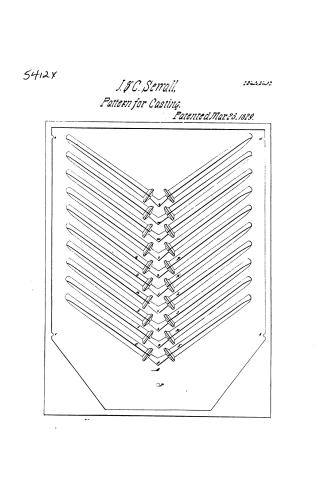
J. S. Charles Sewall's Patent Drawing for a Pattern for Moulding and Casting Composition Spikes, Butt-bolts, and other Hinges


National Archives, Restored Patent Drawings (Record Group 241) · Full-size scan at the National Archives · Catalog record
Show the text on the drawing Hide (52 words)
Words on the drawing as machine-read by the National Archives; not checked. Useful mainly for searching.
Sheet 1. Intented masch 25th 18 29. / JJCHARLES SEWALL / Auntinance / PATTERN FOR / Moulding Casting composilion Spikes, Bullbolls / And other / CLASSIFICATION / Hinges / DIVISION / Patented March / 1829. / Drawing №1. / IV / dip / F° / 22. METAL FOUR / IN MOLDED M / Molders' T
Sheet 2. CLASSIFICATION / 5412-+ / DIVISION.
USPTO scan
The patent as scanned by the USPTO
-
 Page 1
-
 Page 2


U.S. Patent and Trademark Office · Google Patents
Show the transcription Hide (65 words)
Machine transcription (LightOnOCR) of the pages as scanned by the USPTO, most of them the handwritten copies made when the records were restored after the 1836 fire. Not checked; it can misread handwriting, so compare it with the scan.
Page 1.
5412X
J. & C. Serrall,
Pattern for Casting.
Patented Mar. 25, 1829.
2 Sheets. Sheet 1.

Page 2.
5412Y
J. & C. Serrall,
Pattern for Casting.
Patented Mar 25, 1829.
Published accounts: journal notice
Notice in the monthly list of patents, with remarks
Journal of the Franklin Institute, new ser., vol. 3 (1829), p. 419 · View the page
32. For a pattern for Moulding and Casting Composition Spikes, butt bolts, and other castings; Joshua Sewall, and Charles Sewall, Bath, Lincoln county, Maine, March 25.
Remarks. A plate of metal, of any suitable kind, from one-eighth to half an inch in thickness, is cast with one-half of the pattern of the spikes on each side; these half spikes standing anglewise, to deliver well from the sand. This plate is made to suit the size of the flasks to be used, and fitted to the dowells, or pins, which cause the flasks to match. To those who understand any thing of casting, the mode of using it will be obvious. The patentees "claim as new, the method of making the above described plate, or pattern, for casting, with the sections of the spike on each side thereof, so exactly corresponding as to give the perfect shape of the spike, and so fixed upon the plate as readily to draw from the sand. The method of moulding spikes by the pattern, by which the spikes may be cast with points as wide, or wider, than the shanks, and which will, consequently, draw better than spikes moulded by pricking in the pattern, or moulded in any other way now known to be in use. The advantage of having the sections of the spikes so affixed to the plate, that they present on each side of the pattern, a half of the spike from corner to corner, with the point on the one side of the plate indented, and on the other side raised, so as to give the perfect shape of the spike when cast. Also the great saving of time and labour in moulding with the above described plate, or pattern." The indentation and raising, mentioned, relate to the form of the mould, which is necessary, in consequence of the widening out of WOOD's mode of Making Bricks, &c. the end of the spike. The latter part of the claim, is, we apprehend, mere surplusage, as the saving of time is scarcely a patentable article; and the means by which this is accomplished, had been already claimed. We have seen the half patterns of spikes fixed upon mould boards; not upon the opposite sides of the same board, but upon two separate boards; this is the nearest approach to the plan of the patentees with which we are acquainted.
About this record
- Patentee
- DATAMP
- Date
- the Name and Date index of patents, DATAMP, USPTO records
- Invention
- DATAMP
- Listed in
- the Name and Date index of patents, DATAMP, USPTO records, Jim Shaw's X-patent list, the Journal of the Franklin Institute, Burke's List of Patents (1847)
- Burke's 1847 Patent Office list gives the same patent.