

Drawings and documents
National Archives restored drawings: drawing
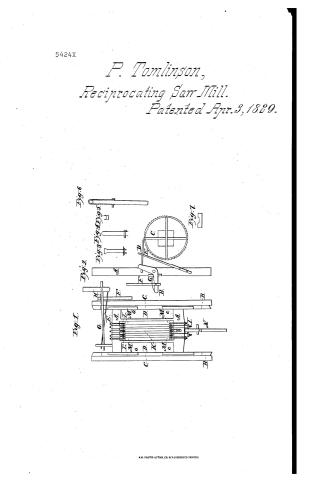
Peter Tomlinson's Patent Drawing for a Machine for Sawing Wood into Planks, etc.

National Archives, Restored Patent Drawings (Record Group 241) · Full-size scan at the National Archives · Catalog record
Show the text on the drawing Hide (213 words)
Words on the drawing as machine-read by the National Archives; not checked. Useful mainly for searching.
110. saws. / [180] Reciprocating Saw Mills / VOOD SAWING, / LACHINES MILLS / ocating Sawa / CLASSIFICATION / 5424+ / DIVISION. / saving wood into planks &cc / Patented April 3 1829 / 5106 / Fig2 / Explanation of the figures. / Fig. Fig.1 / ПИ / Fię 3 / Figh. / Fie.5. / tig 3 Stirrup / Fig1. / FigA Iron band palsing over the neddeepine& down on to the pitman / AA Sam-gate-girts. / BB / Fenderposts / c c / Sarv-gate runners. / Fig 5 Eig Iron on top of pitman / DD / Studs to support the girts of the sangate. / Spring on the leaver attached to sampate / F' / Staffthat commurecates motion to the Knee / Lever that mores up and down with the sangate. / Fig 6. Pilman with iron on the upper end s band which / Notched iron on top of leaver G / II / Stirups and nuts. / ind / palses over the noddle pin. / Sams / MM M M M Braces from the stude to the sams to hold them in shir plans / LLLL Bolts palsing through the sams / Pitman or shaklebar / Fig.7. Noddlepin. / 0.0.0.0 / Scell plates on saragate runners on sides. / Fig2 / Knee Fenderposts viewed side ways / C Ragnohoel / D Hand / K Spring on the fenderposts to Keep back, the hand / F Upright shaff connecting the knee If Letter / G Spring on the upward side of the Knee. / Fig.7 7. / Noddle-pins pine
USPTO scan
The patent as scanned by the USPTO
-
 Page 1
-
 Page 2


U.S. Patent and Trademark Office · Google Patents
Show the transcription Hide (143 words)
Machine transcription (LightOnOCR) of the pages as scanned by the USPTO, most of them the handwritten copies made when the records were restored after the 1836 fire. Not checked; it can misread handwriting, so compare it with the scan.
Page 1.
5424X
P. Tomlinson,
Reciprocating Saw Mill.
Patented Apr. 3, 1829.
Fig. 1
Fig. 2
Fig. 3
Fig. 4
Fig. 5
Fig. 6
Fig. 7
A.M. PHOTO-LITHO. CO. N.Y. (OSBORNE'S PROCESS)
Page 2.
United States Patent Office
PTO - BOYERS, PA Duty Station
MISSING PAGE TEMPORARY NOTICE
PATENT # 5424X FOR ISSUE DATE 4-3-1829
HAS BEEN SCANNED, BUT WITH MISSING PAGE(S). UPON RECEIVING OF MISSING PAGE(S), THE ENTIRE DOCUMENT WILL RE RESCANNED.
PLEASE CALL IMAGE DATA ADMINISTRATION STAFF OF 557-6154 IF YOU HAVE A QUESTION. ASK FOR DAVE GROOMS, ANITA YOUNG OR POLA JONES.
THIS NOTICE IS FOR THE MISSING PAGE CONTAINING:
COLUMN # All Text
Data Conversion Operation
Boyers, Pa
Published accounts: specification
Specification printed in the Journal of the Franklin Institute
Journal of the Franklin Institute, new ser., vol. 7 (1831), p. 265 · View the page
Text of the specification as printed in the Journal, from OCR; not proofread.
Specification of a patent for an improvement in the art of Making and Curing Salted Beef, and particularly of the description called Jerked Beef. Granted to WILLIAM A. TOMLINSON, city of New York, December 14th, 1830. A ROOM, or building, of any description, intended to be used for the purpose, is to be warmed, or heated, by an open fire, or fires, or by a close stove, or stoves, or furnace, of any material or description, and the warın air allowed to circulate freely through it; and the beef being previously salted, or pickled, and cut in such form as best to receive benefit in drying, is to be placed in the room, or building, as above described, either by being suspended, or placed upon racks, or netting, or otherwise disposed, so as best to obtain benefit of the warm or heated air, and is thus to remain; its position to be changed if necessary, until it becomes sufficiently dried to keep; and may then be transported loose, or packed in boxes, or other packages, to any place for use: it is also a part of the process, when preferred, to furnish the room, or building, with windows, so as to admit the rays of the sun to aid the artificial heat or warmth in the drying process; or the beef may be alternately exposed to the artificial heat and the rays of the VOL. VII.-No. 4.-APRIL, 1831. 34 sun, by removal from the room, or building, to the external, or open air, and returned again; and also vice versa. The benefit to be obtained by the above process and its parts, in the making and curing salted beef, and particularly the advantage in the making and curing of jerked beef, over the mode hitherto practised for that article, (that mode consisting in drying the beef by exposure in the open air to the sun alone,) consist in drying the beef more uniformly and equally, gving it a better and sweeter flavour, and enabling it to be kept longer in ary climate without spoiling; and is also a great saving in the expense and time of curing, as the drying goes on during any weather. The application of artificial heat, without the aid of smoke to the curing and preserving of salted beef, and particularly that description of salted beef usually called jerked beef, is a new invention and discovery, and is deemed an application of an old principle to a new purpose, of such importance as to be entitled to a patent. Wм. А. ТOMLINSON.
Published accounts: journal notice
Notice in the monthly list of patents, with remarks
Journal of the Franklin Institute, new ser., vol. 4 (1829), p. 47 · View the page
10. For an improvement in the Saw Mill, by which the same saw gate is made with equal facility to carry one, or any number of saws, at one time, as wished; Peter Tomlinson, Derby, New Haven county, Connecticut, April 3.
Remarks. The principal improvement claimed, is in the manner of making the saw frame, and fixing and tightening the saws. The saw frame is made to run with but little friction in the grooves of the fender posts, by using plates of iron or steel. The girths of the saw frame, instead of being supported at their ends, have studs, which are placed within, as near to the saws as the log to be cut will admit. These are made moveable, for the purpose of shifting the saws, &c. Suppose a number of saws to be run, say seven, the holes by which they are to be straightened are made to correspond perfectly, so that when laid upon each other, one bolt would pass through the whole of them; this is an essential point, as it is by such bolts that the saws are to be strained. The centre saw has a split stirrup, both above and below; the top stirrup being tightened by nuts. When this saw is placed within the slits in the stirrups, the bar or bolt is passed through the holes; other saws, without stirrup irons, are then slipped on at each side; then again saws with stirrups, and afterwards without, when the whole seven will be in their places. Two narrow stirrups are to be placed after the last pair of saws. As the saws move freely, laterally on the bolts, their distances apart may be regulated, and altered with great facility. When the nuts are tightened, all the saws will be strained. Notched braces extending from stud to stud, may retain the saws at their proper distances, or blocks of wood, perfectly true and hard, may be fixed in between them. There are some other improvements claimed, such as a particular mode of attaching the pitman to the bottom of the saw frame, and the mode of regulating the feed. As these are minor points, we shall not lengthen out our description by further explanation.
About this record
- Patentee
- the Journal of the Franklin Institute, Journal
- Date
- the Name and Date index of patents, USPTO records, Jim Shaw's X-patent list
- Invention
- the Name and Date index of patents
- Listed in
- the Name and Date index of patents, USPTO records, Jim Shaw's X-patent list, the Journal of the Franklin Institute, Burke's List of Patents (1847)
- The X number corrects a misprint or misreading in one of the sources.
- The patentee's full name comes from the Franklin Institute's journal.
- The residence comes from the Franklin Institute's journal.
- Burke's 1847 Patent Office list gives the same patent.