

Drawings and documents
National Archives restored drawings: drawing
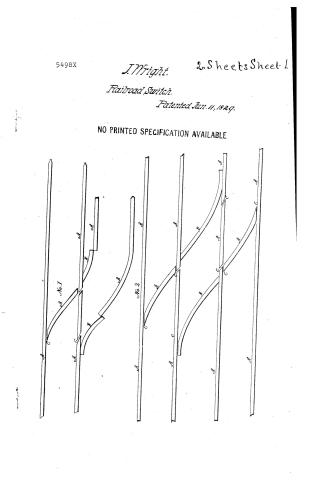
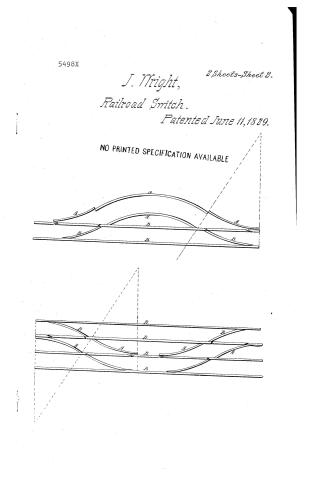
James Wright's Patent Drawing for a Rail Roads


National Archives, Restored Patent Drawings (Record Group 241) · Full-size scan at the National Archives · Catalog record
Show the text on the drawing Hide (114 words)
Words on the drawing as machine-read by the National Archives; not checked. Useful mainly for searching.
Sheet 1. 104. RAILWAYS. / The "Way," J.' / [20] Switches. Lap. / pl- / 1$ / [120] Switches. / 1. The "Way," / James Wricht / ASSIFICATION / shut 2 / 104. RAILWAYS. / 5498-4 / TVTOION. / Prail Prouds / Patented June 11 1829 / DIA
Sheet 2. 4. railways. / Vol.8.p.261. Vol.8.p. 261, / 1. The "Way," / [120] Switches. / the Lap. / CLASSIFICATION / Jumes Wricht / [120] Switches. / The "Way," / 5498-+ / Rail Road / shut! / DIVISION. / RAILWAYS to: / sails of different elevations at the curves so as to occeive / different treads of the whele- / Patented H June 1829, / №1, / N°2, / C' / Made under the direction of the Commision of Patents / Any 1841, / in couf anity with Oct of cougrep 3 March 1837 / Meniya Sumoth / of Patent,
USPTO scan
The patent as scanned by the USPTO
-
 Page 1
-
 Page 2
-
 Page 3


U.S. Patent and Trademark Office · Google Patents
Show the transcription Hide (151 words)
Machine transcription (LightOnOCR) of the pages as scanned by the USPTO, most of them the handwritten copies made when the records were restored after the 1836 fire. Not checked; it can misread handwriting, so compare it with the scan.
Page 1.
5498X
J. Wright.
Railroad Switch.
Patented Jun. 11, 1829.
NO PRINTED SPECIFICATION AVAILABLE
2 Sheets Sheet 1

Page 2.
5498X
J. Wright,
Railroad Switch.
Patented June 11, 1889.
2 Sheets-Sheet 2.
NO PRINTED SPECIFICATION AVAILABLE

Page 3.
United States Patent Office
PTO - BOYERS, PA Duty Station
MISSING PAGE TEMPORARY NOTICE
PATENT # 5498X FOR ISSUE DATE 6-11-1829
HAS BEEN SCANNED, BUT WITH MISSING PAGE(S). UPON RECEIVING OF MISSING PAGE(S), THE ENTIRE DOCUMENT WILL BE RESCANNED.
PLEASE CALL IMAGE DATA ADMINISTRATION STAFF OF 557-6154 IF YOU HAVE A QUESTION. ASK FOR DAVE GROOMS, ANITA YOUNG OR POLA JONES.
THIS NOTICE IS FOR THE MISSING PAGE CONTAINING:
COLUMN # All Text
Data Conversion Operation
Boyers, Pa
Published accounts: journal notice
Notice in the monthly list of patents, with remarks
Journal of the Franklin Institute, new ser., vol. 4 (1829), p. 174 · View the page
11. For an improvement in the Bar-share and Shovel Plough; James Boatwright, Columbia, South Carolina, June 11.
Remarks. A bar, or plate, of wrought iron, from four to ten inches wide, and from fourteen to sixteen inches long, is to have its ends cut off obliquely, so as to form an angle of about 46 degrees with the sides; these ends are to be steeled and sharpened. This plate is to be bent in a regular curve, lengthwise, upon a cylinder of about twenty-one inches in diameter. The plate, or share, is then to be bolted on to the helve, or chip, with one edge downwards. The specification states, that, "Among the advantages of this improved share, the following may be enumerated. Either end may be used, or the form of the ends may be varied, so as to be applicable to different purposes; it may be used either with or without a coulter, as circumstances require; it requires no mould board; is light, effective in its operation, and simple in its construction." "What I claim as new, and an improvement, in this plough, is the form of the share, which can be used at either end, and which, by its peculiar form, acts as a mould board and share, consequently supersedes the necessity of attaching a separate mould board." This plough is said to answer well in the district of country where the patentee resides. Where the soil is light, and the ploughing is intended to be shallow, we have no doubt of its adaptation to the purpose; and this we presume is all that is expected by the inventor.
Published accounts: journal notice
Notice in the monthly list of patents, with remarks
Journal of the Franklin Institute, new ser., vol. 4 (1829), p. 175 · View the page
12. For an improvement in the Rail-road, by which a railway carriage may be made to turn out and in, at the places intended for that purpose, on a single rail-way; or to pass from one track to another, where the road is double; which mode obviates the difficulties heretofore experienced in effecting this object; James Wright, Columbia, Lancaster county, Pennsylvania, June 11.
Remarks. A plate is in the hands of the engraver, to accompany the specification of this patent, and the one obtained by the same gentleman, in April last.
Published accounts: journal notice
Notice in the monthly list of patents, with remarks
Journal of the Franklin Institute, new ser., vol. 4 (1829), p. 271 · View the page
Specification of a patent for an improvement on the Rail-Road, by which a Rail-way Carriage may be made to turn out and in at the places intended for that purpose, on a single rail-way; or to pass from one track to the other where the road is double; which mode obviates the difficulties heretofore experienced in effecting this object. Granted to JAMES WRIGHT, Columbia, Lancaster County, Pennsylvania, June 11th, 1829.
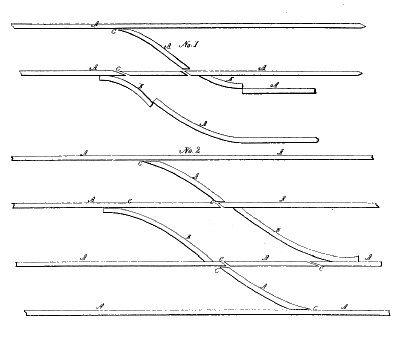
Remarks. THE rail-road carriage which I use, and the kind of rail upon which it runs, are fully described in the specification which I deposited in the patent office of the United States, and for which letters patent were granted unto me, bearing date the seventeenth day of April, one thousand eight hundred and twenty-nine, to which instrument, with the drawings which accompany the same, reference may be had, for the purpose of more clearly understanding the addition to, or improvement upon, the same, which I am now about to describe. For the purpose of rendering this description clear, I deem it best to refer throughout to the accompanying drawings; that marked Fig. 2, Plate 3, representing a single track, with its turning-out place, and that marked Fig. 3, a double track, with the rails for passing from one to the other. In each of these drawings the same letters refer to corresponding parts. The rails marked A, A, are those upon which the rims of the wheels run which are of the larger diameter, and are, therefore, those which have the lesser elevation; those marked B, B, and which are shaded, are the more elevated rails, upon which the rims run that are of the smaller diameter. Those parts, C, C, that are left blank at the junction of the rails, are openings for the passage of the flanches of the wheels; these openings will not be of such a width as to present any sensible obstruction in the passage of the wheels over them. It may sometimes be found useful, and I intend, occasionally, to apply a small thin piece of curved rail, of wrought iron or other material, at the commencement of the turn-out, which, when in its place, shall raise the higher rail sufficiently to prevent the larger rim from touching the lower rail, and which will necessarily have the effect of compelling the car to follow the curve; when this is out of its place, the rim of the smaller diameter will not touch the higher rail, and the car will consequently proceed straight forward. Pieces so used may be fixed upon a pivot, or hinge, in a way so simple that it is unnecessary further to describe it. It will be seen by inspection that the higher rail does not, in any instance, cross the main road, but only occupies the space between the two roads, or tracks, or form one of the rails of the turn-out on the single track, and that the space left for the flanch to pass is always in the lower rail. By the adoption of the foregoing plan, much of the expense heretofore encountered in constructing turn-out places, will be avoided, Self-adapting Rail-way Carriage, or Car. as the distance to which they must extend will be very considerably decreased. Any friction wheel, applicable to rail-way carriages of any other construction, may be applied to my carriage, constructed to operate on a straight or curved road. What I claim as my own invention in the above described plan, is the whole arrangement of the rails of greater or lesser elevation, to my rail-road carriage, each wheel of which has rims of different diameters, so as to effect the purpose of turning out, and in, upon a railJAMES WRIGHT. road.
DATAMP: illustration
Illustrations from DATAMP

DATAMP (Directory of American Tool and Machinery Patents), via the Internet Archive · Archived DATAMP page
About this record
- Patentee
- DATAMP
- Date
- the Name and Date index of patents, DATAMP, USPTO records
- Invention
- DATAMP
- Listed in
- the Name and Date index of patents, DATAMP, USPTO records, Jim Shaw's X-patent list, the Journal of the Franklin Institute, Burke's List of Patents (1847)
- Burke's 1847 Patent Office list gives the same patent.