

Drawings and documents
USPTO scan
The patent as scanned by the USPTO
-
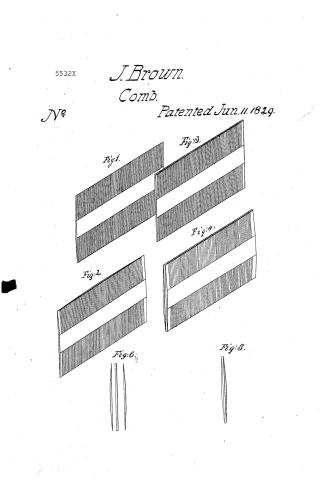 Page 1
-
 Page 2


U.S. Patent and Trademark Office · Google Patents
Show the transcription Hide (132 words)
Machine transcription (LightOnOCR) of the pages as scanned by the USPTO, most of them the handwritten copies made when the records were restored after the 1836 fire. Not checked; it can misread handwriting, so compare it with the scan.
Page 1.
5532X
J. Brown.
Comb.
Patented Jun. 11, 1829.
No.
Fig. 1.
Fig. 2.
Fig. 3.
Fig. 4.
Fig. 5.
Fig. 6.
Page 2.
United States Patent Office
PTO - BOYERS, PA Duty Station
MISSING PAGE TEMPORARY NOTICE
PATENT # 5532X FOR ISSUE DATE 6-11-1829
HAS BEEN SCANNED, BUT WITH MISSING PAGE(S). UPON RECEIVING OF MISSING PAGE(S), THE ENTIRE DOCUMENT WILL BE RESCANNED.
PLEASE CALL IMAGE DATA ADMINISTRATION STAFF OF 557-6154 IF YOU HAVE A QUESTION. ASK FOR DAVE GROOMS, ANITA YOUNG OR POLA JONES.
THIS NOTICE IS FOR THE MISSING PAGE CONTAINING:
COLUMN # All Text
Data Conversion Operation
Boyers, Pa
Published accounts: journal notice
Notice in the monthly list of patents, with remarks
Journal of the Franklin Institute, new ser., vol. 4 (1829), p. 183 · View the page
38. For an improvement in the Application of the Scape Heat from the High Pressure Steam Engine, to the Manufacture of Salt. For which a patent was obtained October 30, 1827; Alexander Brown, Salina, Onondago county, New York, June 11.
Remarks. The specification will appear in the next number.
Published accounts: journal notice
Notice in the monthly list of patents, with remarks
Journal of the Franklin Institute, new ser., vol. 4 (1829), p. 186 · View the page
46. For an improvement in the Manufacture of Combs; John Brown, Providence, Rhode Island, June 11.
Remarks. It is proposed to make fine toothed combs out of small scraps of ivory, which are of little value; pieces sufficiently large to form one row of teeth, leaving a narrow back to connect them together, answering the intended purpose. Two such pieces, when cut, may be joined by an intermediate piece of hard wood, horn, or any other suitable substance, to which they may be attached by cementing, or otherwise.
Published accounts: journal notice
Notice in the monthly list of patents, with remarks
Journal of the Franklin Institute, new ser., vol. 4 (1829), p. 273 · View the page
HI Specification of a patent for an improvement in the application of the Scape-heat from the high pressure Steam Engine, for which a patent was obtained October 30th, 1827; ALEXANDER BROWN, Salina, Onondaga County, New York, June 11th, 1829.
Remarks. WHEREAS, Alexander Brown did, on the thirtieth day of October, one thousand eight hundred and twenty-seven, procure letters patent for a new and useful improvement in the application of the VOL. 1V. No. 4. - ОСТОВER, 1829. 35 / 1 scape-heat from the furnace, and the discharged steam from the engine of the ordinary high pressure steam engine, to the manufacturing of coarse salt from salt water; and which letters patent contain a description, or specification, of said improvement as follows; that is to say: "When the ordinary high pressure steam engine is in operation, much of the heat from the fire in the furnace necessarily escapes through the furnace chimney, and most of the steam generated in the boiler, after performing its operation in the engine, is discharged from the engine. For the purpose of applying that scapeheat and discharged steam to the manufacturing of coarse salt from salt water, the ordinary high pressure steam engine is located in some convenient place. An ordinary salt water vat is erected, from plank or other material, of any given dimensions; say fifty feet by fifteen feet, and two feet deep, and placed on a level, as near as may be, with the bottom of the furnace of the steam engine, and at a short and suitable distance therefrom. The scape-heat and smoke, instead of being permitted to pass through and out of the chimney immediately connected with the furnace, are conducted by means of a metallic cylinder attached, one end thereof, to the furnace, and placed horizontally through the vat, and the other end thereof in a chimney erected on the outer, and the opposite side of the vat, from the furnace; which vat being filled with salt water, sufficient, at least, to cover the cylinder, receives the heat from the cylinder. A second cylinder, for distinction termed the steam cylinder, is also placed horizontally through the aforesaid vat, and one end thereof united to that part of the steam engine which discharges the steam from the engine, and of sufficient dimensions to convey the steam freely, and the other end on the outer and opposite side of the vat. This steam cylinder conveys the heat from the discharged steam, to the water in the vat, and conducts the discharged steam, or the water, should the steam in the cylinder be condensed, and discharges the same on the outside of the vat. The heat imparted from the cylinders to the salt water in the vat will cause an evaporation, and as the salt water contains in solution, besides the salt, some impurities having less affinity for the water than the salt, these settle after the salt water is evaporated to saturation. For the purpose of freeing the salt from those impurities, a second vat, of similar material and equal dimensions with the first, called the crystallizing vat, is erected and placed near the first vat, and sufficiently low to permit the water from the first vat to run into the second. The water in the first vat, after it is saturated, and all the impurities have settled, is drawn off into the second vat, and the steam cylinder is continued through the second vat, and which will impart to the saturated water in that vat, heat sufficient to keep up an evaporation for crystallization, and produce the finest and purest of coarse salt. "This improvement does not consist in any of the machinery of the high pressure steam engine, nor in the conducting heat or steam through salt water by means of metallic cylinders, nor in any particular formation, or location of the vats, but only in the application of the scape-heat and discharged steam, by means of the aforesaid apparatus to the manufacturing of coarse salt from salt water, thereby saving that heat which is usually lost, and applying that steam which is, ordinarily, used only to heat the water in the feeder for the boiler, and as a very small proportion is adequate for that purpose, so much may still be used by permitting the steam cylinder to pass through the feeder. Thus the scape-heat and discharged steam are applied to a useful and profitable purpose, without impairing the power of the steam engine, or diverting it from its destined operation. And whereas, also, the said Alexander Brown hath, by experiment, discovered and established some material improvements on said patent: now therefore the said Alexander Brown is desirous that the said improvements may be patented to him, of which improvements the following is the specification. The scape-heat from the furnace, instead of being conducted through a metallic cylinder, as in the aforesaid specification mentioned, is applied to a common sheet iron pan of any given dimensions, say twelve feet square and two feet deep, and which pan is placed between the furnace and the chimney, and with sufficient elevation to permit the heat and smoke from the furnace to pass freely, and not obstruct 'the draught of the furnace. This pan is used for heating the water which feeds the boiler of the steam engine, and is, for distinction, called the feeder. Salt water from the fountain may be put into the feeder, so that the boiler will be supplied with salt water instead of fresh water, and thereby the salt water in the boiler will be reduced to a state of saturation, or very nearly so. And in case the boiler is supplied with salt water, a discharging valve is placed in the boiler at some convenient place, and as near the bottom thereof as may be; and by which valve the water in the boiler, when saturated, is discharged, to prevent the forming of salt or the settling of the impurities in the boiler. The discharged saturated water is conducted from the discharging valve by a suitable conductor of wood or other material to the settling vat, in the aforesaid specification mentioned; and which settling vat, instead of being placed between the furnace and the chimney, as in the aforesaid specification mentioned, is placed in some other and convenient place, and as near the boiler and crystallizing vat, in the aforesaid specification mentioned, as may be, and of a proper elevation to receive the saturated water discharged from the boiler, and to permit it to run into the crystallizing vat. And the conducting of the water thereafter is the same as in the aforesaid specification mentioned.
About this record
- Patentee
- Jim Shaw's X-patent list
- Date
- the Name and Date index of patents, USPTO records, Jim Shaw's X-patent list
- Invention
- the Name and Date index of patents
- Listed in
- the Name and Date index of patents, USPTO records, Jim Shaw's X-patent list, the Journal of the Franklin Institute, Burke's List of Patents (1847)
- Burke's 1847 Patent Office list gives the same patent.