

Drawings and documents
National Archives restored drawings: drawing
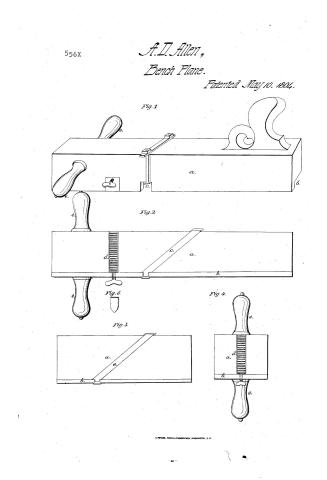
Amos D. Allen's Patent Drawing for a Machine to Cut Chips for Bonnets, Etc.

National Archives, Restored Patent Drawings (Record Group 241) · Full-size scan at the National Archives · Catalog record
Show the text on the drawing Hide (108 words)
Words on the drawing as machine-read by the National Archives; not checked. Useful mainly for searching.
145 WOOD TOOLS / CAASSE TRATION / 25c / Bench Inires. / 556X / Amos D. Allen. / LIV ISION. / Machine to cut chips for Bonnetsse. / Vol.20 Mr. / Patented Inay 10th 1804. / stigni. / A.y.3. / to / Jij.2. / Joy.4. / Inferences. a the stock or jointure b the lip / had under the dinction of the Commition / Patens office Feb. 14 1845. / e. / Siy.s / C. cutting Iron. d the frass box containing the cutting blades. / of Patents in comformity with act of / e.e handles. by 1. puspection view. Jy.2. 2. battomocers. ofy 3 small cutter. / Eongup March 3'. 4837. / Jigh small tool for cutting. diy S. a blad.
USPTO scan
The patent as scanned by the USPTO
-
 Page 1
-
 Page 2


U.S. Patent and Trademark Office · Google Patents
Show the transcription Hide (441 words)
Machine transcription (LightOnOCR) of the pages as scanned by the USPTO, most of them the handwritten copies made when the records were restored after the 1836 fire. Not checked; it can misread handwriting, so compare it with the scan.
Page 1.
556X
A. D. Allen,
Bench Plane.
Patented May 10, 1804.
Fig. 1.
Fig. 2.
Fig. 3.
Fig. 4.
Fig. 5.
Page 2.
James D. Allen of the State of Connecticut May 10, 1804
Letters Patent May 10, 1804.
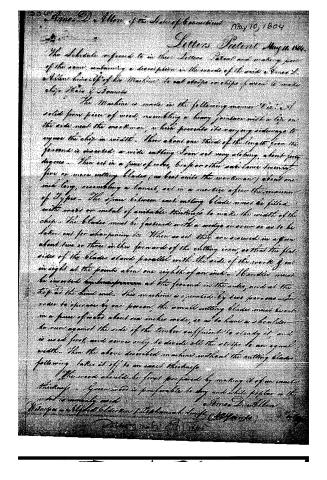
The Schedule referred to in these Letters Patent and making part of the same, containing a description in the words of the said James D. Allen himself of his Machine to cut strips or chips of wood to make chip thins & Staves.
The Machine is made in the following manner: It is a solid form piece of wood, resembling a heavy jointer with a lip on the side near the workman, which prevents its varying sideways to square the chip in width. Then about one third of the length from the fore end is inserted a wide cutting iron set very sloping, about forty degrees. Then set in a piece of iron, brass or other substance twenty five or more cutting blades, as best suits the workman, about one inch long, resembling a harrow, set in a machine after the manner of Sykes. The space between each cutting blade must be filled with wood or metal of suitable thickness to make the width of the chip. The blades must be fastened with a wedge or screw so as to be taken out for sharpening. Then so set they are screwed in again about two or three inches forward of the cutting iron, so that the flat sides of the blades stand parallel with the side of the work, & out in right at the points about one eighth of an inch. Handles must be inserted by screw or otherwise at the fore end in the sides, and at the top at the hind end. This machine is operated by two persons. In order to operate by one person, the small cutting blades must rest in a piece of wood about six inches wide, so as to have a shoulder to run against the side of the timber sufficient to steady it, and is used first and serves only to divide all the strips to an equal width. Then the above described machine without the cutting blades following takes it off to an exact thickness.
The wood should be first prepared by making it of an exact thickness. Green wood is preferable to dry and white poplar is the most commonly used.
James D. Allen
Witnesses: Stephen Clarkson & Nathaniel Lucey (both of Hartford)
Filed May 10, 1804
About this record
- Patentee
- Jim Shaw's X-patent list
- Date
- the Name and Date index of patents, USPTO records, Jim Shaw's X-patent list
- Invention
- the Name and Date index of patents
- Listed in
- the Name and Date index of patents, USPTO records, Jim Shaw's X-patent list, S. A. Elliot's printed list of patents, Burke's List of Patents (1847)
- S. A. Elliot's printed list of patents gives the same name and date.
- Burke's 1847 Patent Office list gives the same patent.