

Drawings and documents
National Archives restored drawings: drawing
Samuel A. Britt's Patent Drawing for Shears for Shearing Cloth

National Archives, Restored Patent Drawings (Record Group 241) · Full-size scan at the National Archives · Catalog record
Show the text on the drawing Hide (116 words)
Words on the drawing as machine-read by the National Archives; not checked. Useful mainly for searching.
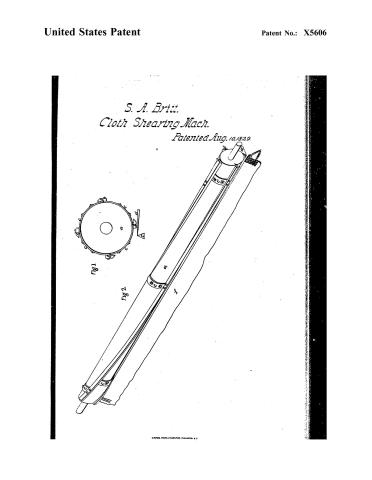
23. CLOTH / [37] Shearing. / Sex / 02 / CLASSIFICATION / 5606.+ / Samul A Britt. / Vol.6 py 45. Vol.6 py.45. / DIVISION. / Patented aug 10. 1829. / Thears for shearing Cloth. / Iy.2. 2. / Preferences. / Jiy.1. a the revolving cylinder / b.b.b.b. the four blades. / C.C.C.C. the springs. / d the bed blade. e.the gauge / Jig. 2. a perquative view of the cylinder a. / b.b.b.b. blades. e.c.e.e springs. / ol bed blade. e the gauge. I. the cloth Fatent affice the is February 1840 / made under the direction of the Commissioner of / Patints in Conformity with act of 3d march 1837. / ML Sumorth / Commissioner of Patento. / End.G.
USPTO scan
The patent as scanned by the USPTO
-
 Page 1
-
 Page 2
-
 Page 3


U.S. Patent and Trademark Office · Google Patents
Show the transcription Hide (301 words)
Machine transcription (LightOnOCR) of the pages as scanned by the USPTO, most of them the handwritten copies made when the records were restored after the 1836 fire. Not checked; it can misread handwriting, so compare it with the scan.
Page 2.
United States Patent
Patent No.: X5606
Samuel A. Britt
Letters Patent
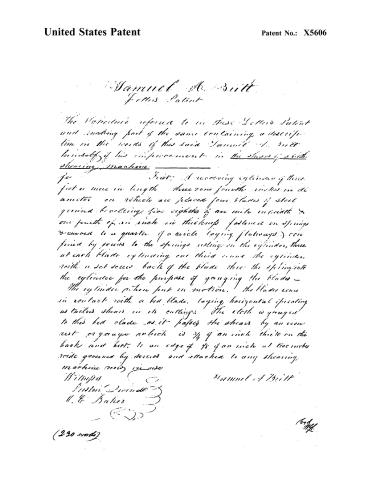
The description referred to in these Letters Patent and nothing part of the same containing a description in the words of this said Samuel A. Britt himself of his improvement in the shears of a cloth shearing machine.
First: A revolving cylinder of three feet or more in length three and one fourth inches in diameter on which are placed four blades of steel ground to cutting, five eighths of an inch in width and one fourth of an inch in thickness fastened on springs & curved to a quarter of a circle laying flatways & confined by springs to the springs resting on the cylinder, three at each blade extending one third round the cylinder, with a set screw back of the blade thru the spring into the cylinder for the purpose of gauging the blades —
The cylinder when put in motion, the blades come in contact with a bed blade, laying horizontal operating as tailors shears in its cutting. The cloth is gauged to this bed blade as it passes the shears by an iron rest or gauge which is 3/4 of an inch thick on the back and but, to an edge of 1/8 of an inch at five inches wide governed by screws and attached to any shearing machine now in use.
Witnesses
Foster L. Linnell
W. E. Baker
Samuel A. Britt
(230 words)
Page 3.
United States Patent
Patent No.: X5606
S. A. Britt.
Cloth Shearing Mach.
Patented Aug. 10, 1829.

Fig 1
Fig 2
R. PETERS, PHOTO-LITHOGRAPHER, WASHINGTON D.C.
Published accounts: journal notice
Notice in the monthly list of patents, with remarks
Journal of the Franklin Institute, new ser., vol. 4 (1829), p. 331 · View the page
We are not sure that tinned iron has been employed for the purpose proposed; but who has not seen the Bibles, Missals, and other books bound in Germany, double fortified with brass, and sometimes with silver? But, as the present claim is to tin only, brass and silver, we are to conclude, will not interfere. Alum is commonly put into paste, and different materials have been added as a protection against insects; we do not know that the two, above named, have ever been employed, nor are we certain that they are the best which can be found. 11. For improvement in the shears of a Cloth Shearing Machine; Samuel A. Britt, Cazenovia, Madison county, New York, August 10th.
Remarks. A cylinder, three or more feet in length, and about three inches in diameter, is surrounded by four blades of steel, which are bent so as to make a quarter of a circle round the cylinder. These blades, or cutters, are each sustained upon springs. The cutters in their revolution pass, and act against, a stationary blade or cutter, performing the operation like ordinary shears. There is not any thing claimed in this invention, and the whole so strongly resembles several other patented machines, as to leave us at a fault in the attempt to discover where the improvement lies. The drawing is without references.
About this record
- Patentee
- DATAMP
- Date
- the Name and Date index of patents, DATAMP, USPTO records
- Invention
- DATAMP
- Listed in
- the Name and Date index of patents, DATAMP, USPTO records, Jim Shaw's X-patent list, the Journal of the Franklin Institute, Burke's List of Patents (1847)
- Burke's 1847 Patent Office list gives the same patent.