

Drawings and documents
National Archives restored drawings: drawing
Obadiah Stith's Patent Drawing for a Cotton Press

National Archives, Restored Patent Drawings (Record Group 241) · Full-size scan at the National Archives · Catalog record
Show the text on the drawing Hide (43 words)
Words on the drawing as machine-read by the National Archives; not checked. Useful mainly for searching.
Tener / [7] / Cotton. / 50 / CLASSIN CATIOS / 5621-1 / DIVISION, / OBADIAH STITH'S. / COTTON PRESS. / Patented 25th aue 1829 / Topiver the press nith the / up & turned on one side / dio / Erio
USPTO scan
The patent as scanned by the USPTO
-
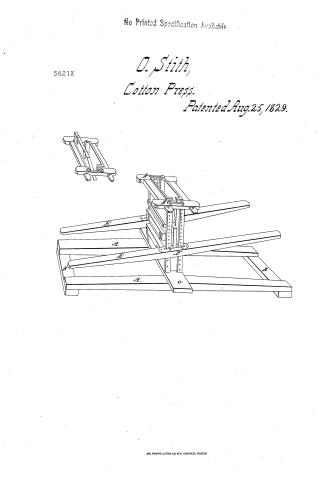 Page 1
-
 Page 2


U.S. Patent and Trademark Office · Google Patents
Show the transcription Hide (138 words)
Machine transcription (LightOnOCR) of the pages as scanned by the USPTO, most of them the handwritten copies made when the records were restored after the 1836 fire. Not checked; it can misread handwriting, so compare it with the scan.
Page 1.
No Printed Specification Available.
5621X
O. Stith,
Cotton Press.
Patented Aug. 25, 1829.
AM. PHOTO-LITHO. CO. N.Y. (OSBORNE'S PROCESS)
Page 2.
United States Patent Office
PTO - BOYERS, PA Duty Station
MISSING PAGE TEMPORARY NOTICE
PATENT # 5621X FOR ISSUE DATE 8-25-1829
HAS BEEN SCANNED, BUT WITH MISSING PAGE(S). UPON RECEIVING OF MISSING PAGE(S), THE ENTIRE DOCUMENT WILL BE RESCANNED.
PLEASE CALL IMAGE DATA ADMINISTRATION STAFF OF 557-6154 IF YOU HAVE A QUESTION. ASK FOR DAVE GROOMS, ANITA YOUNG OR POLA JONES.
THIS NOTICE IS FOR THE MISSING PAGE CONTAINING:
COLUMN # All Text
Data Conversion Operation
Boyers, Pa
Published accounts: journal notice
Notice in the monthly list of patents, with remarks
Journal of the Franklin Institute, new ser., vol. 4 (1829), p. 336 · View the page
26. For a machine for Packing Cotton; Obadiah Stith, Laurenceville, Brunswick county, Virginia, August 25.
Remarks. Each cheek of this press consists of two bars of iron standing upright. They are framed into a bed piece, and stand at the distance of a few inches apart, to allow a piece, called a driver, to extend out between them. These iron bars are perforated with round holes, to receive pins which serve as fulcra, upon which the levers work which are to force the driver and follower down upon the cotton. The cheeks are placed apart at a distance equal to the length of the bale to be packed. The levers, of which there are two, are each twenty feet long; they have a mortise in the middle, to allow them to pass up and down on the iron cheeks at each end of the press. The levers are to be drawn down at each end, alternately, the pins placed in the holes of the bars being shifted as they descend. The sides of the press are boxed up to receive the cotton, which is put in at the top. When the levers are at the upper end of the cheeks, the driver falls on one side, and offers no obstruction to the introduction of the cotton. An iron strap, or stirrup, from each end of the driver, connects it with the levers, descending into the centre of the mortises, where it is secured by strong pins, upon which it works as a joint. We shall probably recur again to this press, as it is certainly more simple than many of those which are used for the same purpose, and we think that it will be found convenient in practice; should this appear to be the fact, an engraving shall, hereafter, be given, for the purpose of making it better known. The general construction of the press is claimed, as is the particular mode in which the levers are made to operate; the iron cheeks with the slot between the bars which compose them, and which allow the driver to be drawn down by the levers; the application of the stirrup and driver, are also claimed.
About this record
- Patentee
- the Journal of the Franklin Institute, Journal
- Date
- the Name and Date index of patents, USPTO records, Jim Shaw's X-patent list
- Invention
- the Name and Date index of patents
- Listed in
- the Name and Date index of patents, USPTO records, Jim Shaw's X-patent list, the Journal of the Franklin Institute, Burke's List of Patents (1847)
- The patentee's full name comes from the Franklin Institute's journal.
- Burke's 1847 Patent Office list gives the same patent.