

Drawings and documents
National Archives restored drawings: drawing
Samuel L. Faries' Patent Drawing for a Eight-barrelled Perfusion Gun

National Archives, Restored Patent Drawings (Record Group 241) · Full-size scan at the National Archives · Catalog record
Show the text on the drawing Hide (40 words)
Words on the drawing as machine-read by the National Archives; not checked. Useful mainly for searching.
89 ORDNANCE. / [105] Machine Guns / $250 / Samuel S Farics / CLASSIFICATI E / 5656-X / eight barrelled perculsion gun. / Patented October 10% 182 / DI TON / E. / Fig. 1. / Fig II / CJ / Fig III
USPTO scan
The patent as scanned by the USPTO
-
 Page 1
-
 Page 2


U.S. Patent and Trademark Office · Google Patents
Show the transcription Hide (878 words)
Machine transcription (LightOnOCR) of the pages as scanned by the USPTO, most of them the handwritten copies made when the records were restored after the 1836 fire. Not checked; it can misread handwriting, so compare it with the scan.
Page 1.
S. L. FARIES.
Machine Gun.
Patented Oct. 10, 1829.
X5656
Fig. 1.
Fig. 2.
Fig. 3.
A. B. C. D. E. F. G. H. I. J. K. L. M. N. O. P. Q. R. S. T. U. V. W. X. Y. Z.
Page 2.
X5654
UNITED STATES PATENT OFFICE.
SAMUEL L. FARRIES, OF MIDDLETOWN, OHIO.
IMPROVEMENT IN GUNS.
Specification forming part of Letters Patent dated October 10, 1829.
To all whom it may concern:
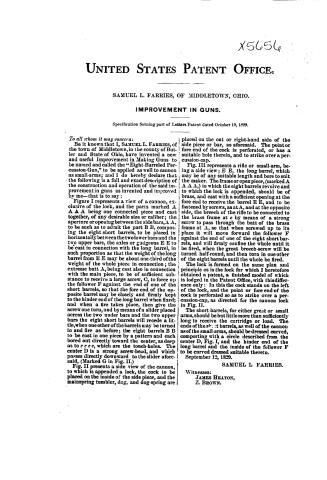
Be it known that I, SAMUEL L. FARRIES, of the town of Middletown, in the county of Butler and State of Ohio, have invented a new and useful Improvement in Making Guns to be named and called the “Eight-Barreled Percussion-Gun,” to be applied as well to cannon as small-arms; and I do hereby declare that the following is a full and exact description of the construction and operation of the said improvement in guns as invented and improved by me—that is to say:
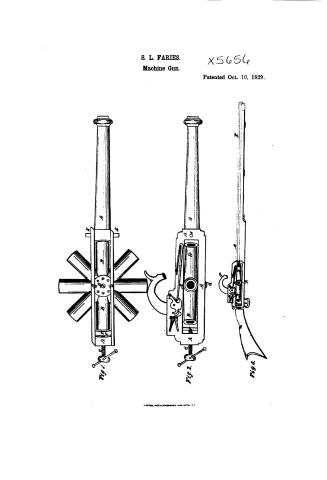
Figure I represents a view of a cannon, exclusive of the lock, and the parts marked A A A A being one connected piece and cast together, of any desirable size or caliber; the aperture or opening between the side bars, A A, to be such as to admit the part B B, composing the eight short barrels, to be placed in horizontally between the two lower bars and the two upper bars, the axles or gudgeons E E to be cast in connection with the long barrel, in such proportion as that the weight of the long barrel from E E may be about one-third of the weight of the whole piece in connection; the extreme butt A, being cast also in connection with the main piece, to be of sufficient substance to receive a large screw, C, to force up the follower F against the end of one of the short barrels, so that the fore end of the opposite barrel may be closely and firmly kept to the hinder end of the long barrel when fixed; and when a fire takes place, then give the screw one turn, and by means of a slider placed across the two under bars and the two upper bars the eight short barrels will recede a little, when one other of the barrels may be turned in and fire as before; the eight barrels B B to be cast in one piece by a pattern and each bored out directly toward the center, as deep as to e e e e, which are the touch-holes. The center D is a strong screw-head, and which passes directly downward to the slider aforesaid, (Marked G in Fig. II.)
Fig. II presents a side view of the cannon, to which is appended a lock, the cock to be placed on the inside of the side piece, and the mainspring tumbler, dog, and dog-spring are placed on the out or right-hand side of the side piece or bar, as aforesaid. The point or fore end of the cock is perforated, or has a suitable hole therein, and to strike over a percussion-cap.
Fig. III represents a rifle or small-arm, being a side view; E E, the long barrel, which may be of any suitable length and bore to suit the maker. The frame or open piece, (marked A A A A,) in which the eight barrels revolve and to which the lock is appended, should be of brass, and cast with a sufficient opening at the fore end to receive the barrel E E, and to be fastened by screws, as at A, and at the opposite side, the breech of the rifle to be connected to the brass frame at c by means of a strong screw to pass through the butt of the brass frame at A, so that when screwed up to its place it will move forward the follower F against the end of one of the eight short barrels, and will firmly confine the whole until it be fired, when the great breech-screw will be turned half-round, and then turn in one other of the eight barrels until the whole be fired.
The lock is formed on the same plan and principle as is the lock for which I heretofore obtained a patent, a finished model of which is lodged in the Patent Office, with this difference only: In this the cock stands on the left of the lock, and the point or fore end of the cock is perforated so as to strike over a percussion-cap, as directed for the cannon lock in Fig. II.
The short barrels, for either great or small arms, should be but little more than sufficiently long to receive the cartridge or load. The ends of the short barrels, as well of the cannon as of the small-arms, should be dressed curved, comporting with a circle described from the center D, Fig. I, and the hinder end of the long barrel and the inside of the follower F to be curved dressed suitable thereto.
September 12, 1829.
SAMUEL L. FARRIES.
Witnesses:
JAMES HEATON,
Z. BROWN.
Published accounts: journal notice
Notice in the monthly list of patents, with remarks
Journal of the Franklin Institute, new ser., vol. 5 (1830), p. 25 · View the page
10. For an Eight Barrelled Percussion Gun; Samuel L. Faries, Middletown, Butler county, Ohio, October 10.
Remarks. We have described several guns for which patents have been obtained, which were provided with a revolving breech, containing four or more chambers to be loaded at one time, and successively brought to coincide with the main barrel, and have spoken of the difficulties attending their employment. The present patentee is more bold than his predecessors, as he proposes to adapt a similar contrivance, not to rifles merely, but also to cannon. He has a revolving breech consisting of eight chambers, united together so as to form radii, each being furnished with its touch hole. This radiating breech turns, with play, on a centre pin, so that each chamber may in succession be brought to coincide with the main barrel, against which it is to be pressed by a screw bearing against the end of its opposite chamber. A percussion lock is to fire the piece. Should a piece of ordnance of this description be manufactured, we should stand aloof at the time of proving it; for although the cheeks between which the breech is to revolve, and also the end in which the screw works, are to be cast solid with the body of the gun, we VOL. V.-No. 1.-JANUARY, 1830. 4 fear that those behind would be in as much danger from the breech, as those before from the ball. A cannon divided transversely, and held together by a screw behind, even supposing no actual fracture to take place, would open the joint every time it was fired, from the power of the recoil, and the vibratory motion experienced by every part of it. The percussion lock for cannon is not that simple thing which answers for small arms; upon this we might offer many remarks, but must defer them for a time. The rifle which Mr. Faries has represented in his drawing, although less objectionable than the great guns, is not, we apprehend, altogether free from the difficulties which have been encountered, but not overcome, by its predecessors.
About this record
- Patentee
- the Journal of the Franklin Institute, Journal
- Date
- the Name and Date index of patents, USPTO records, Jim Shaw's X-patent list
- Invention
- the Name and Date index of patents
- Listed in
- the Name and Date index of patents, USPTO records, Jim Shaw's X-patent list, the Journal of the Franklin Institute, Burke's List of Patents (1847)
- The patentee's full name comes from the Franklin Institute's journal.
- The residence comes from the Franklin Institute's journal.
- Burke's 1847 Patent Office list gives the same patent.