

Drawings and documents
National Archives restored drawings: drawing
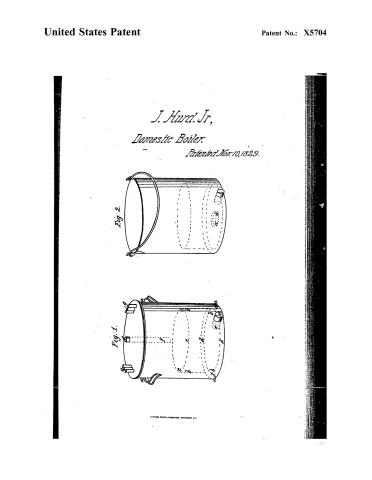
Joseph Hurd's Patent Drawing for an Improved Boiler

National Archives, Restored Patent Drawings (Record Group 241) · Full-size scan at the National Archives · Catalog record
Show the text on the drawing Hide (190 words)
Words on the drawing as machine-read by the National Archives; not checked. Useful mainly for searching.
$1- 126 STOVES & FURNACES / [164] / Domestic Boilers. / CLASSIFICATION / Joseph Hourd jun! / 5704-+ / Explanation of Fig. 1. / Improved Boiler / Patented November 1829. / An improved Boiler with top and tubes, by means of which steam may be conducted to other Vessels. / a.a.a.a.- Sides of boiler b.b.b.b. sides of the chamber, 02 cavity, within d. d. ol.d. a im of tin, 02 other metal / connecting the inner veficl, 02 easity, with the outer, 02 boiler. l.e. a pipe, 02 flue, to carry off smoke. ff a tube from / the top to within an inch of the inner vesselfor pouring in water. g.g. Tubes, by which steam escapes, and may be / conducted to various vessels. / Improved Boiler / Fig 1. / Fig. 2 / Esplanation of Jig. 2. / An improved Boiler without a top, Similar to Jig. 1, except that the opening into the inner. vessel, 02 easity, is / smaller, and intended to fit the funnel of a stove. The inner and outer vefsels are connected together at the circular / hole a.a. leaving the same space between their bottom as their sides. / Endy.
USPTO scan
The patent as scanned by the USPTO
-
 Page 1
-
 Page 2
-
 Page 3
-
 Page 4
-
 Page 5


U.S. Patent and Trademark Office · Google Patents
Show the transcription Hide (1,088 words)
Machine transcription (LightOnOCR) of the pages as scanned by the USPTO, most of them the handwritten copies made when the records were restored after the 1836 fire. Not checked; it can misread handwriting, so compare it with the scan.
Page 2.
United States Patent
Patent No.: X5704
Joseph Hurd, Jr.
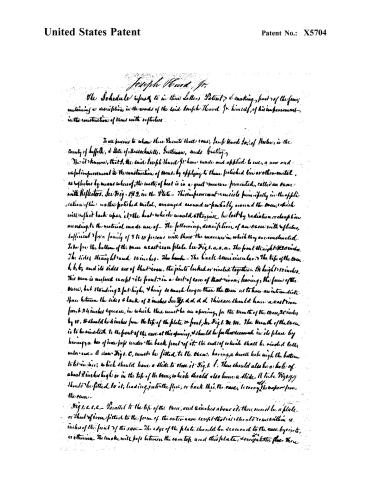
The Schedule refers to in their Letters Patent, & making part of the same, containing a description in the words of the said Joseph Hurd, Jr. himself, of his improvement in the construction of ovens with reflectors.
To all persons to whom these Presents shall come, Joseph Hurd, Jr., of Harbor, in the County of Suffolk, & State of Massachusetts, Gentleman, sends Greeting.
We it known, that I, the said Joseph Hurd, Jr., have made and applied to use, a new and useful improvement in the construction of ovens, by applying to them polished tin or other metal, as reflectors by means whereof, the waste of heat is in a great measure prevented, called an Oven with Reflectors. See Fig. 1 & 2, in the Plate. This improvement consists principally in the application of the sooth polished metal, arranged around or partially around the Oven, which will reflect back upon it, the heat which would otherwise be lost by radiation or absorption according to the material made use of. The following description of an oven with reflectors, sufficient for a family of 8 to 10 persons will show the manner in which they are constructed.
Take for the bottom of the oven a cast iron plate, see Fig. 1, a, a, a. The front straight 18 inches. The sides straight and 10 inches. The back — the back being circular — the top of the oven, b, b, b, and its sides are of sheet iron, the joints locked or riveted together. Its height 10 inches. This oven is enclosed except its front, in a sort of case of sheet iron, having the form of the oven, but standing 2 feet high, being so much larger than the oven as to have an intermediate space between the sides & back of 2 inches, see Fig. d, d, d. This case should have a cast iron front 24 inches square, in which there must be an opening for the mouth of the oven, 20 inches by 10. It should be 4 inches from the top of the plate or front, see Fig. 1, m, m. The mouth of the oven is to be riveted to the front of the case at this opening, & should be further secured in its place by having a bar of iron, see Fig. c, under the back part of it, the end of which shall be riveted to the outer case. A door, Fig. 1, c, must be fitted to the oven, having a small hole high the bottom to let in air; which should have a slide to close it — Fig. 1, f. There should also be a hole of about 2 inches high or in the top of the oven, which should also have a slide. A tube, Fig. g, g, should be fitted to it, leading into the flue, or back into the case, to carry the vapor from the oven.
Fig. 1, e, e, e — Parallel to the top of the oven, and 2 inches above it, there must be a plate or sheet of iron fitted to the form of the outer case except that it should come within 2 inches of the front of the case — The edge of the plate should be secured to the case by rivets, or otherwise. The smoke will pass between the oven top and this plate, & so into the flue. There
Page 3.
United States Patent
Patent No.: X5704
should be a circular opening of about 6 inches in the front plate, immediately over the oven, to introduce a brush or sweeper to clean out soot. Figs. h, k, a cap or hopper must be fitted to it. At the bottom of the front plate under the oven, there must be a square opening 6 inches broad & 4 inches high. Fig. 1, i.e., a door, & fitted to it. This, this the fuel is dropped into the furnace. A box with a neck to receive a funnel must be fitted close & riveted upon this case. Fig. 1, f, f. Should that iron be used for the front, it should have a swell to give it firmness. A case of tin or other polished metal Fig. 2, of the same form as the sheet iron case, but so much larger as to have an intermediate space of 2 inches, must be fitted over the whole. A square opening Fig. 2, a, a, a, a, should be left to get at the doors &c, which may be closed by a door b, b. A hole c for the funnel & other holes e, e, may be left for samplings, the bottoms of which will rest upon the top of the case.
When heat is wanted to warm an apartment, part of the reflector may be taken off, for which purpose it may be made in detached pieces, or it may have doors at the sides, to be opened occasionally. This case & oven should be so placed over a furnace as to include all air except that passes thru the fire. It is particularly adapted for the furnace with reflectors lately invented. The construction of the case above described, appears most suitable for culinary purposes.
The material, size, form, and proportions may be varied at pleasure, as to be important to manufacturers, mechanics & others. It is unnecessary to mention the various modes, in which reflectors may be applied to that in heat and constitute what may be called an oven, in the sense in which it should be understood in this specification.
It is testimony that the above is a true specification of my said improvement, as above described, I have hereunto set my hand and seal, the twelfth day of October in the year of our Lord one thousand eight hundred and twenty nine.
Joseph Hurd Jr.
Witnesses
A. D. Payne
Freeman Wood
Certify that the within Patent was entered on Record at the United States Patent Office on the 16th of November 1829.
John D. Craig
Superintendent of the Patent Office
Patent Office 16th Nov. 1829
By D. H. G.
Page 4.
United States Patent
Patent No.: X5704
J. Hurd, Jr.
Domestic Boiler.
Patented Nov. 10, 1829.
Fig. 2.

Fig. 1.

*H. PETER, PHOTO-LITHOGRAPHER, WASHINGTON, D.C.
Page 5.
United States Patent
Patent No.: X5704
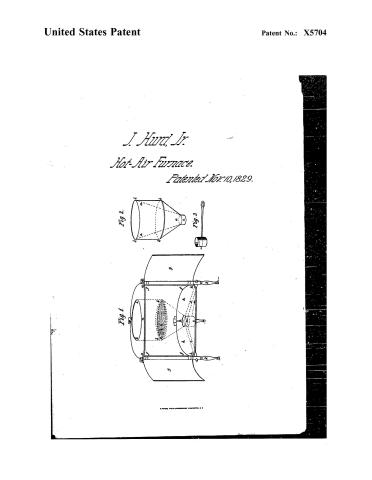
J. Hurd, Jr.
Hot-Air Furnace.
Patented Nov. 10, 1829.
Fig. 1.
Fig. 2.
Fig. 3.
W. PETER, PHOTO-LITHOGRAPHER, WASHINGTON, D.C.
Published accounts: journal notice
Notice in the monthly list of patents, with remarks
Journal of the Franklin Institute, new ser., vol. 5 (1830), p. 129 · View the page
9. For an Improved Boiler; Joseph Hurd, jun. Boston, Massachusetts, November 10.
Remarks. "This improvement consists principally in having a chamber, or cavity, at the bottom of the boiler, which receives all the smoke and hot air from the furnace, and from which all external air is excluded. It has a flue, or pipe, through the side, to carry off the smoke into the chimney, or elsewhere. We expect shortly to see the inventions to which the four preceding patents refer, in actual operation in this city, and are prepared to place them on the list of real improvements; at all events they appear to be founded upon correct scientific principles, and we hope that the test of experiment may show that these principles are well applied. It is probable that a full account of them will hereafter appear in the Journal.
About this record
- Patentee
- the Journal of the Franklin Institute, Journal
- Date
- the Name and Date index of patents, USPTO records, Jim Shaw's X-patent list
- Invention
- the Name and Date index of patents
- Listed in
- the Name and Date index of patents, USPTO records, Jim Shaw's X-patent list, the Journal of the Franklin Institute, Burke's List of Patents (1847)
- The patentee's full name comes from the Franklin Institute's journal.
- Burke's 1847 Patent Office list gives the same patent.