

Drawings and documents
National Archives restored drawings: drawing
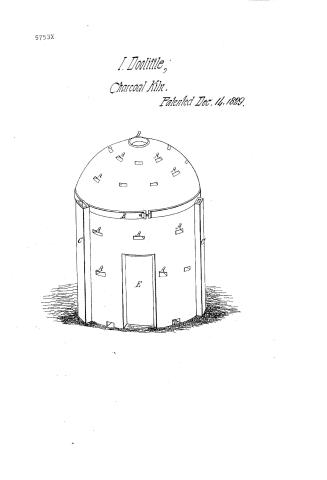
Isaac Doolittle's Patent Drawing for a Charcoal Burner

National Archives, Restored Patent Drawings (Record Group 241) · Full-size scan at the National Archives · Catalog record
Show the text on the drawing Hide (73 words)
Words on the drawing as machine-read by the National Archives; not checked. Useful mainly for searching.
75. METALLURGY. / [61] Coke & Charooal / V02,8,70,274. / $1 / them / Isaac Dodittle / ALAND / CORE / Ohe CC / Kilns. / Chareoal Burner / CCA SINGATION / Patented 14 Du" 1829. / 5753.4 / DIVISION. / References, / Patent Office 31. Aug 1841 / Avent holes. Biron band. / E.door. E. C chineneys. D circular opening'attep / Made under the direction of the Commiprome / of 1837, Patents in conformity with act of / Mennyh Sumoth / Commipione of attents
USPTO scan
The patent as scanned by the USPTO
-
 Page 1
-
 Page 2
-
 Page 3
-
 Page 4


U.S. Patent and Trademark Office · Google Patents
Show the transcription Hide (1,000 words)
Machine transcription (LightOnOCR) of the pages as scanned by the USPTO, most of them the handwritten copies made when the records were restored after the 1836 fire. Not checked; it can misread handwriting, so compare it with the scan.
Page 1.
5753X
I. Doolittle,
Charcoal Kiln.
Patented Dec. 14, 1889.

Page 2.
X 5753
12-14-1829
Minaa Woolittle, Bennington Vermont.
Letters Patent.
The Schedule referred to in these Letters Patent and making part of the same, containing a description in the words of the said Minaa Woolittle, himself of his improvement in the art of shavings wood for the manufacture of charcoal.
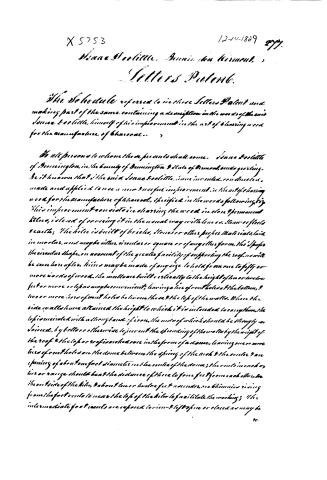
To all persons to whom these presents shall come. Minaa Woolittle of Bennington, in the county of Bennington & State of Vermont, undesigning. Be it known that I the said Minaa Woolittle, have invented, constructed, made and applied to use a new & useful improvement in the art of shavings wood for the manufacture of charcoal, specified in the words following, viz: This improvement consists in shavings the wood in close & permanent kilns, instead of covering it in the usual way with lime or slant or flots & earth; The kiln is built of bricks, stones or other proper materials laid in mortar, and maybe either circular or square or of any other form. The shape the circular shape, on account of the greater facility of supporting the roof, as will be seen hereafter. The kiln maybe made of any size to hold from one to fifty or more cords of wood. The walls are built vertically to the height of two or three feet or more or as may be convenient; leaving a line of vent holes at the bottom, & two or more lines of vent holes between these & the top of the walls. When the side walls have attained the height to which it is intended to carry them, the top is covered with a strong band of iron, the ends of which should be strongly joined, by bolts or otherwise to prevent the spreading of the walls by the weight of the roof & the top or roof is arched over in the form of a dome, leaving one or more lines of vent holes on the dome between the spring of the arch & the center & an opening of about one foot diameter in the center of the dome; the vents in each or line or range should be at the distance of three to four feet from each other on the outside of the kiln, & about two or three feet from under, one chimney rising from the foot ends to near the top of the kiln to facilitate the working; the intermediate foot vents are exposed to view & left open or closed as may be
40.
Page 3.
required; in the side walls are left one or more openings as some circumstance demands in the form of doors, for opening with wood & discharging coals. The bottom of the floor of the kiln is laid with its under edge on a level with the bottom of the foot vents, & is slightly raised towards the centre; this may be made of a floor of common boards laid on sand & covered with three or four inches of clay smoothly & compactly laid on or it may be flagged with stones or paved with bricks, or in any other manner which will render it smooth & solid. The kiln may be filled with wood either by setting the wood on end, as in the ordinary heat pit, or by laying it down as in a wood heap, if the latter method which I prefer, be adopted, it will be well to place some small pieces of wood loosely over the bottom, for the body of wood to rest upon, in order that the air may circulate freely under it. The smallest & thickest wood should be placed at the bottom of the kiln covering the largest (& it is no matter how large) for the upper half a thickness of wood may be laid in the middle corresponding with the openings in the centre of the dome; if so, some dry wood or branches should be placed in the centre at the bottom. When the kiln is entirely filled with wood the discharging doors must be closed, either with iron doors luted, or by means of wood; the fire is introduced thru the central openings at the top; when the fire is kindled this opening must also be closed, which may be done by laying over it an iron plate & some earth; the fire can be easily and effectually governed by opening or closing vents as circumstances require; an experienced artist may very soon learn to discover & to know the state of the fire within from the nature of the smoke from the vents & to draw the fire whichever way he chooses; when the wood is sufficiently charred, the fire may be easily extinguished by closing all the vents and every fissure hermetically; in a few days it will be sufficiently cool to open & draw out the coals or substitute other wood when the operation recommences. What I claim as new and as the object of this application is the construction of permanent kilns.
Page 4.
X5753
kilns above ground, with baked roofs, chimney & vent holes as above described and for the purpose aforesaid, of a size sufficient to do business on an extensive scale. By the addition of a simple apparatus, this method of charring wood may afford vast quantities of pyroligneous acid, which may be applied to a variety of uses in the arts.
In testimony that the above is a true specification of my said improvement as above described, I have hereunto set my hand & seal, this twentieth day of Nov. in the year of our Lord one thousand eight hundred & twenty nine.
A. B. Giles (Witness)
H. L. Shaffer (Witness)
W. Doolittle
End
1794
1018 372
Published accounts: journal notice
Notice in the monthly list of patents, with remarks
Journal of the Franklin Institute, new ser., vol. 5 (1830), p. 162 · View the page
19. For an improvement in the art of Charring Wood, for the manufacture of charcoal; Isaac Doolittle, Bennington, Vermont, December 14.
Remarks. Permanent kilns are to be built of masonry, of such capacity as may be desired. The walls may be run up to the height of 8 or 10 feet, and surrounded at top by a strong band of iron; an arched roof, or dome, is then to be constructed. Vent holes are left at the bottom, and about the middle of the walls, and also in the centre, and other parts of the dome. Chimneys, or flues, are also built around the walls. Door ways are left to charge with wood, and to remove the coal. These may be closed with iron, or with masonry. Stoppers are adapted to the various vents, so that they may be partially, or perfectly, closed. The claim is to " the construction of permanent kilns above ground, with arched roofs, chimneys, and vent holes." It is stated that "by the addition of a simple apparatus, this method of charring wood may afford vast quantities of pyroligneous acid, which may be applied to various uses in the arts." In situations to which wood can be transported with facility, there can be no doubt of the economy of the plan proposed; and that the quality of the coal will be much better than that burned in the usual way, we have no doubt.
About this record
- Patentee
- the Journal of the Franklin Institute, Journal
- Date
- the Name and Date index of patents, USPTO records, Jim Shaw's X-patent list
- Invention
- the Name and Date index of patents
- Listed in
- the Name and Date index of patents, USPTO records, Jim Shaw's X-patent list, the Journal of the Franklin Institute, Burke's List of Patents (1847)
- The patentee's full name comes from the Franklin Institute's journal.
- Burke's 1847 Patent Office list gives the same patent.