

Drawings and documents
National Archives restored drawings: drawing
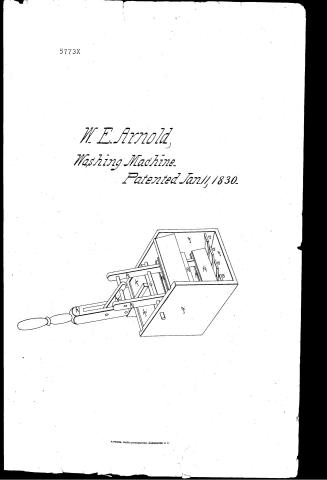
W. E. Arnold's Patent Drawing for a Washing Machine

National Archives, Restored Patent Drawings (Record Group 241) · Full-size scan at the National Archives · Catalog record
Show the text on the drawing Hide (99 words)
Words on the drawing as machine-read by the National Archives; not checked. Useful mainly for searching.
68 / UNDRY. / [91] / ug Mach's / POUNDERS. / $1, / 5773-X / W. E o ARNOLD / WashingMachine / Patented 11 Jan 1830 / A Box B / B. Shofts moring 772 on Pin c / D. Peices of / tank crossing do forming a dasher / Fa] / E: Handle / Perspective, with end rm are at / F' Pilman / to slow the intereor / G. Elastic prices of Wood / H. Part of Cover / FT / Strickland Del 3 / Patent office you 2" 1840 / Made under the direction of the commystower of patents / in conformity with act of March 1337 / Menny X Surworth / Commysioner of patent
USPTO scan
The patent as scanned by the USPTO
-
 Page 1
-
 Page 2
-
 Page 3
-
 Page 4
-
 Page 5


U.S. Patent and Trademark Office · Google Patents
Show the transcription Hide (1,380 words)
Machine transcription (LightOnOCR) of the pages as scanned by the USPTO, most of them the handwritten copies made when the records were restored after the 1836 fire. Not checked; it can misread handwriting, so compare it with the scan.
Page 1.
5773X
W. E. Arnold,
Washing Machine.
Patented Jan. 11, 1830.
Page 2.
Jan. 11, 1830
William C. Arnold of Haddam, county of Middlesex State of Connecticut
Letters Patent
The schedule referred to in these Letters Patent, and making part of the same, containing a description in the words of the said William C. Arnold himself of his improvement in a Machine for washing clothes—
To all, to whom these presents shall come: Be it known, that I William C. Arnold of the town of Haddam, in the county of Middlesex and state of Connecticut, have invented a new & useful improvement in a Machine for washing clothes, & that the following is a full & exact description of the construction & operation of the said Machine as invented or improved by me—
This machine consists of a box fourteen inches long, twelve inches wide & twelve inches deep—At each end of the box & within it, is a piece of wood or plank five inches wide, one inch and a half thick on one side and brought down regularly so as to come to an edge on the other side—These pieces are fastened in the upper part of the box with the thin edges downwards, by means of nails, or by entering the ends of them in places cut for that purpose in the sides of the box—At an equal distance from each end of the box, near the top, is a pin one inch in diameter, extending across the box & entering holes in the sides of the box—This pin passes thru and supports two shafts of wood, eighteen inches long, two inches wide and one inch thick—The holes in the shafts, through which the pin passes are eight inches from one end of the shafts, and ten inches from the other—These shafts are six inches distant one from one from the other, and are calculated to move on the pin—On the larger or lower end of these shafts are four pieces of boards or planks, two on each side of the shafts fastened with nails—These pieces are so long as to extend across the inside of the box—The pieces at the ends of the shafts are three inches wide and one inch and a half thick on the side
Page 3.
X5773
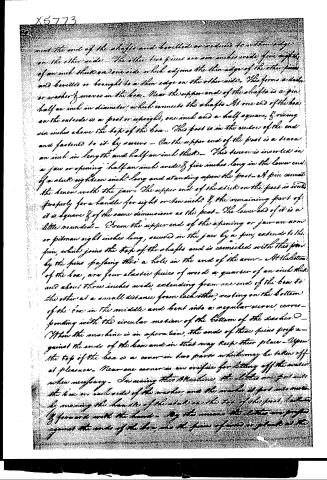
meet the end of the shafts and bevelled or reduced to a thin edge on the other side. The other two pieces are six inches wide, five eighths of an inch thick on one side which adjoins the thin edge of the other piece and bevelled or brought to a thin edge on the other side. This forms a deck or washer & moves in the box. Near the upper end of the shafts is a pin half an inch in diameter which connects the shafts. At one end of the box on the outside is a post or upright, one inch and a half square, & rising six inches above the top of the box. This post is in the centre of the end and fastened to it by screws. On the upper end of the post is a tenon an inch in length and half an inch thick. This tenon is inserted in a jaw or opening half an inch wide & five inches long in the lower end of a stick eighteen inch long and standing upon the post. A pin connects the tenon with the jaw. The upper end of the stick on the post is made properly for a handle for eight or ten inch. If the remaining part of it is square & of the same dimensions as the post. The lower end of it is a little rounded. From the upper end of the opening or jaw an arm or pitman eight inches long, secured in the jaw by a pin, extends to the pin, which joins the top of the shafts and is connected with the pin by the pins passing through a hole in the end of the arm. At the bottom of the box, are four elastic pieces of wood a quarter of an inch thick and about three inches wide, extending from one end of the box to the other at a small distance from each other, resting on the bottom of the box in the middle and bent into a regular curve, corresponding with the circular motion of the bottom of the washer. When the machine is in operation, the ends of these pieces press against the ends of the box and in that way keep their place. Upon the top of the box is a cover in two parts which may be taken off at pleasure. Near one corner is an orifice for letting off the water when necessary. In using this machine, the latter may be set into the box on each side of the washer and the washer is put into motion by moving the handle of the stick on the top of the post, back and forward with the hand. By this means the sticks are pressed against the ends of the box, and the pieces of wood are pressed at the
Page 4.
ends and are made clean. The dimensions of the Machine may be varied. It may be made on a large scale, & put in motion by water or other suitable power. The bottom of the box may be without the elastic piece and consist of one solid piece properly curved from one end to the other. The ends of the box may be so placed as to make an acute angle with the bottom on the inside, & thus to dispense with the piece of plank on the ends. The Machine may be constructed with two or more dashers each of which may be moved by a separate power on the method above described. Or two dashers may be moved by a single power by erecting two posts at the end of the box at a suitable distance from each other, rising above the box supporting a pin passing thro' them and the middle of the jaw or opening, and by adding another arm or pitman to go from the lower end of the jaw to the pin in a second pair of shafts.
The machine may be made double by attaching another similar to the one above described to the end of it so as to be operated upon by the same power. The dasher may be varied in its construction. The boards may be of an even thickness or thicker at one end & placed lengthwise of the shafts with the thicker end down, and fastened to one of pieces joining the shafts. This machine may be put in motion by means of a crank at one end of the box connected with the pitman or arm, or instead of a pitman, with the board and rollers. In the latter case a roller is placed at each end of the box one of them, turning on a fixed pin & the other fixed on a crank & turning with it & the board is fastened at one end to the fixed roller & at the other to the pin near the top of the shafts of the dasher & passing around the rollers. A double or triple crank may be used for the purpose of moving two or more dashers.
What I claim as new in the above described Machine & that for which I ask an exclusive privilege is the arrangement and putting together of the various parts which constitute the same in the manner above specified & the application thereof & of the powers and principles embraced in the operation of said machine in the former and method above set forth and described to the purpose of washing clothes. Jno W. Hargreaves.
Page 5.
X5773
whereof I have hereunto set my hand and seal the 16th day of December A.D. 1829.
Witnesses
Horace Foot
Charles Foot
William E. Arnold
[1400]
Received from Sprague
Published accounts: journal notice
Notice in the monthly list of patents, with remarks
Journal of the Franklin Institute, new ser., vol. 5 (1830), p. 218 · View the page
4. For a Machine for Washing Clothes; William Arnold, Haddam, Middlesex county, Connecticut, January 11.
Remarks. Very much like " a century of inventions" for the same purpose, and, no doubt, equally good with many of them, and destined to live to an equal age. American Patents for January, with Remarks. The claim is to "the arrangement and putting together the various parts."
About this record
- Patentee
- DATAMP
- Date
- the Name and Date index of patents, DATAMP, USPTO records
- Invention
- DATAMP
- Listed in
- the Name and Date index of patents, DATAMP, USPTO records, Jim Shaw's X-patent list, the Journal of the Franklin Institute, Burke's List of Patents (1847)
- Burke's 1847 Patent Office list gives the same patent.