

Drawings and documents
National Archives restored drawings: drawing
Linus Yale's Patent Drawing for a Machine for Hewing Stone

National Archives, Restored Patent Drawings (Record Group 241) · Full-size scan at the National Archives · Catalog record
Show the text on the drawing Hide (33 words)
Words on the drawing as machine-read by the National Archives; not checked. Useful mainly for searching.
125. STONE WORKING / DiV 15 / Degising Stene / 5788-X / LINUS YALES / MACHINE FOR HEWING STONE. / Patented the 20 January 1830 / 2. / Stone / Carriage
USPTO scan
The patent as scanned by the USPTO
-
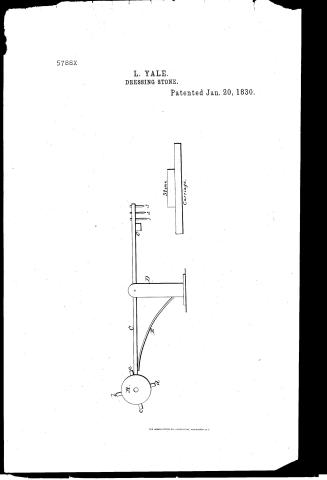 Page 1
-
 Page 2
-
 Page 3
-
 Page 4


U.S. Patent and Trademark Office · Google Patents
Show the transcription Hide (783 words)
Machine transcription (LightOnOCR) of the pages as scanned by the USPTO, most of them the handwritten copies made when the records were restored after the 1836 fire. Not checked; it can misread handwriting, so compare it with the scan.
Page 1.
5788X
L. YALE.
DRESSING STONE.
Patented Jan. 20, 1830.

THE MORRIS PETERS CO., PHOTO-LITHO., WASHINGTON, D.C.
Page 2.
Jan 20 1830 49
Lyman Hale, citizen of the U. S.
Letters Patent. x5788
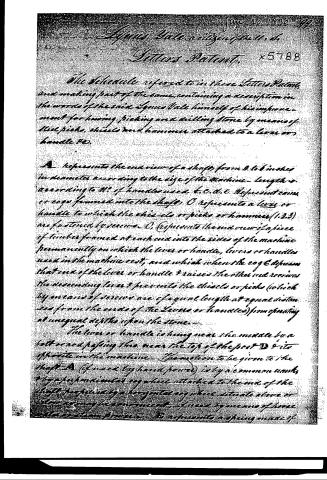
The Schedule referred to in these Letters Patent, and making part of the same, containing a description in the words of the said Lyman Hale himself of his improvement for having picking and drilling stone by means of steel picks, chisels and hammer attached to a lever or handle &c.
A represents the end view of a shaft from 3 to 6 inches in diameter according to the size of the machine - length according to the number of handles used. B, C, D, E represent ears or cogs formed into the shaft. O represents a lever or handle to which the chisels or picks or hammers (1, 2, 3) are fastened by screws. C, (represents the end view of a piece of timber framed at each end into the sides of the machine permanently on which the lever or handle, levers or handles used in the machine rest, and which when the cog C depresses that end of the lever or handle & raises the other end receives the descending lever & presses into the chisels or picks (which by means of screws are of equal length at equal distances from the ends of the levers or handles) from operating at unequal depths upon the stone.
The lever or handle is hung near the middle by a bolt or rod passing thru near the top of the post D & its opposite in the machine. The motion to be given to the shaft A (if used by hand power) is by a common crank & by a perpendicular cog wheel attached to the end of the shaft, provided by a horizontal cog wheel, situated above or below as may be convenient, if used by means of horse power or steam power. D represents a spring made of
Page 3.
wood, wire or steel as may be necessary, fastened at bottom upon or near the sill passing from the foot of the post D to its opposite in the machine, and the upper end pressed upon the lever or shaft, so as to keep it in a position horizontal to the centre of the shaft.
Remarks. By inspection of this draft it is obvious 1st That this machine may be constructed so as to contain from one to fifty levers or handles with from one to three chisels or picks on the end of each (as 1.2.3.) that the shaft A must contain as many rows of cogs as there are levers or handles & that each lever or handle requires at least one spring.
2nd That guides or upright pieces of timber are fastened between the levers or handles so as to give direction to the descending chisels or picks.
3rd That supporting the shaft to contain 2 cogs to each lever or handle that the machine has 10 levers or handles 3 chisels on the end of each one revolution of the shaft will occasion 30 strokes with a chisel upon the stone with the force of which the spring is capable. That should the shaft A revolve 30 times in a minute the stone will have received in that time 900 strokes.
4. That a carriage or carriages are to be constructed containing no new principle in mechanics, calculated to facilitate the operations of the machine in the hewing, dressing & drilling of stone & that it is the object of the petitioner to secure to himself the right of building, using and vending any carriage or carriages for that purpose, leaving all others the right of building like carriages if they please for different uses & purposes.
5. That the main object of the Petitioner is to prohibit all persons without his consent, from the stone to expose from hewing, picking or drilling of stone by means of steel picks chisels or hammers, attached
Page 4.
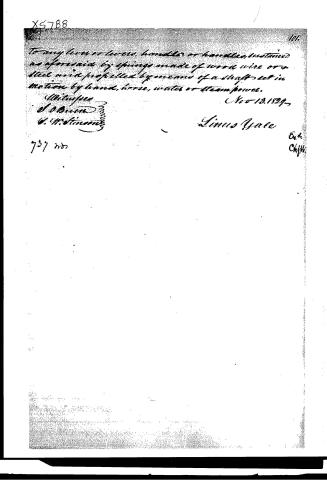
To any lever or levers, handles or handles, sustained as aforesaid by springs made of wood, wire or steel, and propelled by means of a shaft set in motion by hand, horse, water or steam power.
Nov 13, 1899
Linus Yale
737 no
Ex.
Ck. W.
Published accounts: journal notice
Notice in the monthly list of patents, with remarks
Journal of the Franklin Institute, new ser., vol. 5 (1830), p. 222 · View the page
By turning to page 259, vol. 4, first series, an account of similar machinery will be seen, with an accompanying drawing. It was the subject of a patent granted in England, to George Sayner and John Greenwood, for improved sawing machinery. In one point, at least, the apparatus there described is better than that above noticed; two circular saws are used, one above, and the other below the log, but they are placed a little in advance of each other, so that each may cut a little beyond the centre of the log; in other respects they act as in the machine claimed by Mr. Flagg. holdaya/s ន 16. For Hewing, Picking, and Drilling Stone by machinery; Linus Yale, Salisbury, Herkimer county, New York, Jan. 20.
Remarks. There is a lever, or levers, with steel picks, chisels, or hammers, at one end. The lever works on a pivot, at, or near, its middle, the end opposite to the chisels being operated upon by a wheel, with cams, or lifters, like a tilt hammer, so as to make the lever vibrate and the chisels cut. A wooden, or other spring, bears upon the lever so as to keep it in its proper position. The stone is to be placed upon any convenient kind of carriage, that it may be moved about to be operated upon by the chisels, &c. "The main object of the petitioner, is, to prohibit all persons, without his consent, until the patent expires, from hewing, picking, or drilling of stone, by means of steel picks, chisel, or hammer, attached to any lever, or levers, handle, or handles, sustained as aforesaid by springs made of wood, wire, or steel, and propelled by a shaft set in motion by hand, horse, water, or steam power." We fear that Mr. Yale will not accomplish his " main object," as there are a number of American and European patents for applying chisels, &c. for cutting and picking stone, both flat and in the form of mouldings, in which levers, or handles, are certainly used in a way which, we apprehend, will interfere with this subsequent claim.
About this record
- Patentee
- DATAMP
- Date
- the Name and Date index of patents, DATAMP, USPTO records
- Invention
- DATAMP
- Listed in
- the Name and Date index of patents, DATAMP, USPTO records, Jim Shaw's X-patent list, the Journal of the Franklin Institute, Burke's List of Patents (1847)
- Burke's 1847 Patent Office list gives the same patent.