

Drawings and documents
National Archives restored drawings: drawing
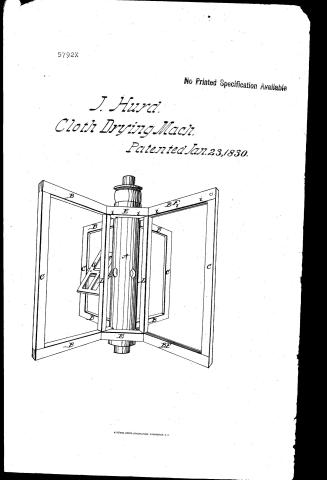
Joseph Hurd's Patent Drawing for an Evaporating Shaft for Drying Cloth, etc.

National Archives, Restored Patent Drawings (Record Group 241) · Full-size scan at the National Archives · Catalog record
Show the text on the drawing Hide (132 words)
Words on the drawing as machine-read by the National Archives; not checked. Useful mainly for searching.
01- / 34. DRIERS. / Reels / Windling. / Fibs Teft Stretching 86 chying bloth / 5792 X / Los. Hard's S / Evaperating Shaft, for drying Cloth &c. / Patented: 23d Ian ry: 1830. / to / BFi / Referenced / A. The shaft. / B.B. arms of the shaft. / C, C. Pieces connecting upperslower- / arms at their extremities. / D,D. Pieces connecting the upper lower / arms nigh the shaft. / E,E. Pieces connecting upper arms to. / gether and lower arms together. / B,F.B,F. Arms composed of two parts, / For 4 inches asunder for tentering / woolen cloths. / B BF F / Co. a frame of open work upon / D. / which may be placed woolge / i, i, Tenter hooks / B delt / bapy from the Original, / attached to the Takens / Endq.
USPTO scan
The patent as scanned by the USPTO
-
 Page 1
-
 Page 2
-
 Page 3


U.S. Patent and Trademark Office · Google Patents
Show the transcription Hide (773 words)
Machine transcription (LightOnOCR) of the pages as scanned by the USPTO, most of them the handwritten copies made when the records were restored after the 1836 fire. Not checked; it can misread handwriting, so compare it with the scan.
Page 1.
5792X
No Printed Specification Available
J. Hurd.
Cloth Drying Mach.
Patented Jan. 23, 1830.
Page 2.
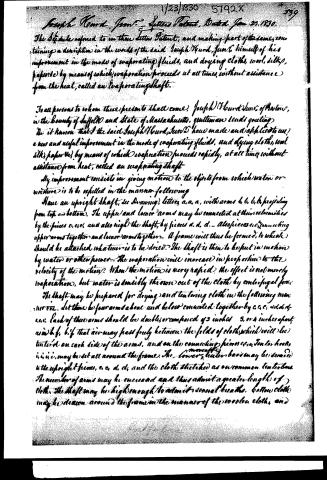
Joseph Hurd. From: Letters Patent, Dated Jan. 23, 1830.
The stipulation referred to in these Letters Patent, and making part of the same, containing a description in the words of the said Joseph Hurd, junr. himself of his improvement in the mode of evaporating fluids, and drying cloths, wool, silks, paper, etc., by means of which, evaporation proceeds at all times, without assistance from the heat, called an evaporating shaft.
To all persons to whom these presents shall come, Joseph Hurd, junr. of Boston, in the County of Suffolk and State of Massachusetts, gentlemens sends greeting.
Be it known that I the said Joseph Hurd, junr. have made and applied to use, a new and useful improvement in the mode of evaporating fluids, and drying cloths, wool, silks, paper, etc., by means of which evaporation proceeds rapidly, at all times, without assistance from heat, called an evaporating shaft.
My improvement consists in giving motion to the objects from which water or moisture is to be expelled in the manner following:
Have an upright shaft, see Drawing, letters a, a, a, with arms b, b, b, projecting from top and bottom. The upper and lower arms may be connected at their extremities by the pieces c, c, c, and also right the shaft, by pieces d, d, d. Also pieces e, e, e, connecting upper arms together and lower arms together. A frame will thus be formed, to which should be attached whatever is to be dried. The shaft is then to be put in motion by water or other power. The evaporation will increase in proportion to the velocity of the motion. When the motion is very rapid, the effect is not merely evaporation, but water is visibly thrown out of the cloth by centrifugal force.
The shaft may be prepared for drying and tenting cloth in the following manner. Let there be four arms above and below connected together by c, c, c, and d, d, d, etc. Each of these arms should be double, or composed of 3 inches, 3, or 4 inches apart, and b, f, b, f, that air may pass freely between the folds of cloth, which will be tented on each side of the arms, and on the connecting pieces c, c, c, and d, d, d, etc., may be set all around the frame. The lower tenting bars may be secured to the upright pieces, e, e, d, d, and the cloth stretched as on common tenting. The number of arms may be increased and thus admit a greater length of cloth. The shaft may be high enough to admit several lengths. Cotton cloth may be drawn around the frame in the manner of the woolen cloth, and
Page 3.
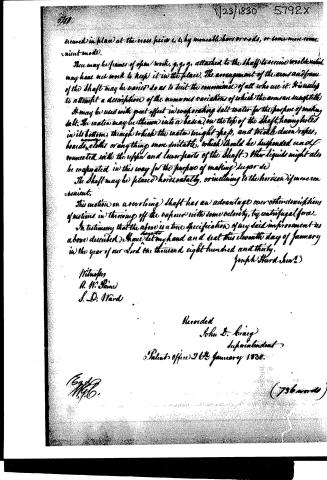
secured in place at the cross pieces c, by moveable bars or rods, or some more convenient mode.
There may be frames of open work, g, g, g, attached to the shaft to receive wheels which may have net work to keep it in the place. The arrangement of the arms and frame of the shaft may be varied so as to suit the convenience of all who use it. It is useless to attempt a description of the numerous variations of which the arms are susceptible.
It may be used with great effect in evaporating salt water for the purpose of making salt. The water may be thrown into a basin, on the top of the shaft, having holes in its bottom, through which the water might pass, and trickle down ropes, boards, cloths or anything more suitable, which should be suspended one of connected with the upper and lower parts of the shaft. Other liquids might also be evaporated in this way for the purpose of making sugar &c.
The shaft may be placed horizontally, or inclining to the horizon if more convenient.
This motion on a revolving shaft has an advantage over other descriptions of motions in throwing off the vapour with some velocity, by centrifugal force.
In testimony that the above is a true specification of my said improvement as above described, I have set my hand and seal this eleventh day of January in the year of our Lord one thousand eight hundred and thirty.
Joseph Hurd
Witnesses
A. W. Paine
S. D. Ward
Recorded
John D. Craig
Superintendent
Patent Office 26th January 1830.
(736 words)
Published accounts: journal notice
Notice in the monthly list of patents, with remarks
Journal of the Franklin Institute, new ser., vol. 5 (1830), p. 225 · View the page
22. For an improvement in the mode of Evaporating Fluids, and Drying Cloths, Wool, Silk, Paper, &c. without assistance from heat; Joseph Hurd, jr., Boston, Massachusetts, January 23.
Remarks. The specification commences by stating that the "improvement consists in giving motion to the objects from which water, or moisture, is to be expelled." a A large revolving frame is to be made, in form something like reel; upon this the cloth, or other article to be dried is extended, and fixed by tenter hooks, or otherwise. "The shaft is to be put in motion by water or other power. The evaporation will increase in proportion to the velocity of the motion. When the motion is very rapid, the effect is not merely evaporation, but water is sensibly thrown out of the cloth by centrifugal force." "It may be used with great effect for evaporating salt water for the purpose of making salt. The water may be thrown into a basin on the top of the shaft, having holes in its bottom, through which the water might pass and trickle down ropes, boards, coarse cloths, or any thing more suitable, which should be suspended and connected with the upper and lower parts of the shaft." This apparatus is certainly well calculated to promote evaporation, and will, we think, be found applicable to many useful purposes.
About this record
- Patentee
- DATAMP
- Date
- the Name and Date index of patents, DATAMP, USPTO records
- Invention
- DATAMP
- Listed in
- the Name and Date index of patents, DATAMP, USPTO records, Jim Shaw's X-patent list, the Journal of the Franklin Institute, Burke's List of Patents (1847)
- Burke's 1847 Patent Office list gives the same patent.