

Drawings and documents
National Archives restored drawings: drawing
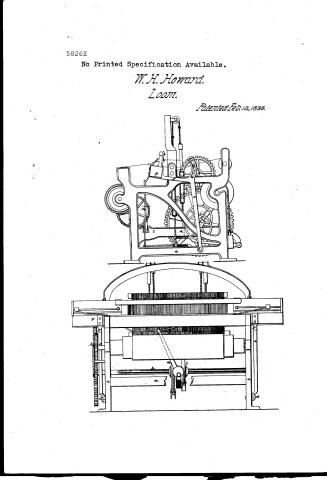
William H. Howard's Patent Drawing for an Improved Vibrating Cam Loom

National Archives, Restored Patent Drawings (Record Group 241) · Full-size scan at the National Archives · Catalog record
Show the text on the drawing Hide (86 words)
Words on the drawing as machine-read by the National Archives; not checked. Useful mainly for searching.
William H. Howard / 5826-X / Improved vibrating Cam Loom / Vol 10 pg 139. / Patenteo Lebr. 12th 12 1830. / MI / Ch. Meischmanu Jes: / references. a.a.a Trame b mainshaft C.C cranks. d.d pivots e.e lathe standard. f.farms g lathe h 6am-shaft / i.i cams. K geering h. cross gist m swag staff. / Gatent office / made under ohe direction of Patents / in conformity with hot of 3d march 1837 / Subvorth / Comminioner of Patents.
USPTO scan
The patent as scanned by the USPTO
-
 Page 1
-
 Page 2
-
 Page 3


U.S. Patent and Trademark Office · Google Patents
Show the transcription Hide (764 words)
Machine transcription (LightOnOCR) of the pages as scanned by the USPTO, most of them the handwritten copies made when the records were restored after the 1836 fire. Not checked; it can misread handwriting, so compare it with the scan.
Page 1.
5826X
No Printed Specification Available.
W. H. Howard.
Loom.
Patented Feb. 12, 1830.
Page 2.
X 5826
William H. Howard.
Latter Patent
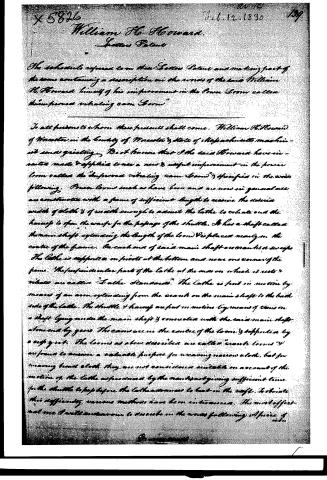
The schedule referred to in the Latter Patent and making part of the same containing a description in the words of the said William H. Howard himself of his improvement in the Power Loom called "the improved vibrating cam Loom"
To all persons to whom these presents shall come. William H. Howard of Worcester in the County of Worcester & State of Massachusetts machine and sword granting, Doth know that I the said Howard have invented made & applied to use a new & useful improvement in the power loom called the "improved vibrating cam Loom" & specify in the words following. Power looms such as have been and are now in general use are constructed with a frame of sufficient length to receive the desired width of cloth & of width enough to admit the lathe to vibrate and the harness to open the ways for the passage of the shuttle. It has a shaft called the main shaft extending the length of the loom & is placed nearly in the centre of the frame. On each end of said main shaft are mounted sweeps. The lathe is supported on pivots at the bottom and near one corner of the frame. The perpendicular parts of the lathe at the ends on which it rests & vibrates are called "Lathe Standards". The lathe is put in motion by means of an arm extending from the crank on the main shaft to the back side of the lathe. The shuttle & harness are put in motion by means of cams on a shaft lying under the main shaft & connected with the said main shaft directly by gears. The cams are in the centre of the loom & supported by a upright. The looms as above described are called "circular looms" & are found to answer a valuable purpose for weaving narrow cloth, but for weaving broad cloth, they are not considered suitable on account of the motion of the lathe as produced by the crank not giving sufficient time for the shuttle to pass before the lathe advances to beat on the cloth. To obviate this difficulty various matters have been introduced. The most effectual one I will now proceed to describe in the words following. I spare of
Page 3.
X 5826
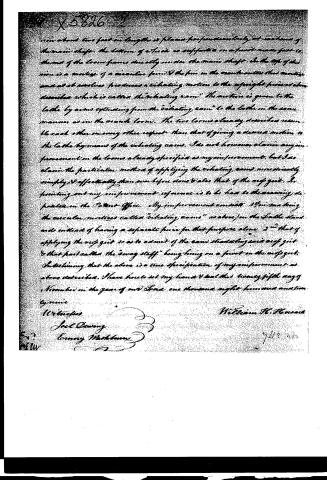
From about two feet in length it places perpendicularly at each end of the main shaft, the bottom of which is supported on a pivot made fast to the end of the lower frame directly under the main shaft. In the top of this piece is a mortise of a circular form & the pin on the crank enters this mortise and as it revolves produces a vibrating motion to the upright piece above described which is called the "vibrating cam." The motion is given to the latter by arms extending from the "vibrating cam" to the latter in the same manner as in the crank lorns. The two lorns already described seem to each other in every other respect than that of giving a direct motion to the latter by means of the vibrating cams. I do not however claim any improvement in the lorns already specified as my improvement, but I do claim the particular method of applying the vibrating cams more directly simply & effectively than ever before done & also that of the orp gear. In pointing out my improvement reference is to be had to the drawing deposited in the Patent Office. My improvement consists 1st in making the circular mortises called "vibrating cams" as above on the latter stand and instead of having a separate piece for that purpose alone 2nd that of applying the orp gear so as to admit of the cams shading said orp gear & that part called the "swing staff" being hung on a pivot on the orp gear. In testimony that the above is a true specification of my improvement as above described, I have here to set my hand & seal this twenty fifth day of November in the year of our Lord one thousand eight hundred and ten.
Witnesses
Joel Dewing
Emory Washburn
William H. Howard
742 1860
Published accounts: journal notice
Notice in the monthly list of patents, with remarks
Journal of the Franklin Institute, new ser., vol. 5 (1830), p. 295 · View the page
17. For an improvement in the Power Loom, called "The Improved Vibrating Cam Loom;" William K. Howard, Worcester, Worcester county, Massachusetts, February 12.
Remarks. The patentee first describes the general construction of the power looms now in use, in order the more fully to illustrate his improvements. In doing this he refers to the drawings, without which it would be in vain to attempt a description. A vague idea of the nature of his improvements may, perhaps, be afforded by what he claims; he says, "I claim the particular method of applying the vibrating cams more directly, simply, and effectually, than ever before done; and also that of the cross girth. In pointing out my improvements, reference is to be had to the drawings deposited in the patent office." "My improvement consists, 1st, in making the circular mortises (called 'vibrating cams, as above) in the lathe standards, instead of having a separate piece for that purpose alone." "2nd. That of applying the cross girth so as to admit of the cams straddling said cross girth; and that part called the sway staff being hung on a pivot on the cross girth."
About this record
- Patentee
- DATAMP
- Date
- the Name and Date index of patents, DATAMP, USPTO records
- Invention
- DATAMP
- Listed in
- the Name and Date index of patents, DATAMP, USPTO records, Jim Shaw's X-patent list, the Journal of the Franklin Institute, Burke's List of Patents (1847)
- Burke's 1847 Patent Office list gives the same patent.