

Drawings and documents
National Archives restored drawings: drawing
John J. Heintzelman's Patent Drawing for a Spiral Spring Truss

National Archives, Restored Patent Drawings (Record Group 241) · Full-size scan at the National Archives · Catalog record
Show the text on the drawing Hide (112 words)
Words on the drawing as machine-read by the National Archives; not checked. Useful mainly for searching.
128 surgery. / Surgical- Trusses [156] Trusses / #2 / John. J. Hountzelman / 5831+ / Spiral Spring Truss / Vol ie pg 259. / Patented Feb. 16 1830. / Section S / Aig.3 / Wholes / Fig.2. / STATE / Fig.1. / 72 / Preferences a circular spring b sheet iron plate. C.C stationary screws. d the opening. / Jig. 3 e flat prece of cock with holes f.f. - g.the implate h.h spiral springs. l the record puce of Cork. / m. . wool. n buckskin 0 the buckel. straps. / Patent affice December th 1841, / ch.L. Theischmann del: / made under the direction of the Commisioner of Patento / in conformity with act of 3. march 1837. / Hd. Sumorth / Commissioner of Patents.
USPTO scan
The patent as scanned by the USPTO
-
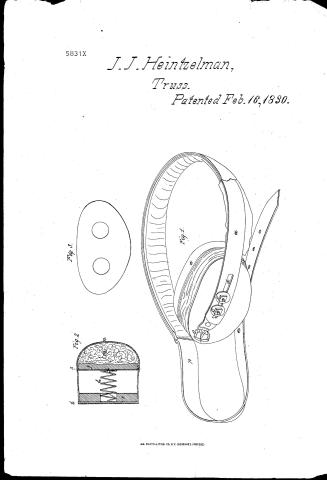 Page 1
-
 Page 2
-
 Page 3
-
 Page 4
-
 Page 5


U.S. Patent and Trademark Office · Google Patents
Show the transcription Hide (1,410 words)
Machine transcription (LightOnOCR) of the pages as scanned by the USPTO, most of them the handwritten copies made when the records were restored after the 1836 fire. Not checked; it can misread handwriting, so compare it with the scan.
Page 1.
5831X
J.J. Heintzelman,
Truss.
Patented Feb. 16, 1830.

AM. PHOTO-LITHO. CO. N.Y. (OSBORNE'S PROCESS)
Page 2.
John A. Heintzelman
Letter Patent
The Schedule referred to in these Letter Patent and making part of the same containing a description in the words of the said John A. Heintzelman himself of his improvement in the "Spinal Spring Trousers."
The large portion of mankind who are afflicted with this complaint; the great variety of forms in which it appears; the fatality which results from improper treatment & the deficiency hitherto experienced for the want of a good Trousers to confine the Diarrhoid & intestines which are the most movable viscera and occupy the front & lower part of the belly within the parities of the abdomen; are circumstances which combine to render the investigation of Homicide for a radical cure, an instrument to mitigate the distress of those afflicted, by a well adapted Trousers peculiarly interesting.
Before I describe my Improvement of the Spinal Spring Trousers I shall concisely state some of the inconveniences & imperfections of the present construction. They are 1st. The one in present use consists of a circular steel Spring about one inch broad with a small sheet iron plate rivetted at the extreme end about four inches in length & about two and a half inches broad in the middle forming part of an oval on the upper & extreme end, on the lower side from the middle gradually inclining, oblique to the plate where it is rivetted to the circular Spring already described with two small hooks on the outside for fastening the straps of leather which is attached to the covering of the circular Spring, so as to secure it on the body.
2nd. On the iron plate above described there is a small convex block secured by several nails on which there is placed a parcel of wool or cotton & the whole thus covered with Huskskin or some other kind of leather with a view of rendering it soft and elastic.
3rd. Now it most naturally follows that the Trousers just described possess no elasticity, besides the careless manner in which the Spring
Page 3.
is frequently prepared paying neither attention nor regard to the tempering of the steel, or frequently allotted to some inexperienced workman or apprentice, or even the formation of the pad & removing which is frequently entrusted to some female for a compensation by no means adequate for the trouble; they are put into the market without inspection may scarcely, seen by the manufacturer himself. It is that the very construction of the above truss renders its use by preferring no elasticity whatsoever (will at once be admitted by every man of ordinary capacity) thereby irritating the parts on which it is worn & naturally endangers the life of him who has the misfortune of being afflicted with a distressing & dangerous disease. by not keeping it confined with in its proper place but on the contrary by causing irritation of the pads & the frequent ruptures of protrusion, eventually suffer strangulation & close the distressing scene by death. By my improvement which I am about now to describe many if not all of the above dangers & difficulties are obviated which I feel satisfied the most experienced & experienced will admit. 1st. The Spring and pad are both elastic, as iron plates rivelled to a circular spring on every blank nailed thereon, or pad stuffed to a degree, the hardness thereof equal to the block itself are to be found in "the Spiral Spring Truss." On the contrary a circular spring the length thereof depends on the size of the person with an opening at one end about one & a half inch long, by which means it is attached to a short iron plate about four inches in length & about two & a half inches broad in the middle forming part of an oval on the extreme end & upper part: on the lower side from the middle gradually inclining in an oblique manner to one end of the circular spring with the opening, as described above, by this means the spring is fastened on the above described plate by two stationary screws passing thro' the said opening into the plate, should it be at any time necessary to lengthen or shorten the circular spring it is easily accomplished by loosening the screws & pushing the circular spring forward or backward as the person may find it necessary & again fastening the screws so that any person of ordinary judgment is able at once to give it the
Page 4.
the requisite length, which is of great importance. To the inside of the small plate as described above there is fastened a flat piece of cork with two round holes therein to admit the spiral springs, which I shall presently describe which confines them in a firm position when they are loaded with pressure more than ordinary & in no degree impair the elasticity thereof in the least, which has been the great consideration hitherto so anxious to obtain. It will easily be perceived from the position in which these spiral springs are placed which is in a direct line from the former described plate & inserted in another two plates of the same size and shape which bears immediately on the pads, so that when the spiral springs are not worn leaving the spring free they naturally force the two plates about one and a half to two inches apart & contract in ratio as force is applied, being evident, the greater exertion is made by the person it naturally follows, the greater the action should be on the pads & so vice versa & which I believe is happily combined in the principles of the spiral spring trap. In relation to the spiral springs they consist of steel wire of the requisite length to the size of the traps made into a spiral form terminating at each end into the centre, the points turned outwards, the whole being parallel; the points are inserted into a small hole expressly made in each plate in a straight line for the reception of the points affixed at the extremity of each spring as just described, by which means they are kept in their proper places; on the other side of the two plates facing the body there is another piece of cork, the size of the two plates about a quarter of an inch thick, the centre of which is rather depressed, on this there is placed cork to the thickness of an inch or more, the whole trap is now carefully covered with soft buckskin leather forming, as it were an even surface over the whole pad; having the edges of the leather secured thus and firmly sewed to the edges of the two well secured to the external plate answering to which the circular spring is fixed, the whole in appearance when the spiral springs are at rest, a balloon inflated, on the back of the pad where the circular spring joins the outside plate there is a small hook fixed which with a leather strap continuing
p. 3
Page 5.
from the covering of the other end of the circular spring is buckled on the body of a moderate length, which must be obvious calls the spiral spring into action, producing great elasticity & rotary motion, as the springs are governed altogether by the motion of the body, whatever position it is placed in or undue strength imposed on the parts, at the same time not impairing the mobility of the Joints in the least degree which has been the deficiency of the former one described.
By this improvement I claim every mode of junction of the Joints formed on any union of the spiral or other springs possessing elasticity, or rotary motion with a slide in the circular spring for lengthening or shortening the same together with a buckle & staple for fastening the same around the body which I find to answer perfectly well.
Witnesses
Henry Gellenjean
Jas McIntire
John J. Mcintzelman
Published accounts: journal notice
Notice in the monthly list of patents, with remarks
Journal of the Franklin Institute, new ser., vol. 5 (1830), p. 297 · View the page
23. For an improved Truss for Ruptures, called the " Spiral Spring Truss;" John J. Heintzelman, Philadelphia, Pennsylvania, February 16.
Remarks. The specification sets forth that the trusses heretofore made have been very carelessly finished, so as to be but little calculated to answer the intended purpose. The improvements proposed are intended to obviate the defects arising from this cause, and to furnish an instrument more perfect in its operation. The circular spring, which is enclosed within the leather covering, is to be of well tempered steel, instead of hammered iron. The pad is to have two plates, forced apart by spiral steel springs. The circular spring is to be attached to the back plate of the pad by means of screws working in a slot, so that it may be lengthened or shortened as may be found necessary. There is a buckle to the strap in lieu of the ordinary holes and buttons. The claims are as follow. VOL. V.-No. 5.-MAY, 1830. 38 1 "I claim every mode of junction of the truss formed on any union of the spiral, or other spring possessing elasticity, or rotary motion; with a slide in the circular spring, for lengthening or shortening the same; together with a buckle and strap for fastening the same around the body, which I find to answer perfectly well." We believe that the lengthening and shortening of the truss by the slot, and tightening screws, is new; but the claim to "the spiral, or other spring, touches ground which has been pre-occupied, and that by more than one incumbent; the securing by a buckle, has been used; the studs and holes were adopted, probably, for the sake of economy, but the buckle has been frequently resorted to since, and certainly has been found " to answer perfectly well." A good drawing accompanies the specification, but it is without written references, and therefore does not fulfil the demands of the law.
About this record
- Patentee
- DATAMP
- Date
- the Name and Date index of patents, DATAMP, USPTO records
- Invention
- DATAMP
- Listed in
- the Name and Date index of patents, DATAMP, USPTO records, Jim Shaw's X-patent list, the Journal of the Franklin Institute, Burke's List of Patents (1847)
- Burke's 1847 Patent Office list gives the same patent.