

Drawings and documents
National Archives restored drawings: drawing
Unknown's Patent Drawing for a Mill for Grinding Corn

National Archives, Restored Patent Drawings (Record Group 241) · Full-size scan at the National Archives · Catalog record
Show the text on the drawing Hide (36 words)
Words on the drawing as machine-read by the National Archives; not checked. Useful mainly for searching.
MILLS. Metallic ayl ,Oisk water Vert / Burg / of / p15 IN / #58457 / MILL / 5845 X / For grinding corn / Patented Feb. 23. 1830. / x/o / 01 / Miths
USPTO scan
The patent as scanned by the USPTO
-
 Page 1
-
 Page 2
-
 Page 3


U.S. Patent and Trademark Office · Google Patents
Show the transcription Hide (691 words)
Machine transcription (LightOnOCR) of the pages as scanned by the USPTO, most of them the handwritten copies made when the records were restored after the 1836 fire. Not checked; it can misread handwriting, so compare it with the scan.
Page 1.
5845X
PATENTED FEB. 23, 1830.
I. WILLSON.
MILL FOR GRINDING CORN.

Page 2.
Jun 29 1832 5845x 135
Increase Wilson of New London, Connecticut
Letter Patent
The schedule referred to in these Letters Patent and making part of the same containing a description in the words of the — Increase Wilson himself of his improvement in mills for grinding corn and other substances,
To all to whom these presents shall come,
Be it known that I Increase Wilson of the Town of New London, in the County of New London & State of Connecticut have invented a new and useful improvement in Mills for grinding corn & other substances & that the following is a full and exact description of the construction and operation of the said Machine as improved by me.
The improvement consists first in connecting two or more cast iron mills (or the grinding parts thereof) together by means of several cast iron gear or bevel wheels, with iron shafts, and coupling boxes or clutches so that by turning one shaft, one or more of said Mills are put in operation & one or all of them readily disengaged by sliding the coupling box attached to each Mill, the object being to enable a person to apply to advantage, whatever power he may desire, to drive the Mills, which in the ordinary way with only one Mill he could not do so conveniently.) There is also another advantage in having two or more small mills instead of one large Mill to grind equally fast, that true small castings may be easily obtained while those of a large size are apt to warp or spring in casting, & small castings are generally harder than large ones.)
The improvement further consists in the construction of the Hopper, which is made in two parts, the main or upper part of iron & to constitute a to slip on and off at pleasure. The lower part of the Hopper is cast iron and secured to a centre board on the
Drawing of the Hopper
Page 3.
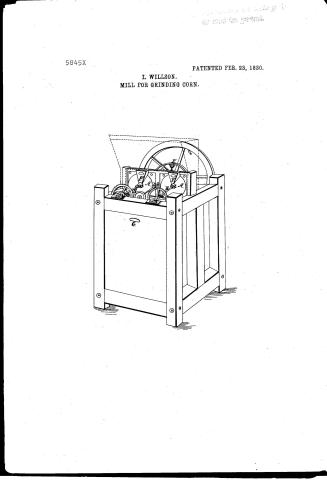
mills both parts of the hopper may be made of sheet iron or tin) the accompanying & annexed drawing planched A. represents the improvement in Mills for grinding Corn and other substances (with two connected together & hopper) - the two mills, running together, Mills, or grinding parts, (of cast iron) connected in a board which is secured across the centre of a frame, one end of each of the inside grinding passing through the centre of each of the outside grinding and connected with shafts, (marked B.B.) by two iron coupling boxes (marked C C) which are made to slide on the shafts so as to disengage one or both mills at pleasure; to the shafts are secured two spur wheels to gear into one of about half their size (as appears by the drawing) which is secured on the main shaft (marked D.) on the main shaft, (which passes through the centre board) a cast iron pulley is secured (marked E.) to which is applied a belt to move the Mills, on the end of the same shaft is a fly wheel into which a handle is placed, when it may be desirable to work the Mills by hand -
The stationary or lower parts of the Hoppers marked F.F. The main Hopper is represented by the dotted lines, has two outlets directly over the stationary or lower parts of the hoppers (F.F.) to pop the corn or other substance into the mills supported by means of a groove cut into each end of the main hopper, so as to slide down the centre parts as far as the upper railing of the frame. A box or drawer to slide out and into the frame to receive the meal is represented on the drawing (marked G.)
Witness
Innocent Wilson.
Wm. P. Cleaveland
Truman G. Tronno
648 n.b
Published accounts: journal notice
Notice in the monthly list of patents, with remarks
Journal of the Franklin Institute, new ser., vol. 5 (1830), p. 302 · View the page
34. For an improved Mill for Grinding Corn and other substances; Increase Wilson, New London, Connecticut, Feb. 23.
Remarks. "The improvement consists in the connecting two or more cast iron mills (or the grinding parts thereof) together, by means of several iron spur or bevil wheels, with iron shafts and coupling boxes, or clutches, so that by turning one shaft, one or more of said mills are put in operation." "There is an advantage in having two or more small mills instead of one large mill to grind equally fast; true, small castings may be easily obtained, while those of a large size are apt to warp or spring in casting, and small castings are usually harder than large ones."
About this record
- Patentee
- DATAMP
- Date
- the Name and Date index of patents, DATAMP, USPTO records
- Invention
- DATAMP
- Listed in
- the Name and Date index of patents, DATAMP, USPTO records, Jim Shaw's X-patent list, the Journal of the Franklin Institute, Burke's List of Patents (1847)
- The National Archives' catalog gives the name differently.
- Burke's 1847 Patent Office list gives the same patent.