

Drawings and documents
USPTO scan
The patent as scanned by the USPTO
-
 Page 1
-
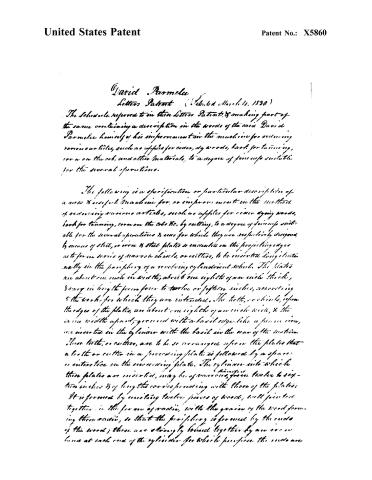 Page 2
-
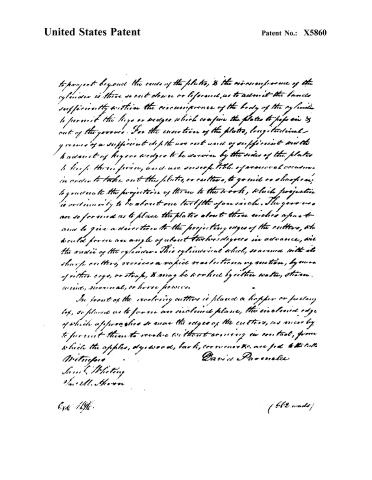 Page 3


U.S. Patent and Trademark Office · Google Patents
Show the transcription Hide (697 words)
Machine transcription (LightOnOCR) of the pages as scanned by the USPTO, most of them the handwritten copies made when the records were restored after the 1836 fire. Not checked; it can misread handwriting, so compare it with the scan.
Page 2.
United States Patent
Patent No.: X5860
David Parmelee
Letters Patent (Filed March 11, 1830)
The Schedule referred to in these Letters Patent, & making part of the same, containing a description in the words of the said David Parmelee himself of his improvement in the machine for reducing various articles, such as apples for cider, dry woods, bark for tanning, corn on the cob, and other materials, to a degree of fineness suitable for the several operations.
The following is a specification or particular description of a new & useful Machine for, or improvements in the method of reducing various articles, such as apples for cider, dry woods, bark for tanning, corn on the cob &c. by cutting, to a degree of fineness suitable for the several operations & also for which they are respectively designed, by means of steel, or iron & steel plates so incised on the projecting edges as to form series of narrow chisels, or cutters, to be inserted longitudinally in the periphery of a revolving cylindrical wheel. The plates are about one inch in width, about one eighth to one inch thick, & vary in length from four to twelve or fifteen inches, according to the work for which they are intended. The teeth, or chisels, upon the edges of the plates, are about one eighth of an inch wide, & the same width apart, ground with a bevel edge like a plane iron, are inserted in the cylinder with the bevel in the rear of the motion. These teeth, or cutters, are to be so arranged upon the plates that a tooth or cutter in a preceding plate is followed by a space or interval in the succeeding plate. The cylinder into which these plates are inserted, may be of various diameters from twelve to sixteen inches & of length corresponding with those of the plates. It is formed by uniting twelve pieces of wood, well jointed together in the form of a radius, with the grain of the wood forming those radii, so that the periphery is formed by the ends of the wood; these are strongly bound together by an iron band at each end of the cylinder for which purpose the ends are
Page 3.
United States Patent
Patent No.: X5860
to project beyond the ends of the plates, & the circumference of the cylinder is then so cut down or formed, as to admit the bands sufficiently within the circumference of the body of the cylinder to permit the lugs or wedges which confine the plates to pop in & out of the grooves. For the insertion of the plates, longitudinal grooves of a sufficient depth are cut, and of sufficient width to admit of lugs or wedges to be driven by the sides of the plates to keep them firm, and are susceptible of removal or removal in order to take out the plates, or cutters, to grind or sharpen, to graduate the projection of them to the work, which projection is ordinarily to be about one twelfth of an inch. The grooves are so formed as to place the plates about three inches apart and to give a direction to the projecting edges of the cutters, which would form an angle of about twelve degrees in advance, in the midst of the cylinder. This cylindrical wheel, so armed with its sharp cutters, receives a rapid revolution by motion, by means of either cogs, or straps, & may be worked by either water, steam, wind, manual, or horse power.
In front of the revolving cutters is placed a hopper or feeding box, so placed as to form an inclined plane, the inclined edge of which approaches so near the edges of the cutters, as merely to permit them to revolve without coming in contact, from which the apples, dry wood, bark, corn cobs, are fed to the cutters.
Witnesses
David Parmelee
Sam C. Whiting
Chas. M. Shown
Expt. 1896.
(462 words)
Published accounts: journal notice
Notice in the monthly list of patents, with remarks
Journal of the Franklin Institute, new ser., vol. 5 (1830), p. 362 · View the page
4. For a machine for Reducing various articles, such as Apples for Cider, Dying Woods, Bark for Tanning, Corn with the Cob, &c. by cutting, to a degree of fineness suitable to the several operations; David Parmelee, Reading, Fairfield county, Connecticut, March 4.
Remarks. The machine for the above purpose consists of a wooden cylinder made in radiating segments in such a manner that the end of the grain may form its whole surface-steel plates pass from end to end of this cylinder, at about three inches apart, the plates are bevelled something like a plane iron, and notched square down, so as to leave teeth with cutting edges of about one-eighth of an inch in width, and about the same distance apart. The plates are fixed in grooves, and by means of a key at one end, and a screw and nut at the other, they can be tightened, removed, and replaced. It is proposed to notch them at both edges, that they may be turned when required. This cylinder is to be made to revolve rapidly within a trough, the cutting edges being nearly in contact with its sides; a hopper is to be placed above to feed the cutters. There is no claim. We fancy that a stone, or other hard substance, mixed with the apples, &c. would make bad work with the cutters.
About this record
- Patentee
- DATAMP
- Date
- the Name and Date index of patents, DATAMP, USPTO records
- Invention
- DATAMP
- Listed in
- the Name and Date index of patents, DATAMP, USPTO records, Jim Shaw's X-patent list, the Journal of the Franklin Institute, Burke's List of Patents (1847)
- Burke's 1847 Patent Office list gives the same patent.