

Drawings and documents
National Archives restored drawings: drawing
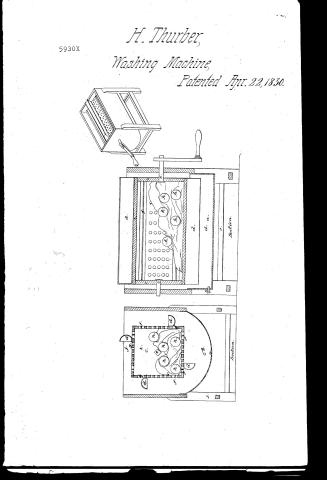
Hezekiah Thurber's Patent Drawing for a Machine for Washing Clothes

National Archives, Restored Patent Drawings (Record Group 241) · Full-size scan at the National Archives · Catalog record
Show the text on the drawing Hide (79 words)
Words on the drawing as machine-read by the National Archives; not checked. Useful mainly for searching.
dicylinder. / $2.50 / CLASSIFICATION / Herekiah Thurber / 5930-x / DIVISION / Machine for Washing blothes / Va.10. pg.37s. / Patented apli22 / References. / i. The water tight Box / a the metal bottom / blug. / Cylinder / endpicees. / d. buckets / asle. / of / bars. / door / Standor legs. / h. balls of wood. / Longitudinal Lection / Transvers Section / Extent office 9. 1841 / made under the I'm after Commissioner / af Intents in conformity with aava, 132/m / Comm prones Paten
USPTO scan
The patent as scanned by the USPTO
-
 Page 1
-
 Page 2
-
 Page 3


U.S. Patent and Trademark Office · Google Patents
Show the transcription Hide (623 words)
Machine transcription (LightOnOCR) of the pages as scanned by the USPTO, most of them the handwritten copies made when the records were restored after the 1836 fire. Not checked; it can misread handwriting, so compare it with the scan.
Page 1.
5930X
H. Thurber,
Washing Machine,
Patented Apr. 22, 1830.
Page 2.
No. 3350
Township 11 North of the Town of Painted Post, Steuben County, N. York
MRS. TAYLOR.
The Schedule referred to in the Letters Patent and making part of the same containing a description in the words of the said Mary Taylor, herself, of her improvement in the Machine for Washing Clothes.
Be it known, That I, Mary Taylor, of the Town of Painted Post, Steuben County and State of New York, have made an improvement in the machine for Washing Clothes, which is described as follows:
This Washing machine consists of the following principal parts. 1. The Water-tight Box. 2. The Barrel or cylinder for holding the clothes. 3. The stand.
1. The Water-tight Box is constructed by framing together by dovetailing, mating &c. two end pieces about twenty-two inches long and about the same depth, 1 inch thick, to two side pieces about 2 feet long, 11 inches wide and 1 inch thick, having a curved part made of wood or metal forming the bottom and corresponding in the curvature of the barrel to be hereafter described. The whole is moved and made perfectly water-tight. There is a plug or cock at the end & near the bottom for draining off the water.
2. The Barrel or Cylinder. The interior of the barrel is a parallelogram formed by uniting together two end pieces about 15 inches square and one inch connected by 11 slats or bars about 20 inches long & 7½ inches wide, ¾ inch thick and perforated with a sufficient number of holes 1¼ inch in diameter. On the outside are four Buckles, one over each of the perforated slats, for raising the water. An outlet from the end of the water box is inserted into the end of the barrel by means of which & a crank it is made to revolve on its axles in the curved Bottom & to which it is adapted. There are also a number of bars with openings or boards, perforated with holes to connect the parts of the barrel, and between the perforated slats before mentioned. One side of the barrel forms a movable door for admitting and taking out again the clothes to be washed & is fastened in any convenient way.
3. The stand is made by either fastening on legs to the water box or making it independent of the box.
Operation. The clothes to be washed are inserted in the barrel. The water and soap are put into the water Box. The barrel is then turned with an irregular motion so as to raise the clothes and let them fall again to the bottom, during this operation the water & clothes are continually rotating and flowing on the clothes through the perforations in the barrel. A number of balls of iron or of about 2 inches in diameter are put on with the clothes, which aid in the washing & the clothes are sufficiently washed when they are taken out of the Barrel and the water.
Page 3.
X5930
mean off. What I claim as my invention is the construction of the several parts of the herein described Machine & the manner of using it. Further to illustrate my invention I refer to the model & drawing of the same deposited in the Patent Office.
In testimony that the foregoing is a true Specification of my invention I have subscribed to the same and signed my name before two Witnesses at the City of Washington this 12th day of April 1830.
Wesleyah Thurber
Copy.
Witnesses
C. A. Gillett
J. Barnes
[629002]
Published accounts: journal notice
Notice in the monthly list of patents, with remarks
Journal of the Franklin Institute, new ser., vol. 6 (1830), p. 13 · View the page
35. For a Machine for Washing Clothes; Hezekiah Thurber, Painted Post, Steuben county, New York, April 22.
Remarks. A box, rectangular within, and having its sides formed of slats, placed at a distance from each other, is to be turned by a crank, in a water tight trough; into the interior box, the clothes are to be placed, with round balls of wood, to aid in rubbing them; the soap suds is to be poured into the exterior box, or trough. The crank is then to be turned with an irregular motion, and the clothes allowed to fall from side to side until they are cleansed. The claim is to "the construction and combination of the several parts of the before described machine, and the manner of using it. There could not well be any thing less definite than this claim, yet we do not perceive how it could have been made more so, as the pigeon holes of the patent office are replete with similar contrivances. "The manner of using it," is, we suppose, the putting the clothes inside, and the turning of a crank; a procedure equally novel with "the construction and combination of the several parts."
About this record
- Patentee
- DATAMP
- Date
- the Name and Date index of patents, DATAMP, USPTO records
- Invention
- DATAMP
- Listed in
- the Name and Date index of patents, DATAMP, USPTO records, Jim Shaw's X-patent list, the Journal of the Franklin Institute, Burke's List of Patents (1847)
- Burke's 1847 Patent Office list gives the same patent.