

Drawings and documents
National Archives restored drawings: drawing
C. F. Fisher's Patent Drawing for a Chymical Double Still

National Archives, Restored Patent Drawings (Record Group 241) · Full-size scan at the National Archives · Catalog record
Show the text on the drawing Hide (401 words)
Words on the drawing as machine-read by the National Archives; not checked. Useful mainly for searching.
195. ALCOHOL. / Distilled Spirits. / Apparatus. / Stills. / $1- / C.F FISHER / Chymeal double Still / 5935-X / Patented 24 1530 / Fig.1. The vannerpaging through the steampune into the steam separator and cuto the doubling still / 2. showing the operation the Steam / 3. The holes in the separator / 4. hous fastened to the still through which the serew passes / 5 screes to faster The small still to the large still / b. Nuts or burs for the serews 105. which is fustened on the large still with 2 rivets / 11/1 The Highth of the singlings in the doubling still / 8.- 2 hon handles factured to the small still to liftit / smighings run ere at I / hear / Ho / A. The small stilleap / B. small still 32. Gallons for 110. 115. or 120 Gallon still / C. Steam hipe 5 Inclus wide & 13 inches long through which the bapour of the lower still papses into letter D / the separator with small holes around it to prevent the steam or vanour from порид off in large theams / into the doubling still and from boiling in large Volleys; The separator is th mches from the top to the strainer / and s makes wede & the straier is 2 mehes wide, the lower rim of the trainer is 11/4 mch broad this rim is / intended to prevent any bapour from noting under the separator or thainer, The separator is kept from the / tom of the small still 3/4 inch with 4 prices of copper and are fastened to the inside of the separa tor each / 3/4uch longer than the rim of the separator, the Separator is fastened with 2 long thing at the sides which / slip under the breast or ton of the still to prevent the separator from rising while the thill is w in opino / tion / E. Collar 6. or s inches high fastened to the small still and to fit in the mouth of the large still / F.K. 110. 115, or 120 gallon still / G. stir hole with a plug / H. the hole that the large still is charged with / I. Tube 1/2 inch wide to rest on the bottom of the small still open at the side of the lower end next to the / Cock through which the doubling is pumped in, with a time or conner permp / J. things Astened to the side of the separator and to extend to the breast of the still for to Keep the / Separator down when the still is in question
USPTO scan
The patent as scanned by the USPTO
-
 Page 1
-
 Page 2
-
 Page 3


U.S. Patent and Trademark Office · Google Patents
Show the transcription Hide (606 words)
Machine transcription (LightOnOCR) of the pages as scanned by the USPTO, most of them the handwritten copies made when the records were restored after the 1836 fire. Not checked; it can misread handwriting, so compare it with the scan.
Page 1.
5935X C. F. FISHER.
Alcohol Still.
Patented Apr 24, 1830.
NO PRINTED COPY OF SPECIFICATION IN OFFICE.

Page 2.
244. 4/24/1830 5935x
Charles Fisher.
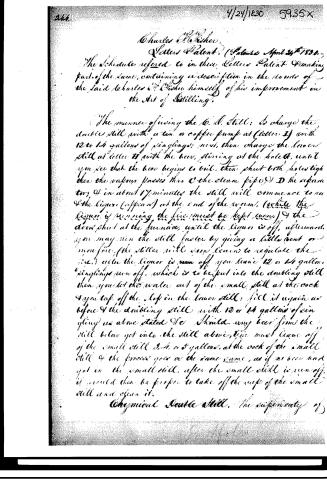
Letters Patent. (Patented April 24th 1830.)
The Schedule referred to in these Letters Patent, making part of the same, containing a description in the words of the said Charles Fisher himself of his improvement in the Art of Distilling.
The manner of using the C. A. Still: to charge the double still with a tin or copper pump as (letter A) with 12 to 14 gallons of singlings; next, then charge the lower still at letter B with the beer, stirring at the hole G, until you see that the beer begins to boil, then shut both holes tight then the vapour passes thro C the steam pipe, D the separator, & in about 17 minutes the still will commence to run & the liquor (offal) at the end of the worm, (while the liquor is running the fire must be kept even,) & the door shut at the furnace, until the liquor is off, afterward you may run the still faster by giving a little vent or more fire, (the stiller will soon learn to regulate the fire,) when the liquor is run off you leave 12 or 14 gallons singlings run off, which is to be put into the doubling still then you let the water out of the small still at the cock & you tap off the top in the lower still; fill it again as before & the doubling still with 12 or 14 gallons of singlings as above stated &c. Should any beer from the still below get into the still above, you must leave off of the small still 3, 4 or 5 gallons, at the cock of the small still & the process goes on the same same, as if no beer had got in the small still, after the small still is run off, it would then be proper to take off the cup of the small still and clean it.
Chemical Double Still. The superiority of
Page 3.
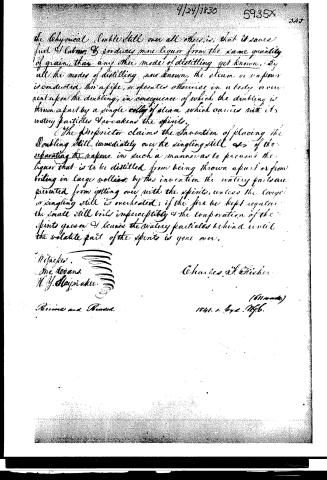
the Chemical Double Still over all others, is, that it saves fuel & labour, & produces more liquor from the same quantity of grain, than any other mode of distilling yet known. By all the modes of distilling now known, the steam or vapour is conducted through a pipe, or operates otherwise in a body or container upon the distilling, in consequence of which the distilling is thrown apart by a single volley of steam which carries with it watery particles & weakens the spirits.
The Proprietor claims the invention of placing the Double Still, immediately over the singling still & of the separating the vapour in such a manner as to prevent the liquor that is to be distilled from being thrown apart or from boiling in large vats; by this invention the watery particles are prevented from getting over with the spirits, unless the large or singling still is overheated; if the fire be kept regular the small still boils imperceptibly & the evaporation of the spirits goes on & leaves the watery particles behind until the volatile part of the spirits is gone over.
Witness.
The Deans.
H. J. Haymaker.
Charles W. Hicher
(611 words)
1841. 2. 8. 4. N.Y.
Received and Recorded
Published accounts: journal notice
Notice in the monthly list of patents, with remarks
Journal of the Franklin Institute, new ser., vol. 6 (1830), p. 14 · View the page
39. For an improvement in the Art of Distilling; Charles F. Fisher, York, York county, Pennsylvania, April 23.
Remarks. A small doubling still of the capacity of 32 gallons is placed over a common still of from 110 to 120 gallons. The vapour from the beer in the latter, ascends through a tube into the upper still, where there is a contrivance called a separator, which is perforated with small holes for the purpose of distributing the vapour in minute streams, instead of permitting it to rush up in a large volume. The patentee says that his mode of construction is superior to "all others, as it saves fuel and labour, and produces more liquor from the same quantity of grain than any other mode of distilling yet known." He claims "the invention of placing the doubling still immediately over the singling still, and of the separating of the vapour in such a manner as to prevent the liquor that is to be distilled from being thrown apart, or from boiling in large vollies."
About this record
- Patentee
- DATAMP
- Date
- the Name and Date index of patents, DATAMP, USPTO records
- Invention
- DATAMP
- Listed in
- the Name and Date index of patents, DATAMP, USPTO records, Jim Shaw's X-patent list, the Journal of the Franklin Institute, Burke's List of Patents (1847)
- The Franklin Institute's journal gives a different date.
- Burke's 1847 Patent Office list gives the same patent.