

Drawings and documents
National Archives restored drawings: drawing
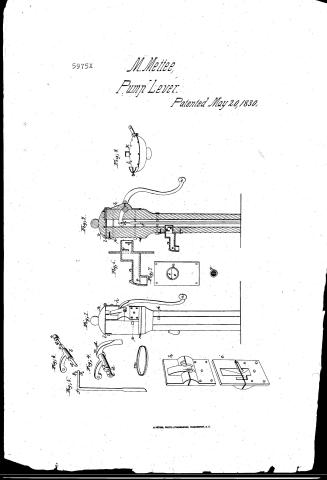
Martin Mettee's Patent Drawing for an Improvement in Pumps

National Archives, Restored Patent Drawings (Record Group 241) · Full-size scan at the National Archives · Catalog record
Show the text on the drawing Hide (174 words)
Words on the drawing as machine-read by the National Archives; not checked. Useful mainly for searching.
103. PU MPS. / [118] Brakes & Levers. / $250 / 5975-+ / Martin Mettu / Aig.3 do / Improvement in Pumps. / Sat, may 20-1830 / b. / Vol. 10 pg. 115. / Preferences a the fulorum. b the pm C i shoulder the of the pin. box inside ddthe gudgeons K. the "e steel ferruls. l the plate the hooksfthe / piston g the spring key h fulerum box fulerum ball cop / patented May 20. 1830. / Tig.5. / Sig i. Perspective view. Fig 2 section of Pump Fig. 3.4.5. see a.b.f. dig.6 section of the sport Fig.7 the spout / m the band 12 the spout 0.0 half headings p.p. square headed bolt q. circular grate in the spout. / plate seen from behind. Fig 8 = The ballcap. / Jig.1. / Tig.2. / ofigh. a. d / K. / L. / L... / d. / of / p. / Jig 6 / Jig.8. / .U / L. / K. / p- / m. / 91 / Sig.7. / o. / q. / i. / Patent office December #541 / X1 / made under the direction of the Commisioner of Patents / in conformity with act of 3? march 1837. / us Sumoth / ch.L., Aleintmam fruit / Comminisioner of Patents.
USPTO scan
The patent as scanned by the USPTO
-
 Page 1
-
 Page 2
-
 Page 3
-
 Page 4
-
 Page 5


U.S. Patent and Trademark Office · Google Patents
Show the transcription Hide (1,219 words)
Machine transcription (LightOnOCR) of the pages as scanned by the USPTO, most of them the handwritten copies made when the records were restored after the 1836 fire. Not checked; it can misread handwriting, so compare it with the scan.
Page 1.
5975X
M. Mettee,
Pump Lever.
Patented May 20, 1830.
Fig. 8.
Fig. 9.
Fig. 6.
Fig. 7.
Fig. 2.
Fig. 3.
Fig. 4.
Fig. 5.
Fig. 1.
Fig. 10.
Fig. 11.
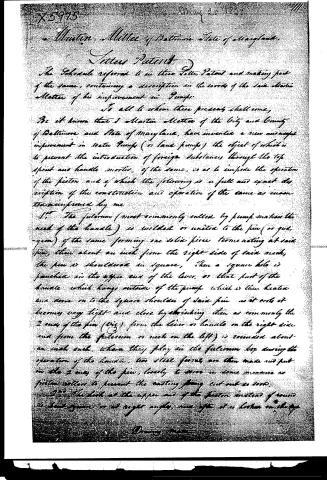
Page 2.
X5975
May 20, 1830
Martin Mettee of Baltimore State of Maryland.
Letters Patent
The Schedule referred to in these Letters Patent and making part of the same, containing a description in the words of the said Martin Mettee of his improvement in Pumps:
To all to whom these presents shall come,
Be it known that I Martin Mettee of the City and County of Baltimore and State of Maryland, have invented a new and useful improvement in water Pumps (or land pumps) the object of which is to prevent the introduction of foreign substances through the top spout and handle mortice of the same, so as to improve the operation of the piston and of which the following is a full and exact description of the construction and operation of the same as hereinbefore improved by me
1st. The fulcrum (most commonly called by pump makers the neck of the handle) is welded or united to the pin (or rod, gear) of the same forming one solid piece terminating at said pin, then about an inch from the right side of said neck, the pin is shouldered in square, then a square hole is punched in the upper end of the lever, or that part of the handle which hangs outside of the pump which is then heated and driven on to the square shoulder of said pin as it cools it becomes very tight and close by shrinking then as commonly the 2 ends of the pin (viz) from the lever or handle on the right side and from the fulcrum or neck on the left) is rounded about an inch each, where they play in the fulcrum box during the operation of the handle, two steel ferrules are then made and put on the 2 ends of the pin, loosely to serve in some measure as piston rollers to prevent the casting being cut out as soon.
2nd. The lock at the upper end of the piston instead of round is half square or at right angles, now after it is broken on the top
Drawing here
Page 3.
12. X5978
eye, a spring key is (proper) into it, so that the piston can be unhooked, without taking out the handle, it is also calculated to last longer the piston being more regular than in a round bent hole, which cuts out tolerable room.
3rd. The fulcrum box is made of cast iron (or wood if most convenient) the lower part of which from the fulcrum-pin downwards is permanently fastened to the pump by 5 square headed bolts screwed into the wood, the other half, say from the pin, upwards, is fastened to the lower part, by a joint hinge, the joint of which is thrown about one inch or more down from the centre (or that part where the two castings separate from each other) the object of which is to throw the upper castings somewhat off when opened in order to slip out the handle from the right side, or from where the pin at that end rests on the casting.
There is also a flange or cap at the right & left of the centre of the casting which completely hides the two ends of the pin as also another on the upper and lower part of said casting, which fits tolerably close around the pin, in the space between the neck and lever (or handle) the handle playing between said flange on its left and the bearing for the pin in the casting on its right the upper casting has also a projection or swell about 2½ inches wide in the centre thereof, commencing at the pin, and gradually diminishing to nothing before it quite reaches the upper end. This is to prevent the fulcrum or neck from striking against the same during the operation of the handle, the handle as may be expected hangs about two inches or more out of centre to the right side of the pump, nothing a seam of the neck, and pin which is completely enclosed in the said fulcrum box or casting which also entirely encloses the motion for the handle.
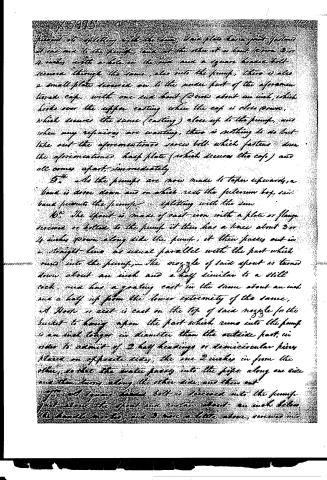
4th. The butt cap at the top of the pump, has a plate or ring, which is screwed to the upper part of the same to
Page 4.
prevent its splitting with the dam, said plate has a joint fastened at one end to the pump, and at the other it is bent (down 3 or 4 inches) with a hole in the end and a square head bolt screwed through the same, also into the pump, there is also a small plate screwed on to the under part of the aforementioned curved cap, with one end bent (down) about an inch, which hooks over the upper casting when the cap is close down, which secures the same (casting) close up to the pump, and when any repairs are wanting, there is nothing to do but take out the aforementioned screw bolt which fastens down the aforementioned back plate (which secures the cap) and all comes apart immediately.
5th. As the pumps are now made to take upwards, a band is drawn down and on which rests the fulcrum box, said band prevents the pumps splitting with the dam.
6th. The spout is made of cast-iron with a plate or flange screwed or bolted to the pump, it then has a knee about 3 or 4 inches down along side the pump, it then passes out in a straight line as usual parallel with the part which runs into the pump, the orifice of said spout is turned down about an inch and a half similar to a still cock, and has a gusset cast in the same about an inch and a half up from the lower extremity of the same, at North or east is cast on the top of said nozzle for the bucket to hang upon, the part which runs into the pump is an inch longer in diameter than the outside part, in order to admit of 2 half headings or semicircular pieces placed on opposite sides, the one 2 inches in from the other, so that the water goes into the pipe along one side and then turns along the other side, and then out.
7th. A square head bolt is screwed into the pump just above the spout and extends about an inch below the barrel, and 3 more a little above, screwed into
Page 5.
of the other angles, the object of which is to prevent also the pipes from cracking or splitting with the snow, as they frequently do. I forgot to mention that a circular grating is also put in the front at the extremity of the inner end, which runs into the pump. Perhaps I shall never have any occasion to make use of the last mentioned grating, nor yet of the aforementioned headings yet I wish to have them inserted in the Patent.
Witnesses
John Gill
James T. D. Gill
Martin Metter
12 8 0
Published accounts: journal notice
Notice in the monthly list of patents, with remarks
Journal of the Franklin Institute, new ser., vol. 6 (1830), p. 85 · View the page
30. For an improvement in Street Pumps, to prevent persons from throwing stones, or other hard articles into the same; Martin Mettee, Baltimore, Maryland, May 20.
Remarks. A patent was taken out in September last, by Mr. J. W. Hillias, of Baltimore, with the same view as the above; it is noticed at page 410, vol. iv. new series. The present patentee uses a cast iron box for the gudgeons of his pump handle to work in. The short end of the lever, which is attached to the piston rod, is not in a line with the handle, or long end, and the mortise or slot, in which the handle works, does not, therefore, pass through to the inside of the body of the pump. The nozzle is to be of cast iron, with a flanch, to attach it to the pump by means of screws; it is also to be formed with an elbow, and to have two half diaphragms, or partitions, within it, at a distance from each other, to prevent the introduction of stones, &c. There is no claim.
About this record
- Patentee
- DATAMP
- Date
- the Name and Date index of patents, DATAMP, USPTO records
- Invention
- DATAMP
- Listed in
- the Name and Date index of patents, DATAMP, USPTO records, Jim Shaw's X-patent list, the Journal of the Franklin Institute, Burke's List of Patents (1847)
- The Franklin Institute's journal spells the name differently.
- Burke's 1847 Patent Office list gives the same patent.