

Drawings and documents
National Archives restored drawings: drawing
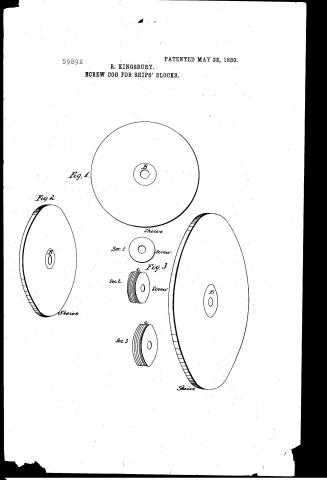
R. Kingsbury's Screw Cog for Ships Blocks

National Archives, Restored Patent Drawings (Record Group 241) · Full-size scan at the National Archives · Catalog record
Show the text on the drawing Hide (53 words)
Words on the drawing as machine-read by the National Archives; not checked. Useful mainly for searching.
64.JOUR-BOXES, PULLEYS, SHAPPING / (114) SHIPS,-CONSTRUCTION / Pullays. / Blocks & Tackle. / R. Kingstery's / Patented 22May 1830 / 5989-x / Krew Cog for Ships Blocks. / Fig1 / Wooden Shews / metal / Shéive / See.1 / Fig 2 / Serew / Fig3 / See.2 / OIR / Screw / Sheive / See.3 / Sheive / Phyry
National Archives restored drawings: drawing
R. Kingsbury's Patent Drawing for a Screw Cog for Ship's Blocks

National Archives, Restored Patent Drawings (Record Group 241) · Full-size scan at the National Archives · Catalog record
Show the text on the drawing Hide (53 words)
Words on the drawing as machine-read by the National Archives; not checked. Useful mainly for searching.
64.JOUR-BOXES, PULLEYS, SHAPPING / (114) SHIPS,-CONSTRUCTION / Pullays. / Blocks & Tackle. / R. Kingstery's / Patented 22May 1830 / 5989-x / Krew Cog for Ships Blocks. / Fig1 / Wooden Shews / metal / Shéive / See.1 / Fig 2 / Serew / Fig3 / See.2 / OIR / Screw / Sheive / See.3 / Sheive / Phyry
USPTO scan
The patent as scanned by the USPTO
-
 Page 1
-
 Page 2
-
 Page 3
-
 Page 4


U.S. Patent and Trademark Office · Google Patents
Show the transcription Hide (967 words)
Machine transcription (LightOnOCR) of the pages as scanned by the USPTO, most of them the handwritten copies made when the records were restored after the 1836 fire. Not checked; it can misread handwriting, so compare it with the scan.
Page 1.
5989X
PATENTED MAY 22, 1830.
R. KINGSBURY.
SCREW COG FOR SHIPS' BLOCKS.
Fig. 1.
Fig. 2.
Sheive
Sec. 1
Screw
Fig. 3
Sec. 2.
Screw
Sec. 3
Sheive
Page 2.
Wm. Kingsbury of Bath, State of Maine
Letters Patent.
The schedule referred to in these Letters Patent and making part of the same containing a description in the words of the said Wm. Kingsbury himself of his improvement, being a screw cog or bush for cogging shives in ships blocks and for other purposes.
To all to whom these presents shall come,
Be it known, that I Wm. Kingsbury of Bath in the County of Lincoln and State of Maine, have invented a new and useful improvement—being a screw cog or bush for cogging shives in ships blocks and other similar articles and the application of the screw to such cogs or bushes, for the purpose of fitting the same and that the following is a full and exact description of the construction, and fitting and operation of said Machine as invented or improved by me.
The cog or bush is a cylinder, and its length is equal to the thickness of the shive, or thing to be cogged or bushed, and whose diameter is one sixteenth of an inch or there about longer than the diameter of the hole to be cogged or bushed. On the outside of the cog or bush, is cast or cut a screw by which the cog or bush is drawn into the shive, or thing to be cogged, and which fastens the cog to the shive, or in other words the cog or bush invented by me, is a screw whose length is equal to the thickness of the thing to be cogged, and of such size as to screw firmly into the hole of the shive or thing to be cogged and the invention consists principally in the application of the screw to cogs for shives of ships blocks, but the same may be applied to cogs or bushes for other things. The invention is more particularly described in the drawing hereto annexed, in which Fig. 2, and the 3, represent the screw cog.
Page 3.
X5989
invented by me. Fig 1. Fig 2. Fig 3. are shins B.B.D. are screw cogs fitted to the shins, screwed into them in the manner of my invention C.C. are screws or the thread of a screw, cut or cut on the rim of the cog, and which draw the cog into the hole of the shin. The screw cog or bush is intended generally to be used for engaging shins of ship blocks of all kinds, and other similar articles that run on iron pins or journals; and can be made of iron or composition, either by casting or working and cutting. It differs from the common cog or bush in this, that it has no plate, and does not require rivetting to the shin. The common cog is sunk the thickness of the plate into the shin, and the plate being about one third of the circumference of the shin and about a third of its thickness out in a triangular form is rivetted through the shin at the angle. The method of letting the plate cog into lignum vitae, is difficult; the wood being hard, it is almost impossible to let them in tight, they soon wear loose and become useless. The plate being let in on one side of the shin tends to cant the shin on the shell of the block, as the strain comes on one side of the shin; the shin is necessarily cut so thin to receive the plate that the rivets have but little support, they often crack the shin and render it useless or become loose, and a shin once cugged in this way cannot again be cugged. The following are some of the advantages of the screw cog, or bush, as invented by me. It has no plate to weaken the shin, it requires no rivetting but can be screwed into the hole of the lignum vitae shin, the hole being bored about one eighteenth of an inch smaller than the cog, the thread of the screw cutting into the shin so that they become perfectly firm & tight and stationary and will not wear loose. The screw cog can be made with as little expense as the common plate cog, and can be fitted to the shin with much less expense. It may be screwed into
Page 4.
X5989
into the shive with a square steel scanner, now in common use for scanning out iron cogs. The screw cog can be applied to all the shives in all the blocks of the ship, whereas the plate cog can only be applied to shives of the larger size; it may also be applied to shives whose pin holes have been worn so large as to be unfit for use, and to such as have had their pin holes worn oblong and thus become useless. But the principal advantage of the screw cog is the saving of expense. It can be fitted to the shive for less than one fourth part of the expense of fitting the plate cog.
What I claim as new and as my own invention or discovery in the above described Machine, and for which I ask an exclusive privilege, is the screw cog or bush for shives and other articles, and the application of the screw to the cog or bush for fitting the same to shives and other articles.
Witnesses
Elisha Plentler
Joseph Sewall
Abby Hingeberg
Ex. 3
ClyW.
948 m7
Published accounts: journal notice
Notice in the monthly list of patents, with remarks
Journal of the Franklin Institute, new ser., vol. 6 (1830), p. 150 · View the page
44. For a new mode of Cogging or Bushing Sheeves for Ships' Blocks, and for other purposes; Rhodes Kingsbury, Bath, Lincoln county, Maine, May 22.
Remarks. The bushes, or cogs of sheeves, are usually made of iron, with a triangular plate, or flanch, on one side, which is to be let into the sheeve, and rivetted through at each of the corners. The mode now patented is to make the bush, or cog, cylindrical on the outside, to cast or cut a screw upon it, and to screw it into the sheeve, where it will remain firmly fixed, without the letting in of a plate, the insertion of rivets, or any other fastening than the screw. The patentee states that the whole strength of the sheeve is thus preserved, the danger of becoming loose obviated, and three-fourths of the labour of fixing, saved. The claim is to the application of a screw in the manner, and for the purposes, above designated.
About this record
- Patentee
- DATAMP
- Date
- the Name and Date index of patents, DATAMP, USPTO records
- Invention
- DATAMP
- Listed in
- the Name and Date index of patents, DATAMP, USPTO records, Jim Shaw's X-patent list, the Journal of the Franklin Institute, Burke's List of Patents (1847)
- Burke's 1847 Patent Office list gives the same patent.