

Drawings and documents
National Archives restored drawings: drawing
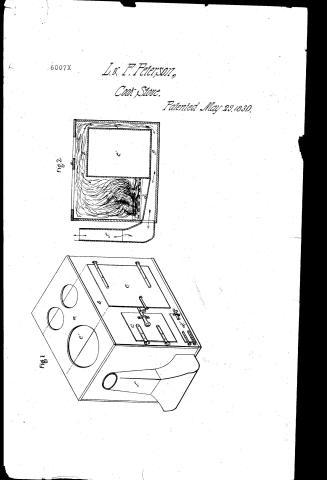
Lewis Peterson and Peter Peterson's Patent Drawing for a Cooking Stove

National Archives, Restored Patent Drawings (Record Group 241) · Full-size scan at the National Archives · Catalog record
Show the text on the drawing Hide (113 words)
Words on the drawing as machine-read by the National Archives; not checked. Useful mainly for searching.
126. STOVES & FURNACES / $2- / [154] Cooking Stoves. / Luvis Petersons. Peter Peterson / Va.10 pg 535 / Patented May 29. 1830. / CLASSIFICATION / Cooking Stove. / 6007-4 / DIVISION / Section / Tig. / Preferencis. / e' / a the topplate with 3 opening for boilers Jig.i. / b. the front side. / b. / C door to the fireplace see Jig .2. Section / d ashpit d'the ashpit door. / e the door of the oven. e' the oven / f the pipe. / g ..g.g. the flue. / colo / Patent office December thism / made under the direction of the Commissioner of Patents / in conformity with act of 3ᵈ march 1837 / H.L / charl.L. Meischmann del. / Commitioner of Patents
USPTO scan
The patent as scanned by the USPTO
-
 Page 1
-
 Page 2
-
 Page 3


U.S. Patent and Trademark Office · Google Patents
Show the transcription Hide (548 words)
Machine transcription (LightOnOCR) of the pages as scanned by the USPTO, most of them the handwritten copies made when the records were restored after the 1836 fire. Not checked; it can misread handwriting, so compare it with the scan.
Page 1.
6007X
L. & F. Peterson,
Cook Stove.
Patented May 29, 1830.
Fig. 2.
Fig. 1.
Page 2.
May 29, 1836
Lewis Peterson & Peter Peterson
Letters Patent, dated 29 May 1836
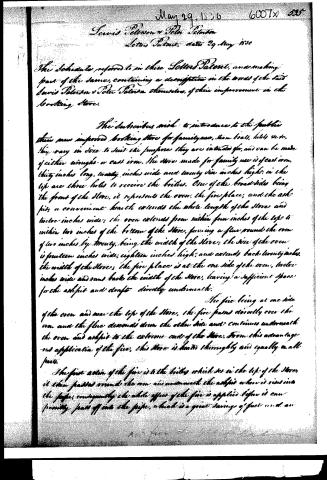
The Schedule, referred to in these Letters Patent, and making part of the same, containing a description in the words of the said Lewis Peterson & Peter Peterson themselves, of their improvement in the Cooking Stove.
The subscribers wish to introduce to the public their new improved cooking stove for family use, steam boats, hotels &c &c. They vary in size to suit the purposes they are intended for, and can be made of either wrought or cast iron. The stove made for family use is of cast iron, thirty inches long, twenty inches wide and twenty six inches high; in the top are three holes to receive the boilers. One of the broad sides being the front of the stove, it represents the oven, the fire place, and the ash pit; a convenient hearth extends the whole length of the stove and twelve inches wide; the oven extends from within four inches of the top to within two inches of the bottom of the stove, forming a fine round the oven of two inches by twenty, being the width of the stove; the size of the oven is fourteen inches wide, eighteen inches high; and extends back twenty inches, the width of the stove; the fire place is at the one side of the oven, twelve inches wide and runs back the width of the stove, leaving a sufficient space for the ash pit and draft directly underneath.
The fire being at one side of the oven and near the top of the stove, the fire passes directly over the oven and the flue descends down the other side and continues underneath the oven and ash pit to the extreme end of the stove. From this advantageous application of the fire, this stove is heated thoroughly and equally on all parts.
The first action of the fire is to the boilers which are in the top of the stove; it then passes around the oven and underneath the ash pit where it rises into the flue; consequently the whole effect of the fire is applied before it can possibly pass off into the flue, which is a great saving of fuel and an
Page 3.
536
5/29/1830 6007x
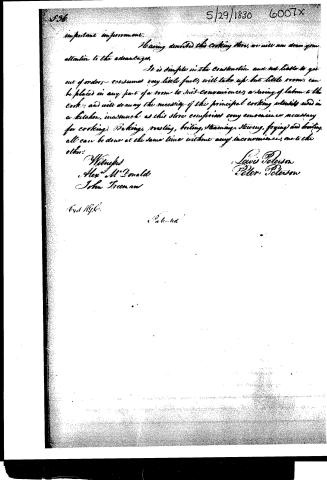
important improvement.
Having described this cooking stove, we will now draw your attention to the advantages.
It is simple in the construction and not liable to get out of orders—consumes very little fuel, will take up but little room, can be placed in any part of a room to suit convenience, a saving of labor to the cook; and will do away the necessity of the principal cooking utensils used in a kitchen, inasmuch as this stove comprises every convenience necessary for cooking. Baking, roasting, boiling, steaming, stewing, frying and broiling, all can be done at the same time without any inconvenience, one to the other.
Witnesses
Alex McDonald
John Freeman
Lewis Peterson
Peter Peterson
4th May 6.
Patented
Published accounts: journal notice
Notice in the monthly list of patents, with remarks
Journal of the Franklin Institute, new ser., vol. 6 (1830), p. 156 · View the page
61. For a Cooking Stove; Lewis Peterson and Peter Peterson, Pittsburgh, Allegheny county, Pennsylvania, May 29.
Remarks. The stove described is to be made of cast or sheet iron. In the front is the door of the oven, and that for the fire-place. The oven extends from top to bottom, and from back to front, with the exception of the spaces left for the flue. The fire-place is on one side of the oven, and the flame and heated air from it are to pass round the other three sides; the flame first rises, and passes over the oven, and under the top plate, then down between the oven and one of the end plates; then under the oven and fire-place, and up at the other end of the stove to the pipe, or chimney. The top plate has three perforations to receive cooking vessels. There is no claim made, but the advantages presented by this stove are particularly detailed. The patentees say that " it is simple in the construction, and not liable to get out of order; consumes very little fuel; will take up but very little room; can be placed in any part of a room to suit convenience; a saving of labour to the cook; and will do away the necessity of the principal cooking utensils used in a kitchen, inasmuch as this stove comprises every convenience necessary for cooking. Baking, roasting, boiling, steaming, stewing, frying, and broiling, all can be done at the same time, without any inconvenience one to the other."
About this record
- Patentee
- DATAMP
- Date
- the Name and Date index of patents, DATAMP, USPTO records
- Invention
- DATAMP
- Listed in
- the Name and Date index of patents, DATAMP, USPTO records, Jim Shaw's X-patent list, the Journal of the Franklin Institute, Burke's List of Patents (1847)
- Burke's 1847 Patent Office list gives the same patent.