

Drawings and documents
USPTO scan
The patent as scanned by the USPTO
-
 Page 1
-
 Page 2
-
 Page 3


U.S. Patent and Trademark Office · Google Patents
Show the transcription Hide (772 words)
Machine transcription (LightOnOCR) of the pages as scanned by the USPTO, most of them the handwritten copies made when the records were restored after the 1836 fire. Not checked; it can misread handwriting, so compare it with the scan.
Page 2.
United States Patent
Patent No.: X6029
Henry B. Williams, Baltimore City, Maryland
Letters Patent
Date June 11, 1890.
The Schedule referred to in these Letters Patent and making part of the same containing a description in the words of the said Henry B. Williams himself of his Improvement in Gasometers.
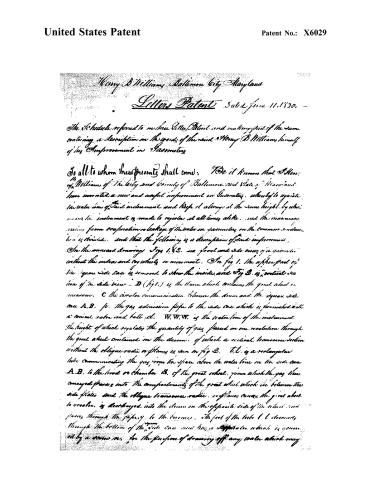
To all to whom these presents shall come: To be it known that I Henry B. Williams of the City and County of Baltimore and State of Maryland have invented a new and useful improvement in Gasometers, whereby to equalize the volume of said instrument and keep it always at the same height, by which means the instrument is made to regulate at all times alike, and the inaccuracies arising from evaporation or leakage of the water in gasometers on the common and usual plan is avoided. And that the following is a description of said improvement.
In the annexed drawings Figs 1 & 2 are front and side views of a gasometer without the index and regulating instrument. In Fig 1, the upper part of the square side case is removed to show the inside, and Fig 2 is a sectional view of the side view — D (Fig 1) is the drum which contains the great wheel or measure. C the circular communication between the drum and the square side case A.B. F. the gas admission pipe to the side case which is furnished with a conical valve and ball. Cl. W.W.W. is the water line of the instrument, the height of which regulates the quantity of gas passed in one revolution through the great wheel contained in the drum, of which a vertical transverse section without the oblique radii or planes is seen in Fig 2. T.T. is a rectangular tube communicating the gas from the space above the water line in the side case A.B. to the hood or chamber S. of the great wheel, from which the gas then conveyed passes into the compartments of the great wheel which lie between the side plates and the oblique transverse radii or planes causes the great wheel to rotate, is discharged into the drum on the opposite side of the wheel and passes through the pipe y. to the bottom. The foot of the tube T.T. descends through the bottom of the side case and has a trap or collector which is opened by a screw M. for the purpose of draining off any water which may
Page 3.
United States Patent
Patent No.: X6029
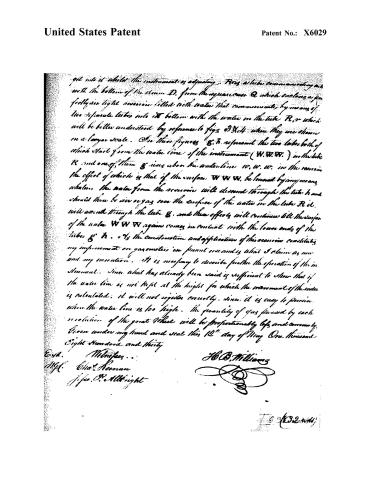
get into it whilst the instrument is adjusting. Pass a tube communicating with the bottom of the cistern D, from the aqueous case Q which encloses a perfectly air tight reservoir filled with water that communicates by means of two separate tubes into its bottom with the water in the tube R, or which will be better understood by reference to figs 3 & 4, when they are shown on a larger scale. On these figures 8 & 7 represent the two tubes both of which start from the water line of the instrument (W.W.W.) in the tube R and one of them 8 rises above the waterline W.W.W. in the reservoir the effect of which is that if the surface W.W.W. be lowered by any means whatever the water from the reservoir will descend through the tube R and should there be air or gas over the surface of the water in the tube R it will ascend through the tube 8, and these effects will continue till the surface of the water W.W.W. again comes in contact with the lower ends of the tubes 8 & 7. As the construction and application of this reservoir constitutes my improvement on gasometers I am present in and by what I claim as new and my invention. It is necessary to describe further the operation of the instrument. Since what has already been said is sufficient to show that if the water line is not kept at the height for which the movement of the index is calculated, it will not register correctly. Since it is easy to perceive when the water line is too high. The quantity of gas passed by each revolution of the great wheel will be proportionally less and consequently given under my hand and seal this 12th day of May One thousand Eight Hundred and thirty
Eph. Minifex...
Mg. O. P. Altright
J. B. Williams
Published accounts: journal notice
Notice in the monthly list of patents, with remarks
Journal of the Franklin Institute, new ser., vol. 6 (1830), p. 224 · View the page
We have seen an expert sawyer cut eight cords of wood in a day; now we apprehend that the machine described would not effect this with the aid of two men, after it had been hauled to the place of its destination. We greatly err, or the patentee will find that he has expended more thought, labour, and money, on the present scheme, than its returns will justify. 17. For an improvement in Gasometers, [Gas Meters;] Henry B. Williams, Baltimore, Maryland, June 11.
Remarks. Instead of a gasometer, as the instrument is called in the specification, the patent is taken for an improvement in the gas meter. The former is a large reservoir, or vessel, for containing the gas at the works, the latter a small instrument placed in a house, to measure and register the number of cubic feet of gas burned. In the machine generally used, this is done by causing the gas, as it passes through the instrument, to turn a small tin water wheel, which gives motion to a train of wheels, terminating in an index on a dial plate. From leakage, or evaporation, the quantity of water in the instrument is liable to vary, when its indications become inaccurate. The improvement now patented is intended to remove this difficulty, by causing the water always to stand at the same height, which is to be effected by placing a reservoir to supply any waste which may occur.
About this record
- Patentee
- DATAMP
- Date
- the Name and Date index of patents, DATAMP, USPTO records
- Invention
- DATAMP
- Listed in
- the Name and Date index of patents, DATAMP, USPTO records, Jim Shaw's X-patent list, the Journal of the Franklin Institute, Burke's List of Patents (1847)
- Burke's 1847 Patent Office list gives the same patent.