

Drawings and documents
USPTO scan
The patent as scanned by the USPTO
-
 Page 1
-
 Page 2
-
 Page 3
-
 Page 4
-
 Page 5
-
 Page 6
-
 Page 7
-
 Page 8
-
 Page 9
-
 Page 10
-
 Page 11
-
 Page 12
-
 Page 13
-
 Page 14
-
 Page 15
-
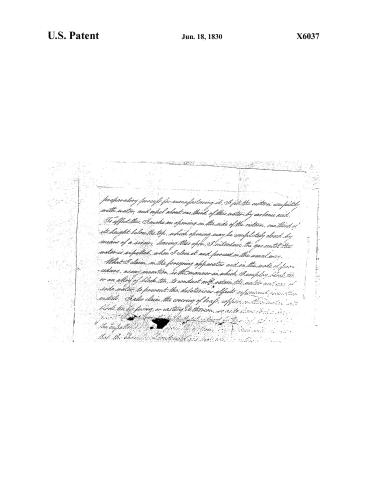 Page 16
-
 Page 17
-
 Page 18
-
 Page 19
-
 Page 20
-
 Page 21


U.S. Patent and Trademark Office · Google Patents
Show the transcription Hide (3,945 words)
Machine transcription (LightOnOCR) of the pages as scanned by the USPTO, most of them the handwritten copies made when the records were restored after the 1836 fire. Not checked; it can misread handwriting, so compare it with the scan.
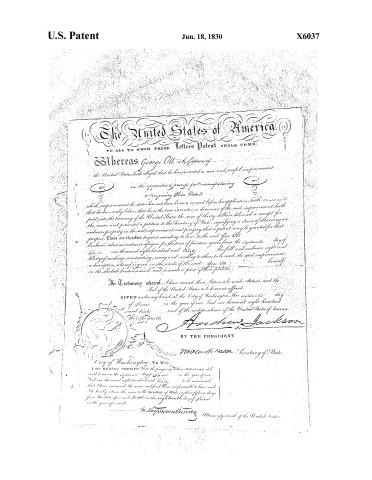
Page 2.
U.S. Patent Jun. 18, 1830 X6037
The United States of America
TO ALL TO WHOM THESE Letters Patent SHALL COME:
Whereas George Ott, A Citizen of the United States hath alleged that he has invented a new and useful improvement in the apparatus or process for manufacturing or preparing Soda Vats, which improvement he states has not been known or used before his application, hath also certified that he does really believe that he is the true inventor or discoverer of the said improvement, hath paid into the treasury of the United States the sum of thirty dollars, delivered a receipt for the same, and presented a petition to the Secretary of State, signifying a desire of obtaining an exclusive property in the said improvement, and praying that a patent may be granted for that purpose. These are therefore to grant, according to law, to the said Geo. Ott his heirs, administrators or assigns, for the term of fourteen years, from the eighteenth day of June one thousand eight hundred and thirty, the full and exclusive right and liberty of making, constructing, using and vending to others to be used, the said improvement, a description whereof is given in the words of the said Geo. Ott himself, in the schedule hereto annexed, and is made a part of these presents.
In Testimony whereof, I have caused these Letters to be made Patent, and the Seal of the United States to be hereunto affixed.
GIVEN under my hand, at the City of Washington, this eighteenth day of June in the year of our Lord one thousand eight hundred and thirty and of the Independence of the United States of America the fifty fourth.
Andrew Jackson
BY THE PRESIDENT.
Wm. O. St. Clair
Secretary of State.
City of Washington, To W. H.
I DO HEREBY CERTIFY, That the foregoing Letters Patent were delivered to me on the eighteenth day of June in the year of our Lord one thousand eight hundred and thirty to be committed; that I have examined the same, and find them conformable to law, and do hereby return the same to the Secretary of State, within fifteen days from the date of the same, to wit, on this eighteenth day of June in the year of our Lord.
M. M. M. M. M. M. M. M. …
Page 3.
U.S. Patent
Jun. 18, 1830
X6037
The United States of America
TO ALL TO WHOM THESE Letters Patent SHALL COME:
Whereas George Ott, A Citizen of the United States, hath alleged that he has invented a new and useful improvement in the apparatus or process for manufacturing or preparing Soda Water, which improvement he states has not been known or used before his application, hath that he does really believe that he is the true inventor or discoverer of the said improvement, hath paid into the treasury of the United States the sum of thirty dollars, delivered a receipt for the same, and presented a petition to the Secretary of State, signifying a desire of obtaining an exclusive property in the said improvement, and praying that a patent may be granted for that purpose. These are therefore to grant, according to law, to the said Geo. Ott his heirs, administrators or assigns, for the term of fourteen years, from the sixteenth day of June, one thousand eight hundred and thirty, the full and exclusive right and liberty of making, constructing, using and vending to others to be used, the said improvement, a description whereof is given in the words of the said Geo. Ott, hereof in the schedule hereto annexed, and is made a part of these presents.
In Testimony whereof, We have caused these Letters to be made Patent...
Page 4.
U.S. Patent Jun. 18, 1830 X6037
Given one thousand eight hundred and thirty
the privilege of making, constructing, using and vending to others, to be used, the said improvement; a description whereof is given in the words of the said Spec. On himself, on the schedule hereto annexed, and is made a part of these presents.
In Testimony whereof, I have caused these Letters to be made Patent, and the Seal of the United States to be hereunto affixed.
GIVEN under my hand, at the City of Washington, this eighteenth day of June, in the year of our Lord one thousand eight hundred and thirty, and of the Independence of the United States of America the fifty-fourth.
Andrew Jackson
BY THE PRESIDENT.
Wm. L. Marcy
Secretary of State.
City of Washington, To Wm.
I DO HEREBY CERTIFY, That the foregoing Letters Patent were delivered to me on the eighteenth day of June, in the year of our Lord one thousand eight hundred and thirty, to be commenced, that I have examined the same, and find them conformable to law, and do hereby return the same to the Secretary of State, within fifteen days from the date aforesaid, to wit, on this eighteenth day of June, in the year aforesaid.
Wm. M. P. B. B. B.
Attorney General of the United States.
Page 5.
U.S. Patent
Jun. 18, 1830
X6037
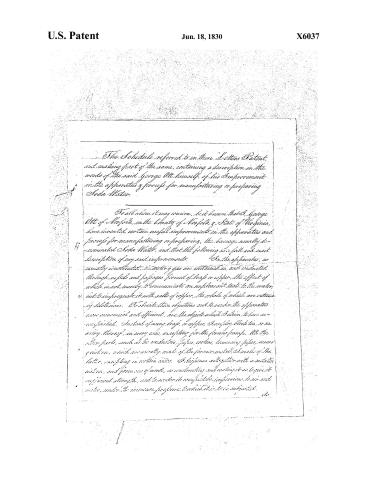
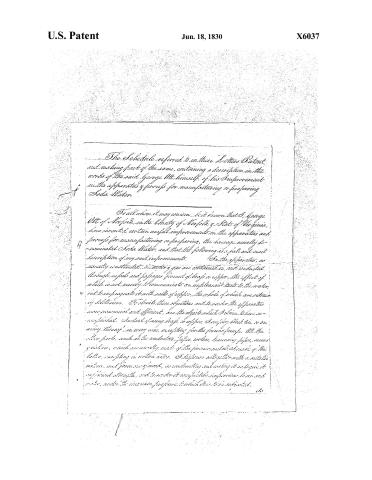
The Schedule referred to in these Letters Patent, and making part of the same, containing a description in the words of the said George Ott himself, of his Improvement in the apparatus & process for manufacturing or preparing Soda Water.
To all whom it may concern, be it known that I, George Ott of Norfolk, in the County of Norfolk & State of Virginia, have invented certain useful improvements in the apparatus and process for manufacturing or preparing, the beverage usually denominated Soda Water, and that the following is a full and exact description of my said improvements.
In the apparatus, as usually constructed, the water & gas are contained in, and conducted through vessels and passages formed of brass or copper, the effect of which is not merely to communicate an unpleasant taste to the water, but to impregnate it with salts of copper, the whole of which are extremely deleterious. To obviate these objections and to render the apparatus more economical and efficient, are the objects which I claim to have accomplished. Instead of using brass, or copper, I employ block tin, or an alloy thereof, in every case, excepting for the force pump. All the other parts, such as the conduits, pipes, coolers, traversing pipes, valves & cistern, which are usually made of the former metal, I make of the latter, excepting in certain cases. I dispense altogether with a metallic cistern, and form one of wood, in constructing and coating it so as to give it sufficient strength, and to render it completely impervious to air and water, under the immense pressure to which it is to be subjected.
Page 6.
U.S. Patent
Jun. 18, 1830
X6037
The Schedule referred to in these Letters Patent, and making part of the same, containing a description in the words of the said George Utt himself, of his Improvement in the apparatus & process for manufacturing or preparing Soda Water.
To all whom it may concern, be it known that I, George Utt of Norfolk, in the County of Norfolk & State of Virginia, have invented certain useful improvements in the apparatus and process for manufacturing or preparing, the beverage usually denominated Soda Water, and that the following is a full and exact description of my said improvements.
In the apparatus, as usually constructed, the water & gas are contained in, and conducted through vessels and passages formed of brass or copper, the effect of which is not merely to communicate an unpleasant taste to the water, but to impregnate it with salts of copper, the whole of which are extremely deleterious. To obviate these objections and to render the apparatus more economical and efficient, are the objects which I claim to have accomplished. Instead of using brass, or copper, I employ block tin, or an alloy thereof, in every case, excepting for the force pump. All the other parts, such as the conductors, pipes, coolers, traversing pipes, valves & cistern, which are usually made of the former metals, I make of the latter, excepting in certain cases. I dispense altogether with a metallic cistern, and form one of wood, so constructing and coating it as to give it sufficient strength, and to render it completely impervious to air and water, under the immense pressure to which it is to be subjected.
16
Page 7.
U.S. Patent
Jun. 18, 1830
X6037
The Schedule referred to in these Letters Patent, and making part of the same, containing a description in the words of the said George Ott himself, of his Improvement in the apparatus & process for manufacturing or preparing Soda Water.
To all whom it may concern, be it known that I, George Ott of Norfolk, in the County of Norfolk & State of Virginia, have invented certain useful improvements in the apparatus and process for manufacturing or preparing, the beverage usually denominated Soda Water, and that the following is a full and exact description of my said improvements.
The apparatus, as usually constructed, the carbonic gas are contained in, and conducted through, vessels and passages formed of brass or copper, the effect of which is not merely to communicate an unpleasant taste to the water, but to impregnate it with salts of copper, the whole of which
Page 8.
U.S. Patent
Jun. 18, 1830
X6037
process for manufacturing or preparing, the beverage usually denominated Soda Water, and that the following is a full and exact description of my said improvements. On the apparatus, as usually constructed, the water & gas are contained in, and conducted through vessels and passages formed of brass or copper, the effect of which is not merely to communicate an unpleasant taste to the water, but to impregnate it with salts of copper, the whole of which are extremely deleterious. To obviate these objections and to render the apparatus more economical and efficient, are the objects which I claim to have accomplished. Instead of using brass, or copper, I employ, block tin, or an alloy thereof, in every case, excepting for the forcing pump. All the other parts, such as the conductors, pipes, coolers, traversing pipes, &c., &c., &c., which are usually made of the former metals, I make of the latter, excepting in certain cases. I dispense altogether with a metallic cistern, and form one of wood, so constructing and coating it as to give it sufficient strength, and to render it completely impervious to air and water, under the immense pressure to which it is to be subjected.
Page 9.
U.S. Patent Jun. 18, 1830 X6037
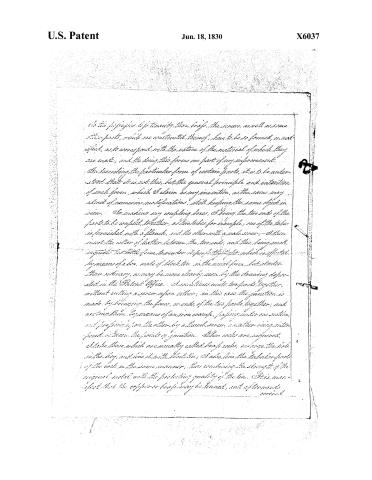
is tin for superior durability than brass. the screws, as well as some other parts, which are constructed thereof, have to be so formed, or modified, as to correspond with the nature of the material of which they are made; and the doing this forms one part of my improvement.
In describing the particular form of certain parts, it is to be understood that it is not this, but the general principle and intention of such form, which I claim as my invention, as the same may admit of numerous modifications, still keeping the same object in view. In making my coupling boxes, I bring the two ends of the parts to be coupled together, as two tubes for example; one of the tubes is furnished with a flanch, and the other with a male screw;—I then insert the collar of leather between the two ends, and this, being small, requires but little force to render it perfectly tight, which is effected by means of a box, made of block tin, in the usual form, but stouter than ordinary, as may be more clearly seen by the drawing deposited in the Patent Office. I sometimes unite two parts together, without cutting a screw upon either; in this case the junction is made by bringing the faces, or ends, of the two parts together; and uniting them by means of an iron cramp, passing under one section, and passing upon the other by a thumb screw, a weather being interposed between the points of junction. When cocks are required, I take those which are usually called brass cocks, enlarge the hole in the key, and line it with block tin; I also line the tubular parts of the cocks in the same manner, thus combining the strength of the original metal with the protecting quality of the tin. It is manifest that the copper or brass may be turned, and afterwards covered
Page 10.
U.S. Patent
Jun. 18, 1830
X6037
U.S. tin for the less tenacity than brass, the screws, as well as some other parts, which are constructed thereof, have to be so formed, or modified, as to correspond with the nature of the material of which they are made; and the doing this forms one part of my improvement.
In describing the particular form of certain parts, it is to be understood that it is not this, but the general principle and intention of such form, which I claim as my invention, as the same may admit of numerous modifications, still keeping the same object in view.
In making my coupling boxes, I bring the two ends of the parts to be coupled, together, as two tubes for example; one of the tubes is furnished with a flange, and the other with a male screw; and then insert the collar of leather between the two ends, and this being done, requires but little force to render it perfectly tight, which is effected by means of a box, made of block tin, in the usual form, but which, than ordinary, may be more clearly seen in the drawings.
Page 11.
U.S. Patent
Jun. 18, 1830
X6037
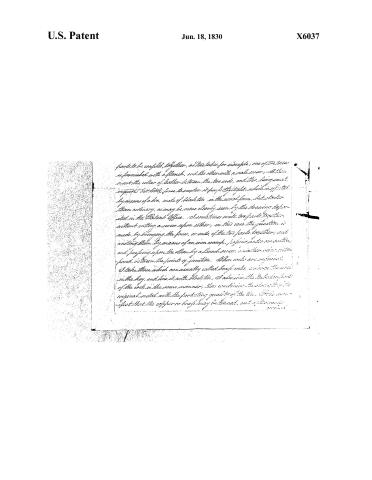
parts to be coupled together, as two tubes for example; one of the tubes is furnished with a flange, and the other with a male screw;—I then insert the collar of leather between the two ends, and this, being small, requires but little force to render it firm, to the tight, which is effected by means of a box, made of block tin, in the usual form, but stouter than ordinary, as may be more clearly seen by the drawings deposited in the Patent Office. I sometimes unite two parts together, without cutting a screw upon either; in this case, the junction is made by bringing the faces, or ends, of the two parts together; and uniting them by means of an iron cramp, superior under one section, and pressing upon the other by a thumb screw, a leather being interposed between the points of junction. When cocks are required, I take those which are usually called brass cocks, and line the inside in the key, and line it with block tin; I also line the tubular part of the cock in the same manner; thus combining the advantages of the original metal with the protecting qualities of the tin. It is manifest that the copper or brass may be retained, and a permanent
Page 12.
U.S. Patent
Jun. 18, 1830
X6037
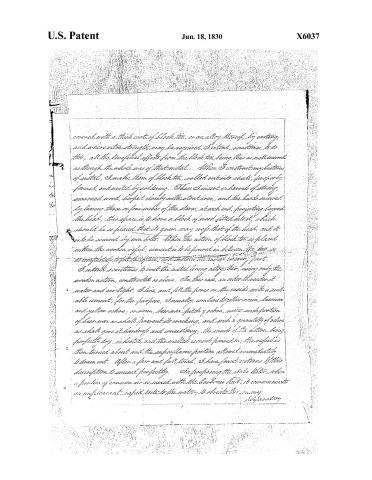
covered with a thick coat of block tin, or an alloy thereof, by casting, and where extra strength may be required, I intend, sometimes, to do this; all the beneficial effects from the block tin being thus as well secured as though the whole was of that metal. When I construct my cisterns of metal, I make them of block tin, rolled out into sheets, properly formed, and united by soldering. These I insert in barrels of strong, seasoned wood, hooped closely with stout iron, and the heads secured by leaving three or four inches of the staves, at each end, projecting beyond the head; this space is to have a block of wood fitted into it, which should be so placed that its grain may cross that of the head, and it is to be secured by iron bolts. When the cistern of block tin is placed within the wooden vessel, cement is to be poured in between the two as completely to fill the space, and sustain the metal in every part.
I intend sometimes to omit the metal lining altogether, using only the wooden cistern, constructed as above. In this case, in order to render it water and air-tight, I line, and fill the pores on the inside with a suitable cement; for the purpose, I usually combine together resin, beeswax and yellow ochre, or resin, beeswax, pitch & ochre, using such portion of beeswax as shall prevent its cracking, and such a quantity of ochre as shall give it hardness and consistency; the inside of the cistern being perfectly dry, is heated, and the melted cement poured in; the vessel is then turned about and the superfluous portion allowed immediately to drain out. After a fair and full trial, I have found cisterns of this description to succeed perfectly. In preparing the Sile Water, when a portion of common air is mixed with the carbonic acid, it communicates an unpleasant, acrid taste to the water, to obviate this, in my
[signature]
Page 13.
U.S. Patent
Jun. 18, 1830
X6037
coated with a thick coat of block tin, or an alloy thereof, by casting, and where entire strength may be required, I intend, sometimes, to do this; all the beneficial effects from the block tin being thus as well secured as though the whole was of that metal. When I construct my bisters of metal, I make them of block tin, rolled out into sheets, properly formed, and united by soldering. These I insert in barrels of strong seasoned wood, lashed closely with stout iron, and the heads secured by leaving three or four inches of the staves, at each end, projecting beyond the head; this space is to have a block of wood fitted into it, which should be so placed that its grain may cross that of the head, and it is to be secured by iron bolts. When the interior of block tin is placed within the wooden vessel, cement is to be poured in between the two, so as completely to fill the space, and saturate the metal in every part. I intend sometimes to omit the metal lining altogether, using only the wooden interior...
Page 14.
U.S. Patent
Jun. 18, 1830
X6037
...cement is to be poured in between the two, so as to fill the space, and to fill the space in every part.
I intend sometimes to omit the metal lining altogether, using only the metal cylinder, constructed as above. In this case, in order to render it water-tight, I line, and fill the pores on the inside with a suitable cement, for the purpose. I usually combine together rosin, beeswax, and yellow ochre, or resin, beeswax, pitch & ochre, using such portion of beeswax as shall prevent its cracking, and such a quantity of ochre as shall give it hardness and consistency, the inside of the cylinder being perfectly dry, is heated, and the melted cement poured in, the vessel is then turned about and the superfluous portion allowed immediately to drain out. After a fair and full trial, I have found waters of this description to succeed perfectly. In preparing the Soda Water, when a portion of common air is mixed with the carbonic acid, it communicates an unpleasant, acrid taste to the water; to obviate this, in my
J. G. Partridge
Page 15.
U.S. Patent
Jun. 18, 1830
X6037
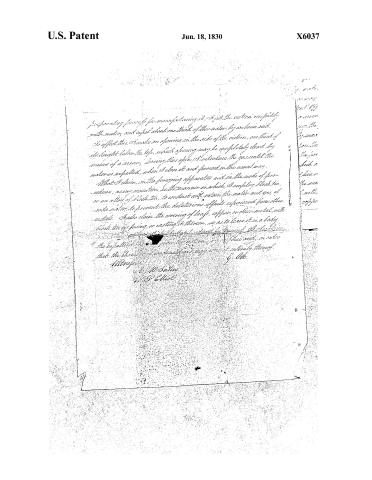
preparatory process for manufacturing it, to fill the cistern completely with water, and expel about one third of this water by carbonic acid.
To effect this, I make an opening in the side of the cistern, one third of its height below the top, which opening may be completely closed by means of a screen; having this open, I introduce the gas until the water is expelled, when I close it and proceed in the usual way.
What I claim, in the foregoing apparatus and in the mode of procedure, as my invention, is the manner in which I employ block tin, or an alloy of block tin, to conduct and retain the water and gas, of soda water, to prevent the deleterious effects experienced from other metals. I also claim the covering of brass, copper, or other metal, with block tin by fusing, or casting it thereon, so as to leave it in a body.
Witnesses:
J. W. Sinton
W. P. Elliot
Page 16.
U.S. Patent
Jun. 18, 1830
X6037
preparatory process for manufacturing it, I fill the cistern completely with water, and expel about one third of this water by carbonic acid. To effect this, I make an opening in the side of the cistern, one third of its height below the top, which opening may be completely closed by means of a screw, leaving this open, I introduce the gas until the water is expelled, when I close it and proceed in the usual way. What I claim, in the foregoing apparatus and in the mode of procedure, as my invention, is the manner in which I employ block tin or an alloy of block tin, to conduct and retain the water and soda water to prevent the deleterious effects experienced from other metals. I also claim the covering of brass, copper, or other metals with block tin by fusing, or casting it thereon, so as to have it in the form of a coating, and that the chlorine is employed in the same manner as before described.
Page 17.
U.S. Patent
Jun. 18, 1830
X6037
Page 18.
U.S. Patent
Jun. 18, 1830
X6037
- cedure, as any invention, is the manner in which or an alloy of black tin, to conduct and return to soda water, to prevent the deleterious effects metals. I also claim the covering of brags, coffee black tin by fusing, or casting it thereon, so as to the expulsion from the action, that the chamber of condensed gas may be Nitrogen.
L. W. Sutter
W. P. Elliot
Page 19.
U.S. Patent
Jun. 18, 1830
X6037
...as my invention is the manner in which I employ block tin, alloy of block tin, to conduct and retain the water and gas, of water, to prevent the deleterious effects experienced from other...
...I also claim the covering of brass, copper, or other metal, with tin by fusing, or casting it thereon, so as to leave it in a body...
...I also claim...
...the chamber of condensed gas may consist entirely thereof.
Witnesses:
J. M. Smithe
W. P. Elliot
J. Ott.
Page 20.
U.S. Patent
Jun. 18, 1830
X6037
or an alloy of black tin, to conduct with soda water to prevent the deleterious metals. I also claim the covering of brass black tin by fusing, or casting it thereon, the expulsion of the air from the interior, that the chamber of condensed gas may
Witnesses
H. M. Sutcliffe
W. P. Elliott
Page 21.
U.S. Patent
Jun. 18, 1830
X6037
water is expelled, when I close it and proceed in the usual way.
What I claim, in the foregoing apparatus and in the mode of procedure, as my invention, is the manner in which I employ black tin, or an alloy of black tin, to conduct and retain the water and gas, of soda water, to prevent the deleterious effects experienced from other metals. I also claim the covering of brass, copper, or other metal, with black tin by fusing, or casting it thereon, so as to leave it in a body
Witnesses:
J. B. McEntire
W. P. Elliott
G. Att.
Published accounts: journal notice
Notice in the monthly list of patents, with remarks
Journal of the Franklin Institute, new ser., vol. 6 (1830), p. 227 · View the page
26. For improvements in the apparatus, and in the process for Manufacturing or Preparing Soda Water; George Ott, Norfolk, Norfolk county, Virginia, June 18.
Remarks. The claim of the patentee will exhibit the nature of the improvements for which this patent is obtained. "What I claim in the foregoing apparatus, and in the mode of procedure, as my invention, is the manner in which I employ block tin, or an alloy of block tin, to conduct and retain the water, and gas, of soda water, to prevent the deleterious effects experienced from other metals. I also claim the covering of brass, copper, or other metal, with block tin, by fusing, or casting it thereon, so as to leave it in a body greatly exceeding in thickness that produced by tinning. I also claim the expelling of water from the cistern, by carbonic acid, in order that the chamber of condensed gas may consist entirely thereof." The cistern for containing the soda water is to be made of block tin rolled out, and soldered together; this is to be enclosed in a vessel of wood, strongly hooped, and the heads confined by bolts of iron; the interval between the metal lining and the wood, is to be filled with cement. Sometimes the cisterns are to be made entirely of wood, strongly bound, and lined with an impervious cement. In all cases the connecting pipes, &c. are to be of block tin.
DATAMP: illustration
Illustrations from DATAMP

DATAMP (Directory of American Tool and Machinery Patents), via the Internet Archive · Archived DATAMP page
About this record
- Patentee
- DATAMP
- Date
- the Name and Date index of patents, DATAMP, USPTO records
- Invention
- DATAMP
- Listed in
- the Name and Date index of patents, DATAMP, USPTO records, Jim Shaw's X-patent list, the Journal of the Franklin Institute, Burke's List of Patents (1847)
- Burke's 1847 Patent Office list gives the same patent.