

Drawings and documents
National Archives restored drawings: drawing
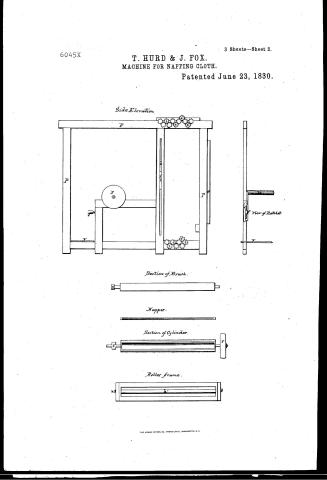
Thomas Hurd and Jesse Fox's Patent Drawing for a Machine for Napping Cloth


National Archives, Restored Patent Drawings (Record Group 241) · Full-size scan at the National Archives · Catalog record
Show the text on the drawing Hide (60 words)
Words on the drawing as machine-read by the National Archives; not checked. Useful mainly for searching.
Sheet 1. 26. CLOTH. / [37] Napping / sayso / 6045-X / Thomas Hourd & S / Machine for naping Cloth. / Patented: 23 June: : 1830. / OIR
Sheet 2. Plan / 6045-+ / Side Elevation / End Eleration / Ip 0 / Scale 3/4 inch to a foot
Sheet 3. 6045-7 60 / 1+1 / Hand / Side Elevation. / Setion of Brush. / Napper. / Section ofCylinder. / ViewofRatchet. / Roller frame. / u!
USPTO scan
The patent as scanned by the USPTO
-
 Page 1
-
 Page 2
-
 Page 3
-
 Page 4
-
 Page 5
-
 Page 6
-
 Page 7
-
 Page 8
-
 Page 9
-
 Page 10
-
 Page 11
-
 Page 12
-
 Page 13
-
 Page 14


U.S. Patent and Trademark Office · Google Patents
Show the transcription Hide (4,488 words)
Machine transcription (LightOnOCR) of the pages as scanned by the USPTO, most of them the handwritten copies made when the records were restored after the 1836 fire. Not checked; it can misread handwriting, so compare it with the scan.
Page 1.
6045X
T. HURD & J. FOX.
MACHINE FOR NAPPING CLOTH.
Patented June 23, 1830.
3 Sheets—Sheet 1.
THE NORRIS PETERS CO., PHOTO-LITHO., WASHINGTON, D. C.
Page 2.
6045X
T. HURD & J. FOX.
MACHINE FOR NAPPING CLOTH.
Patented June 23, 1830.
3 Sheets—Sheet 2.
Side Elevation

Section of Brush.

Napper.

Section of Cylinder.

Roller frame.

THE NORRIS PETERS CO., PHOTO-LITHO., WASHINGTON, D. C.
Page 3.
6045X
T. HURD & J. FOX. 3 Sheets—Sheet 3.
MACHINE FOR NAPPING CLOTH.
Patented June 23, 1830.
End Elevation
Side Elevation
THE NORRIS PETERS CO., PHOTO-LITHO., WASHINGTON, D. C.
Page 4.
X6045 June 29, 1820 119
Thomas Hound & Jesse Fox, Citizens of Letters Patent.
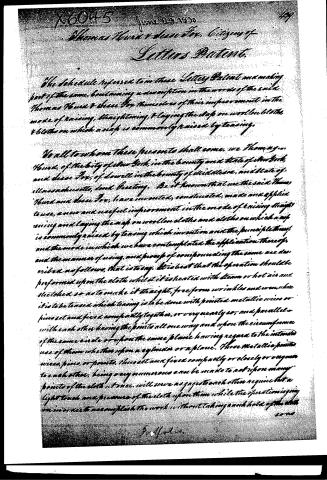
The schedule referred to in these Letters Patent on making part of the same, containing a description in the words of the said Thomas Hound & Jesse Fox themselves of their improvement in the mode of raising, straightening, & laying the nap on woollen cloths, & cloths on which a nap is commonly raised by teasing.
To all to whom these presents shall come, we Thomas Hound, of the city of New York, in the county and state of New York, and Jesse Fox, of Lowell in the county of Middlesex, and state of Massachusetts, and Greeting. Be it known that we the said Thomas Hound and Jesse Fox, have invented, constructed, made and applied to use, a new and useful improvement in the mode of raising straightening and laying the nap on woollen cloths and cloths on which a nap is commonly raised by teasing which invention and the principle thereof and the mode in which we have contemplated the application thereof, and the manner of using, and proof of compounding the same are described as follows, that is to say, It is best that the operation should be performed upon the cloth whilst it is heated with steam or hot air and stretched so as to make it straight, free from wrinkles and even where it is to be teased which teasing is to be done with pointed metallic wires or pins set and fixed compactly together, or very nearly so, and parallel with each other having the points all one way and upon the circumference of the same circle or upon the same plane having regard to the intended use of them whether upon a cylinder or a plane. These metallic points wires pins, or points, thus set and fixed compactly or closely or very near to each other, being very numerous can be made to act upon many points of the cloth at once, will wear as great stretch others require but a light touch and pressure of the cloth upon them while the operation is going on in order to accomplish the work without taking a mark hole of the cloth
J. H. Ains.
Page 5.
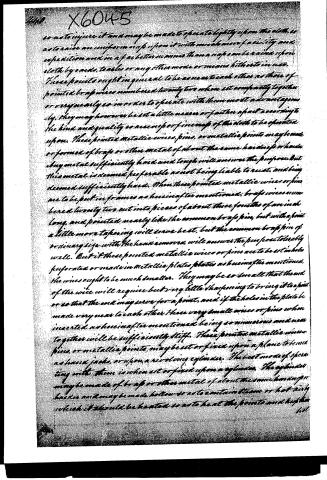
so as to injure it and maybe made to operate lightly upon the cloth, or act as an uniform sharp upon it with much more facility and expedition and in a far better manner than a nap can be raised upon cloth by naps, teals or any other mode or means hitherto in use. These points ought in general to be as near to each other as those of pointed brass wires numbered twenty two when set compactly together or very nearly so in order to operate with them most advantageously, they may however be set a little nearer or farther apart according to the kind and quality or essence or fineness of the cloth to be operated upon. These pointed metallic wires, pins, or metallic points may be made or formed of brass or other metal of about the same hardness or hardness metal sufficiently hard and tough will answer the purpose. But this metal is deemed preferable as not being liable to rust, and being deemed sufficiently hard. When these pointed metallic wires or pins are to be put in frames as hereinafter mentioned, brass wires numbered twenty two cut into pieces of about three fourths of an inch long, and pointed nearly like the common brass pins, but with a point a little more tapering will serve best, but the common brass pin of ordinary size with the head removed will answer the purpose tolerably well. But if these pointed metallic wires or pins are to be set in holes perforated or made in metallic plates plates as hereinafter mentioned, the wires ought to be much smaller. They may be so small that the end of the wire will require but very little sharpening to bring it to a point or so that the end may serve for a point, and if the holes in the plate be made very near to each other these very small wires or pins when inserted as hereinafter mentioned being so numerous and near together will be sufficiently stiff. These pointed metallic wires or pins, or metallic points may be set or fixed upon a plane to be used as hand jacks, or upon a revolving cylinder. The best mode of operating with them is when set or fixed upon a cylinder. The cylinder may be made of brass or other metal of about the same hardness or hardness and may be made hollow so as to contain steam or hot air by which it should be heated so as to heat the points and keep them
Page 6.
X6045
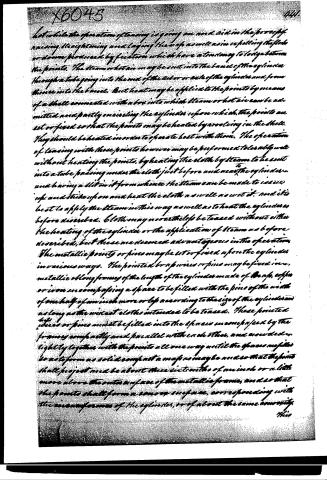
that while the operation of teasing is going on and aid in the process of raising, straightening and laying the nap as well as in expelling the flake or down produced by friction which have a tendency to lodge between the points. The steam or hot air may be sent into the base of the cylinder through a tube going into the end of the tub or side of the cylinder and from thence into the base. But heat may be applied to the points by means of a shell connected with a box into which steam or hot air can be admitted and partly encircling the cylinder upon which the points are set or fixed so that the points may be heated by revolving in the shell. They should be heated in order to operate best with them. The operation of teasing with these points however may be performed tolerably well without heating the points, by heating the cloth by steam to be sent into a tube passing under the cloth just before and near the cylinder, and having a slit in it from whence the steam can be made to issue up and strike upon and heat the cloth as well as wet it. And it is best to apply the steam in this way as well as to heat the cylinder as before described. Cloth may nevertheless be teased without either the heating of the cylinder or the application of steam as before described, but these are deemed advantageous in the operation.
The metallic points or pins may be set or fixed upon the cylinder in various ways. The pointed brass wires or pins may be fixed in a metallic oblong frames of the length of the cylinder made of brass, copper or iron encompassing a space to be filled with the pins of the width of one half of an inch more or less according to the size of the cylinder and as long as the widest cloths intended to be teased. These pointed wires or pins must be filled into the spaces encompassed by the frames compactly and parallel with each other, and wound or tightly together with the points all one way until the spaces are filled so as to form as solid compact a mass as may be and so that the points shall project and be about three sixteenths of an inch or a little more above the outer surface of the metallic frames, and so that the points shall form a convex surface, corresponding with the inner circumference of the cylinder, or of about the same amount.
This
Page 7.
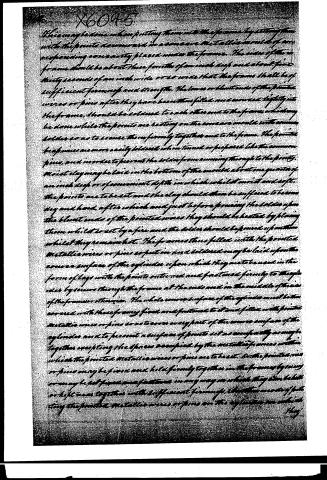
This may be done when putting them into the furnace by setting them with the points downward in a conical metallic mould of an expanding concavity placed under the furnace. The sides of the mould frame should be about three fourths of an inch deep and about four thirty seconds of an inch wide or so wide that the frame shall be of sufficient firmness and strength. The blunt ends of the pointed wires or pins after they have been thus filled and covered tightly into the frame, should be soldered to each other and to the frame which may be done while the points are resting on the conical mould with common solder so as to secure them firmly together and to the frame. The pointed brass wires are more easily soldered when turned or prepared like the common pins, and in order to prevent the solder from running through to the points, moist clay may be laid in the bottom of the mould about one quarter of an inch deep or of a convenient depth in which whilst moist and soft, the points are to be set and the clay should then be suffered to become dry and hard, after which and just before pouring the solder upon the blunt ends of the pointed wires they should be heated by placing them whilst so set by a fire and the solder should be poured upon them whilst they remain hot. The frames thus filled with the pointed metallic wires or pins so put in and soldered may be laid upon the conical surface of the cylinder upon which they are to be used in the form of lugs with the points outward and fastened firmly to the cylinder by screws through the frame at the ends and in the middle of the sides of the frames or otherwise. The whole conical surface of the cylinder must then covered with these framing frames and fastened to it and filled with pointed metallic wires or pins so as to cover every part of the conical surface of the cylinder and to present a surface of points set as compactly as may be together excepting the spaces occupied by the metallic frames within which the pointed metallic wires or pins are to be set. So the pointed wires or pins may be fixed and held firmly together in the frames by wires or may be set upon some fixture in any way in which they are held or kept near together with sufficient firmness. The other mode of fastening the pointed metallic wires or pins on the cylinder on which they
Page 8.
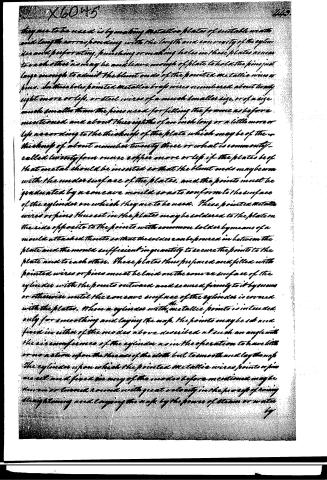
they are to be used is by making metallic plates of suitable width and length corresponding with the length and convexity of the cylinders and perforating, punching or making holes in these plates so as to each other as may be and leave enough of plate to hold the pins just large enough to admit the blunt ends of the pointed metallic wires or pins. But the holes pointed metallic wires or pins numbered about thirty eight more or less, or steel wires of a much smaller size, or of a size much smaller than the pins used for filling the frame as before mentioned and about three eighths of an inch long or a little more or less according to the thickness of the plate which may be of the thickness of about number twenty three or what is commonly called twenty four ounce copper more or less if the plates be of that metal should be inserted so that the blunt ends may be even with the under surface of the plates, and the points must be graduated by a concave mould so as to conform to the surface of the cylinders on which they are to be used. These pointed metallic wires or pins thus set in the plates may be soldered to the plates on the side opposite to the points with common solder by means of a mould attached thereto so that the solder can be poured in between the plate and the mould sufficient in quantity to secure the points to the plate and to each other. These plates thus prepared and filled with pointed wires or pins must be laid on the convex surface of the cylinders with the points outward and secured firmly to it by screws or otherwise until the concave surface of the cylinders is covered with the plates. When a cylinder with metallic points is intended only for smoothing and laying the nap, the points may be set and fixed in either of the modes above described at such an angle with the circumference of the cylinder as in the operation to have little or no action upon the threads of the cloth but to smooth and lay the nap the cylinder upon which the pointed metallic wires, points or pins are set and fixed in any of the modes before mentioned may be driven or turned round with great velocity in the process of napping, straightening and laying the nap, by the power of steam or water.
Page 9.
by connecting the cylinder which is to be fixed in a frame with let to a drum, and the cloth while passing over the cylinder should be made to touch the points lightly and its pressure upon the points may be graduated by a roller near the cylinder over which it passes connected with ratchets so that the roller may be raised or lowered as an occasion may require. The cloth may be stretched upon rollers in any of the various modes now in use while it is made to pass over the cylinder. When the pointed metallic wires are to be used upon a plane as hand jacks or otherwise they may be set in either of the modes above mentioned excepting that the points in this case ought to be even with each other or in the same plane. When the operation is to be performed by points set or made upon a cylinder a revolving cylinder brush having a motion contrary to the cylinder containing the points, should be so fixed as to be in contact with the points on that cylinder in order to assist in clearing the flacks or down from between the points. Ker sinners and cloths of a similar kind may be stretched and made to pass over the cylinder in the following manner. The two ends of the cloth in the process of teasing should be sewed or connected together and the cloth should be made to pass alternately over and under revolving rollers fixed in a frame sufficient in number to take up the whole of the cloth so that no part of it may hang loose and so that it may pass over the cylinder in which the points are and that the surface on which a nap is to be raised straightened and laid may be made to touch the points lightly as it passes over the cylinder. And one of the revolving rollers next to the cylinder should be so fixed in a movable frame set in grooves that by means of handles and ratchets before mentioned the frame may be raised or lowered and with it the roller set in it so as to let the surface of the cloth to be teased down upon the points, or raise it and generate the action or friction of the points upon the cloth at the discretion of the operator. The cloth, during the operation of raising straightening and laying the nap should be stretched and kept stretched.
Page 10.
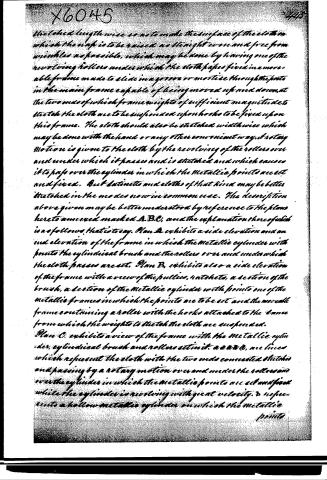
stretched lengthwise so as to make the surface of the cloth on which the nap is to be raised as straight even and free from wrinkles as possible, which may be done by having one of the revolving rollers under which the cloth passes fixed in a movable frame made to slide in a groove or mortise through the posts in the main frame capable of being moved up and down at the two ends of which frame weights of sufficient magnitude to stretch the cloth are to be suspended upon hooks to be fixed upon this frame. The cloth should also be stretched widthwise which may be done with the hand or any other convenient way. A rotary motion is given to the cloth by the revolving of the rollers over and under which it passes and is stretched and which causes it to pass over the cylinder in which the metallic points are set and fixed. But batistis and cloths of that kind may be better stretched in the modes now in common use. The description above given may be better understood by reference to the plans hereto annexed marked A, B, C, and the explanation thereof which is as follows, that is to say. Plan A exhibits a side elevation and an end elevation of the frame in which the metallic cylinder with points the cylindrical brush and the rollers over and under which the cloth passes are set. Plan B, exhibits also a side elevation of the frame with a view of the pulleys, hatches, a section of the brush, a section of the metallic cylinder with points one of the metallic frames in which the points are to be set and the movable frame containing a roller with the hooks attached to the frame from which the weights to stretch the cloth are suspended. Plan C, exhibits a view of the frame with the metallic cylinder, cylindrical brush and rollers set in it. a a a a, are lines which represent the cloth with the two ends connected stretched and passing by a rotary motion over and under the rollers and over the cylinder in which the metallic points are set and fixed while the cylinder is revolving with great velocity. b represents a hollow metallic cylinder on which the metallic points
Page 11.
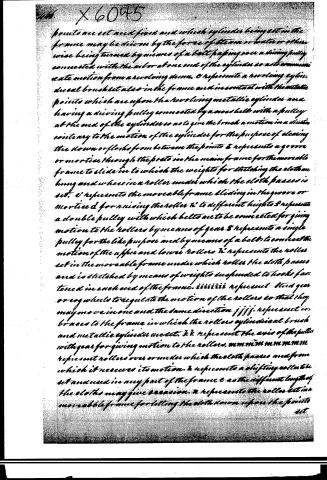
points are set and fixed and which cylinders being set in the frame may be driven by the force of steam or water or otherwise being turned by means of a belt passing over a driving pulley connected with the motor at one end of the cylinders so as to communicate motion from a revolving drum. O represents a revolving cylindrical brush set also in the frame and in contact with the metallic points which are upon the revolving metallic cylinders and having a driving pulley connected by a cross belt with a pulley at the end of the cylinders so as to give the brush a motion in a direction contrary to the motion of the cylinders for the purpose of cleaning the drum or flocks from between the points. S represents a groove or mortice through the posts in the main frame for the movable frame to slide in to which the weights for stretching the cloth are hung and where in a roller under which the cloth passes is set. C represents the movable frame sliding in the groove or mortice and for raising the rollers R to different heights. R represents a double pulley with which belts are to be connected for giving motion to the rollers by means of gears. S represents a single pulley for the like purpose and by means of a belt to connect the motion of the upper and lower rollers. R represents the rollers set in the movable frame under which roller the cloth passes and is stretched by means of weights suspended to hooks fastened in each end of the frame. iiiiiiiii represents fixed gear or cog wheels to regulate the motion of the rollers so that they may move in one and the same direction. jjjjj represents braces to the frame in which the rollers cylindrical brush and metallic cylinders are set. K represents the axis of the pulleys with gear for giving motion to the rollers. mmmmmmmmmmm represents rollers over or under which the cloth passes and from which it receives its motion. A represents a shifting roller to be set and used in any part of the frame as the different lengths of the cloths may give occasion. R represents the rollers set in movable frame for letting the cloth down upon the points set.
Page 12.
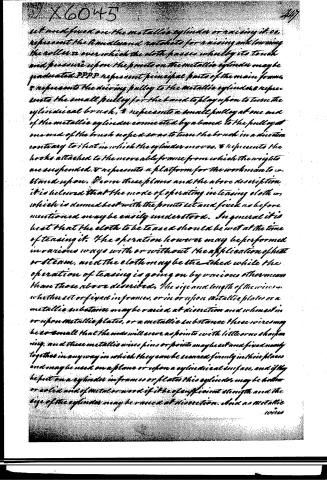
set and fixed on the metallic cylinder or raising it, or, represent the handle and ratchet for raising and lowering the roller, or over which the cloth passes whereby its touch and pressure upon the points on the metallic cylinder may be graduated. PPPP represent principal parts of the main frame, r represents the driving pulley to the metallic cylinder, s represents the small pulley for the band to play upon to turn the cylindrical brush, t represents a small pulley at one end of the metallic cylinder connected by a band to the pulley at one end of the brush so as to turn the brush in a direction contrary to that in which the cylinder moves. u represents the hooks attached to the moveable frame from which the weights are suspended. v represents a platform for the workman to stand upon. From these plans and the above description it is believed that the mode of operating in teasing cloth, which is deemed best with the points set and fixed as before mentioned may be easily understood. In general it is best that the cloth to be teased should be wet at the time of teasing it. The operation however may be performed in various ways with or without the application of heat or steam, and the cloth may be thus teased while the operation of teasing is going on by various other means than those above described. The size and length of the wires, whether set or fixed in frames, or in or upon metallic plates or a metallic substance may be varied at discretion and when set in or upon metallic plates, or a metallic substance these wires may be so small that the ends will serve as points with little or no sharpening, and these metallic wires pins or points may be set and fixed nearly together in any way in which they can be secured firmly in their places and may be used on a plane or upon a cylindrical surface, and if they be put on a cylinder in frames or plates this cylinder may be hollow or solid and of metal or wood if it be of sufficient strength and the size of the cylinder may be varied at discretion. And as metallic
Page 13.
448. X6045
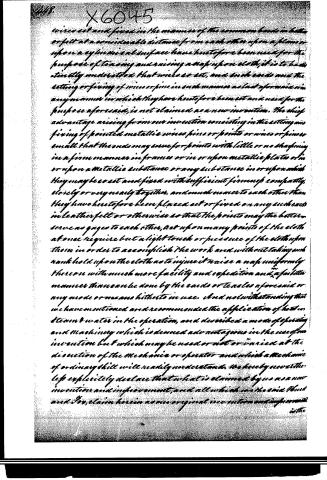
wires set and fixed in the manner of the common hand in leather or felt at a considerable distance from each other upon a plane or upon a cylindrical surface have heretofore been used for the purpose of tensing and raising a nap upon cloth, it is to be distinctly understood that wires or set, and such cords and the setting or fixing of wires or pins in such manner as last aforesaid in any manner in which they have heretofore been set and used for the purpose aforesaid, is not claimed as a new invention. The chief advantage arising from our invention consisting in the setting and fixing of pointed metallic wires pins or points or wires or pins so small that the ends may serve for points with little or no sharpening in a firm manner in frames or in or upon metallic plates or in or upon a metallic substance or any substance in or upon which they may be cast and fixed with sufficient firmness compactly, closely or very nearly together, and much nearer to each other than they have heretofore been placed set or fixed on any such cords in leather felt or otherwise so that the points may the better serve as gages to each other, set upon many points of the cloth at once require but a light touch or pressure of the cloth upon them in order to accomplish the work and without taking such rank hold upon the cloth as to injure it raise a nap uniformly thereon with much more facility and expedition and a far better manner than can be done by the cords or tenacles aforesaid or any mode or means hitherto in use. And notwithstanding that we have mentioned and recommended the application of heat or steam & water in the operation, and described a mode of operating and machinery which is deemed advantageous in the use of our invention but which may be used or not or varied at the discretion of the mechanic or operator and which a mechanic of ordinary skill will readily understand, we hereby nevertheless explicitly declare that what is claimed by us as a new invention and improvement, and all which we the said Hunt and Fox, claim herein as our original invention and improvement is the
Page 14.
X6045
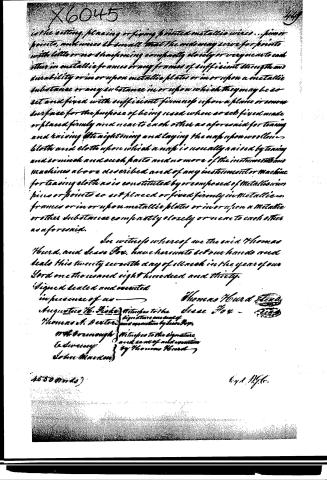
is the setting, placing or fixing pointed metallic wires... pins or points, and wires so small that the end may serve for points with little or no sharpening compactly closely or very near to each other in metallic frames or any frames of sufficient strength and durability or in or upon metallic plates or in or upon a metallic substance or any substance in or upon which they may be so set and fixed with sufficient firmness upon a plane or smooth surface for the purpose of being used when so set fixed made or placed firmly and near to each other as aforesaid for tearing and raising straightening and laying the nap upon woollen cloth and cloth upon which a nap is usually raised by tearing and so much and such parts and no more of the instruments and machines above described and of any instrument or machine for tearing cloth as is constituted by or composed of metallic wires pins or points so set placed or fixed firmly in metallic frames or in or upon metallic plates or in or upon a metallic or other substance compactly closely or near to each other as aforesaid.
In witness whereof we the said Thomas Hurd, and Jesse Fox, have hereunto set our hands and seals this twenty seventh day of March in the year of our Lord one thousand eight hundred and thirty.
Signed, sealed and executed
in presence of us —
Augustus H. Hoke
Thomas A. Dexter
W.H. Brownough
E. Dewey
John Marlow
Thomas Hurd
Jesse Fox
Witnesses to the signature and seal of
Thomas Hurd
by Jesse Fox
Witnesses to the signature and seal of
Thomas Hurd
by Thomas Hurd
4650 words
6 yd. 11/16.
Published accounts: journal notice
Notice in the monthly list of patents, with remarks
Journal of the Franklin Institute, new ser., vol. 6 (1830), p. 230 · View the page
"What I claim as my invention is the mode of pressing, and the follower, as before described; likewise the revolving grinding machine, with the knives attached to them." 34. For an improvement in the mode of Raising, Straightening, and Laying the Nap upon Woollen Cloths, and cloths upon which a nap is commonly raised by teasing. Thomas Hurd, City of New York, and Jesse Fox, Lowell, Middlesex county, Massachusetts, June 23.
Remarks. The machinery for which this patent is taken, is described at great length, and represented in a number of different drawings. The main object of the patentees will be seen by the annexed quotation, which comprises the concluding part of the specification. "And as metallic wires are set and fixed, in the manner of the common cards, in leather, or felt, at a considerable distance from each other, upon a plane, or upon a cylindrical surface, have heretofore been used for the purpose of teasing and raising a nap upon cloth, it is to be distinctly understood that wires so set, and such cards, and the setting or fixing of wires, or pins, in such manner as last aforesaid, or in any manner in which they have heretofore been set and used for the purpose aforesaid, is not claimed as a new invention; the chief advantage arising from our invention consisting in the setting and fixing of pointed metallic wires, pins, or points, or wires or pins so small that the ends may serve for points with little or no sharpening, in a firm manner in frames, or in or upon metallic plates, or in or upon a metallic substance, or any substance in or upon which they may be set, and fixed with sufficient firmness, comparatively closely, or very nearly together, and much nearer to each other than they have heretofore been placed, set or fixed, in any such cards, leather, felt, or otherwise, so that the points may the better serve as gauges to each other, act upon many points of the cloth at once, require but a light touch, or pressure of the cloth upon them in order to accomplish the work, and without taking such rank hold upon the cloth as to injure it, raise a nap uniformly thereon, with much more facility and expedition, and in a far better manner than can be done by the cards or teazles aforesaid, or any mode or means hitherto in usor And notwithstanding that we have mentioned and recommended the application of heat, steam, and water, in the operation, and described a mode of operating, and machinery which is deemed advantageous in the use of our inventions, but which may be used or not, or varied at the discretion of the mechanic or operator, and which a mechanic of ordinary skill will readily understand, we hereby nevertheless explicitly declare that what is claimed by us as a new invention and improvement, and all which we the said Hurd and Fox claim herein, as our original invention and improvement, is the setting, placing pointed metallic wires, pins, or points, and wires so small that the ends may serve for points with little or no sharpening," &c. &c. The remainder is a formal repetition of what we have given above, and need not, therefore, be copied.
About this record
- Patentee
- DATAMP
- Date
- the Name and Date index of patents, DATAMP, USPTO records
- Invention
- DATAMP
- Listed in
- the Name and Date index of patents, DATAMP, USPTO records, Jim Shaw's X-patent list, the Journal of the Franklin Institute, Burke's List of Patents (1847)
- Burke's 1847 Patent Office list gives the same patent.