

Drawings and documents
National Archives restored drawings: drawing
John Goulding's Patent Drawing for Making and Using Looms

National Archives, Restored Patent Drawings (Record Group 241) · Full-size scan at the National Archives · Catalog record
Show the text on the drawing Hide (42 words)
Words on the drawing as machine-read by the National Archives; not checked. Useful mainly for searching.
X3- / John Goulding making Using Pooms / Satented / Go 61-+ / N°4 / Tm / Ic / El / T' / Do / Cuffied Copies from drawing attached to the Patent / March 23. 1844 As
USPTO scan
The patent as scanned by the USPTO
-
 Page 1
-
 Page 2
-
 Page 3
-
 Page 4
-
 Page 5
-
 Page 6


U.S. Patent and Trademark Office · Google Patents
Show the transcription Hide (1,437 words)
Machine transcription (LightOnOCR) of the pages as scanned by the USPTO, most of them the handwritten copies made when the records were restored after the 1836 fire. Not checked; it can misread handwriting, so compare it with the scan.
Page 1.
6061X
J. Goulding.
Loom.
Patented Jul. 7, 1830.
No. 4.

Page 2.
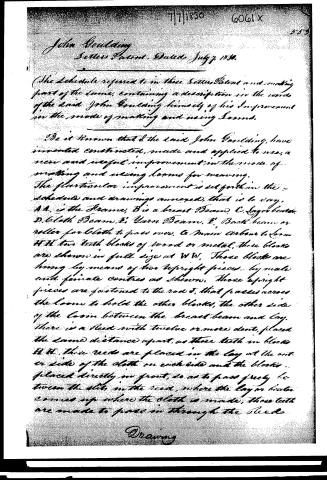
John Goulding
Letters Patent. Dated, July 7, 1830.
(The Schedule referred to in these Letters Patent and making part of the same, containing a description in the words of the said John Goulding himself of his Improvement in the mode of making and using Looms.)
Be it known that I the said John Goulding, have invented constructed, made and applied to use, a new and useful improvement in the mode of making and using Looms for weaving. The particular improvement is set forth in the schedule and drawings annexed, that is to say, A A. is the Frame, B is a breast Beam, C. Laying beater, D. Cloth Beam, E. Yarn Beam, F. Back beam or roller for cloth to pass over, G. Main Arbour to form H H two teeth blocks of wood or metal, these blocks are shown in full size at W W. These blocks are hung by means of two upright pieces by male and female centres as shown. These upright pieces are fastened to the rod S, that passes across the Loom to hold the other blocks, the other side of the Loom between the breast beam and lay. There is a Reed with twelve or more dents, placed the same distance apart, as those teeth in blocks H H. These reeds are placed in the lay at the outer side of the cloth on each side and the blocks placed directly in front, so as to pass freely between the slits in the reed, where the lay or beater comes up where the cloth is made. These teeth are made to pass in through the Reeds.
Drawing
Page 3.
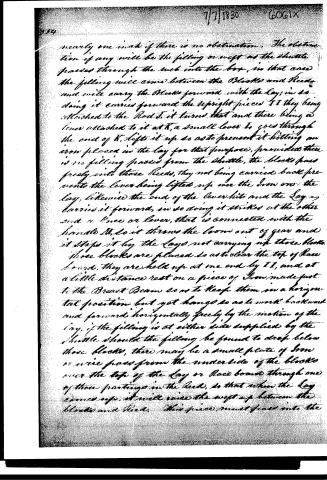
nearly one inch if there is no obstruction. The obstruction if any will be the filling or woft as the shuttle passes through the web into the box, in that case the filling will come between the Blocks and Reeds and will carry the Blocks forward with the Lay; in so doing it carries forward the upright pieces II they being attached to the Rod I, it turns that and there being a lever attached to it at K, a small lever L goes through the end of K, lifts it up so as to prevent it hitting an iron placed in the lay for that purpose, provided there is no filling passed from the shuttle, the blocks pass freely into those Reeds, they not being carried back prevents the lever being lifted up over the iron on the lay, likewise the end of the lever hits and the Lay carries it forward, in so doing it strikes at the other end a knee or lever, that is connected with the handle M, so it throws the loom out of gear and it stops it by the Lays not carrying up those blocks.
Three blocks are placed so as to clear the top of Race board, they are held up at one end by II, and at a little distance rest on a piece of Iron made fast to the Breast Beam so as to keep them in a horizontal position but yet hang so as to work backward and forward horizontally freely by the motion of the lay, if the filling is at either side supplied by the Shuttle should the filling be found to drop below those blocks, there may be a small piece of Iron or wire pass from the under side of the blocks over the top of the Lay or Race board through one of those partings in the Reeds, so that when the Lay comes up, it will raise the woft up between the blocks and Reeds. This piece must pass into the
Page 4.
7/7/1830 6061X 550
Race board of the lay so that the shuttle may pass over it freely. If the Lay should not come up accurately, there must be a support at each side of the lay to bring it into the proper place; when it arrives at the place where these blocks enter the Reeds.
In figure No. 4, a Loom frame, b is a breast beam, c Lay or a beater, d d, upright pieces of Iron fastened to the breast beam, at each end with a pivot so as to turn freely. e e is a small wire fastened to d d, so as the ends on, on, can rise and fall freely. These ends, m, m, that turn downwards is for the purpose of the weft or filling to wind around when the shuttle passes across the web, by the yarn winding round it draws the wire up to the selvage or edge of the cloth; in so doing it turns on its centre, turns f f, draws b, connecting wire, b, being attached to g draws or turns g, so as to prevent K from hitting g, when the Lay comes up to where the cloth is made, now providing there is no filling or weft in the shuttle it will prevent m, from being drawn up to the selvage; likewise prevents f from being moved, if not being moved g, does not move, so when the lay comes up to where the cloth is made or nearly up, it will strike g, a forward and hit a knee that is connected with the handle of the loom, that stops and starts, the loom; in so doing the loom will be stopped. g, hangs on a pin in the centre so that it can vibrate fore and aft, and backwards and forwards d, must have a spring attached to it, so as to incline it from the edge of the cloth, when the weft is wound round the wire at m, the lay or beater comes up, the Race board strikes the wire c two inches
Page 5.
334
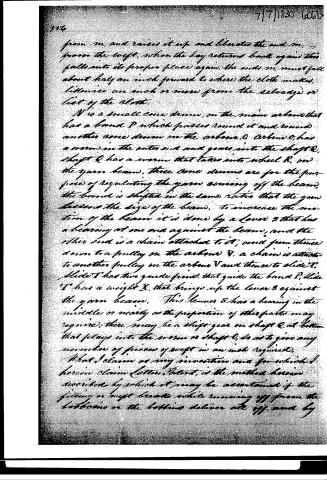
from m, and raises it up and liberates the end m, from the weft, when the loy returns back again this falls into its proper place again. The ends m must fall about half an inch forward to where the cloth makes, likewise an inch or more from the selvage or list of the cloth.
N is a small cone drum, on the main arbor that has a band P which passes round it and round another cone drum on the arbor O. Arbor O has a worm in the outer end and gear into the shaft Q, shaft Q has a worm that takes into wheel R, in the yarn beam. These cone drums are for the purpose of regulating the yarn coming off the beam, the band is shifted in the same ratio that the yarn leaves the size of the beam. To increase the motion of the beam it is done by a lever S that has a bearing at one end against the beam, and the other end is a chain attached to it, and from thence down to a pulley on the arbor V. A chain is attached to another pulley in the arbor V and thence to slide T. Slide T has two guide pins, that guide the band P. Slide T has a weight X, that brings up the lever S against the yarn beam. This lever S has a bearing in the middle or nearly as the proportion of other parts may require; there may be a shift gear on shaft Q at bottom that plays into the worm or shaft O, so as to give any number of pieces of weft in an inch required.
What I claim as my invention and for which I herein claim Letter Patent, is the method herein described by which it may be ascertained if the filling or weft breaks while running off from the bobbin or the bobbin deliver ate off, and by
Page 6.
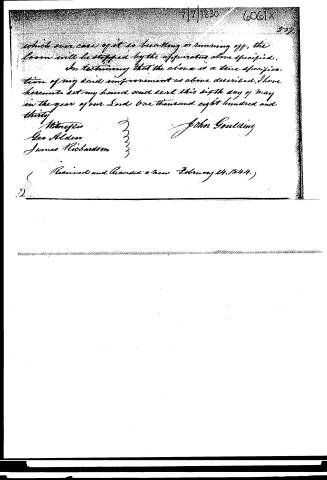
which ever case of it is breaking or running off, the
lawn will be stopped by the apparatus above specified.
In testimony that the above is a true specifica-
tion of my said improvement as above described, I have
hereunto set my hand and seal this 5th day of May
in the year of our Lord One thousand eight hundred and
thirty.
Witnesses
Geo Alden
James Richardson
John Goulding
(Received and Recorded a New February 14, 1844.)
Published accounts: journal notice
Notice in the monthly list of patents, with remarks
Journal of the Franklin Institute, new ser., vol. 6 (1830), p. 291 · View the page
5. For an improvement in Looms; John Goulding, Dedham, Norfolk county, Massachusetts, July 7.
Remarks. The improved apparatus cannot be described in words, we therefore shall give no more than the claim, which will show what is intended to be effected. "What I claim as my invention, is, the method herein described, by which may be ascertained if the filling, or weft, breaks while running off from the bobbins, or the bobbins deliver all off, and by which ever cause of its so breaking, or running off, the loom will be stopped by the apparatus above specified."
DATAMP: illustration
Illustrations from DATAMP
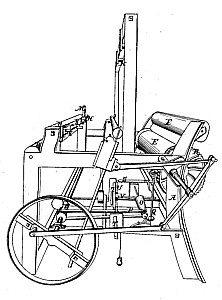

DATAMP (Directory of American Tool and Machinery Patents), via the Internet Archive · Archived DATAMP page
About this record
- Patentee
- DATAMP
- Date
- the Name and Date index of patents, DATAMP, USPTO records
- Invention
- DATAMP
- Listed in
- the Name and Date index of patents, DATAMP, USPTO records, Jim Shaw's X-patent list, the Journal of the Franklin Institute, Burke's List of Patents (1847)
- Burke's 1847 Patent Office list gives the same patent.