

Drawings and documents
USPTO scan
The patent as scanned by the USPTO
-
 Page 1
-
 Page 2
-
 Page 3
-
 Page 4
-
 Page 5
-
 Page 6


U.S. Patent and Trademark Office · Google Patents
Show the transcription Hide (1,425 words)
Machine transcription (LightOnOCR) of the pages as scanned by the USPTO, most of them the handwritten copies made when the records were restored after the 1836 fire. Not checked; it can misread handwriting, so compare it with the scan.
Page 2.
United States Patent
Patent No.: X6092
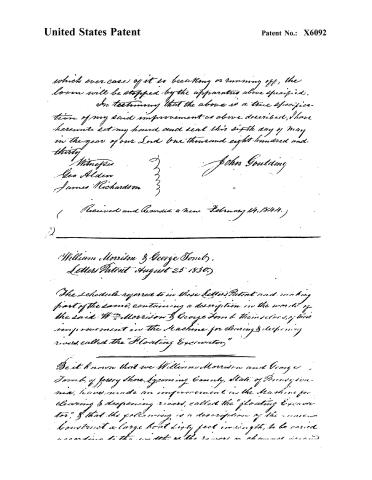
which ever case of it so breaking or running off, the
loom will be stopped by the apparatus above specified.
In testimony that the above is a true specification
of my said improvement as above described, I have
hereunto set my hand and seal this sixth day of May
in the year of our Lord one thousand eight hundred and
thirty.
Witnesses
Geo Alden
James Richardson
John Goulding
(Received and Recorded a new February 14, 1844.)
William Morrison & George Tombs.
Letters Patent August 25 1830.
The schedule referred to in these Letters Patent and making
part of the same, containing a description in the words of
the said Wm Morrison & George Tombs themselves, of their
improvement in the Machine for clearing & deepening
rivers, called the "Floating Excavator"
Be it known that we William Morrison and George
Tombs, of Jersey Shore, Lycoming County, State of Pennsylvania,
have made an improvement in the Machine for
clearing & deepening rivers, called the "floating Excavator," & that the following is a description of the same—
construct a large boat fifty feet in length, to be varied
according to the width of the rivers or channels intended
Page 3.
United States Patent
Patent No.: X6092
magnitude of the work—The whole width to be 12 feet, with arms projecting over at each side 4 feet, with 4 "Gunnwales" of the full length of the of the length of the boat to be placed 4 feet from each other & planted on the bottom. The top of the boat & the arms also to be covered with plank 2 inches thick, except a space of four feet in the middle, which is left for a, moving carriage). On each end of this Boat are joined 2 pieces of timber 24 feet in length, & confined to the top of the Gunnwales, to be finished by 1/4 with a mortise thru each end at the outside of the Boat, of sufficient size to admit a piece of timber 6 inches square, which passes thru that mortise & an iron staple driven into the side of the Boat; the end of the piece of timber to be sharpened, & placed on the bottom of the river, said piece of timber has a mortise thru the upper end, of sufficient size to receive a lever 3 inches thick, & seven inches in width, the end outside the Boat to be fastened to a piece of iron joined perpendicularly from the end of the confined piece of timber; said piece of iron is called a wind, 5 feet in length & may be varied as occasion requires, & the end of the lever (which serves to raise the boat) is fastened down by two perpendicular pieces of timber of sufficient strength to hold the same, attached to the confined pieces of timber in the centre of the boat—
There are to be 4 of the pieces of timber six inches square made precisely alike, 4 levers, 4 iron swords, & 4 staples all placed in similar positions, at the 4 corners of the Boat, on the outside, each lever at the end fastened in the same manner which is the force as the levers
Page 4.
United States Patent
Patent No.: X6092
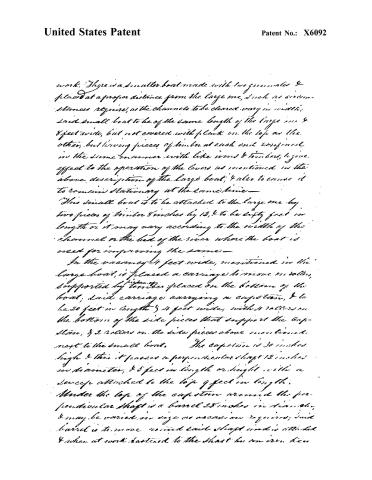
work. There is a smaller boat made with two gunwales & placed at a proper distance from the large one, such as circumstances require, as the channels to be cleaned vary in width; said small boat to be of the same length of the large one & 8 feet wide, but not covered with plank on the top as the other, but having pieces of timber at each end confined in the same manner with like irons & timbers; to give effect to the operation of the levers as mentioned in the above description of the large boat, & also to cause it to remain stationary at the same time—
This small boat is to be attached to the large one by two pieces of timber 8 inches by 12, & to be eight feet in length or it may vary according to the width of the channel or the bed of the river where the boat is used for improving the same—
In the vacancy 4 feet wide, mentioned in the large boat, is placed a carriage to move on rollers, supported by timbers placed on the bottom of the boat, said carriage carrying a capstan, & to be 20 feet in length & 4 feet wide, with 4 rollers on the bottom of the side pieces that support the capstan, & 2 rollers on the side pieces above mentioned, next to the small boat. The capstan is 30 inches high & thence it passes a perpendicular shaft 12 inches in diameter, & 5 feet in length or height with a sweep attached to the top 9 feet in length. Under the top of the capstan around the perpendicular shaft is a barrel 28 inches in diameter, & may be varied in size as occasion requires; said barrel is to move round said shaft and is attached & when at work fastened to the shaft by an iron key
Page 5.
United States Patent
Patent No.: X6092
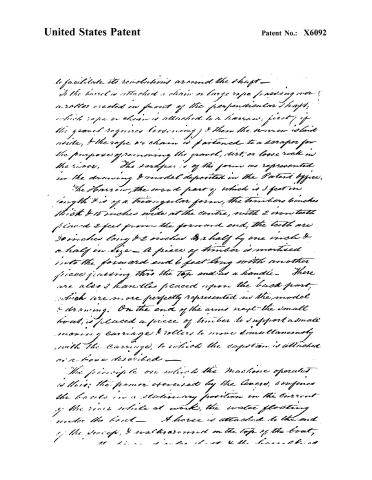
to facilitate its revolutions around the shaft—
If the barrel is attached a chain or large rope passing over a roller erected in front of the perpendicular shaft, which rope or chain is attached to a harrow, first if the gravel requires loosening, & then the harrow is laid aside, & the rope or chain is fastened to a scraper for the purpose of removing the gravel, dirt, or loose rock in the river. The scraper is of the form as represented in the drawing & model deposited in the Patent Office.
The harrow, the wood part of which is 3 feet in length & is of a triangular form, the timber binches thick & 15 inches wide at the centre, with 2 iron teeth placed 2 feet from the forward end, the teeth are 30 inches long & 2 inches & a half by one inch & a half in size—A piece of timber is mortised into the forward end 6 feet long with another piece passing thru the top end as a handle—There are also 2 handles placed upon the back part, which are more perfectly represented in the model & drawing. On the end of the arms next the small boat, is placed a piece of timber to support a small moving carriage & rollers to move simultaneously with the carriage, to which the capstan is attached as above described—
The principle on which the machine operates is this: the power exercised by the lever, confines the boats in a stationary position in the current of the river while at work, the water floating under the boat— A horse is attached to the end of the sweep, & walks around on the top of the boat,
Page 6.
United States Patent
Patent No.: X6092
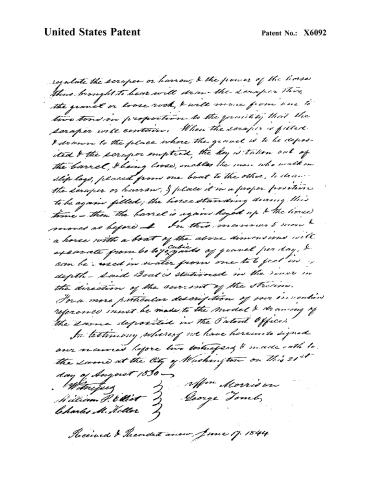
regulate the scraper or harrow, & the power of the horse thus brought to bear will draw the scraper thru, the gravel or loose rock, & will move from one to two tons in proportion to the gravity that the scraper will contain. When the scraper is filled & drawn to the place where the gravel is to be deposited & the scraper emptied, the key is taken out of the barrel, & being loose, enables the man who walks on slip logs, placed from one boat to the other, to draw the scraper or harrow, & place it in a proper position to be again filled; the horse standing during this time — then the barrel is again keyed up & the horse moves as before — In this manner 5 men & a horse with a boat of the above dimensions will excavate from 60 to 70 yards of gravel per day, & can be used in water from one to 6 feet in depth — Said Boat is stationed in the river in the direction of the current of the stream.
For a more particular description of our invention reference must be made to the Model & drawing of the same deposited in the Patent Office.
In testimony whereof we have hereunto signed our names before two witnesses & made oath to the same at the City of Washington on this 21st day of August 1830
Witnesses
William P. Elliot
Charles M. Keller
Affix Morrison
George Tombs
Received & Recorded anew, June 17, 1844
Published accounts: journal notice
Notice in the monthly list of patents, with remarks
Journal of the Franklin Institute, new ser., vol. 6 (1830), p. 302 · View the page
7. For an improvement in the Machine for Clearing and Deepening Rivers, called the "Floating Excavator;" William Morrison and George Tomb, Jersey Shore, Lycoming county, Pennsylvania, August 25.
Remarks. Two boats are to be made, somewhat in the form of scows. They are each to be about 60 feet in length, and connected together by timbers passing from gunwale to gunwale. The scoop by which the excavating is to be effected, works between the boats. One of the vessels must be of sufficient width to allow of a circular walk for a horse; the other need not be more than half that width. A capstan is placed in the centre of the larger boat, and from this a lever, or sweep, projects, to which a horse is to be attached to turn the capstan. The rope, or chain, which winds round the barrel of this capstan, is attached either to a harrow, or to a scraper, as the case may be. When the earth or gravel requires to be loosened, the harrow is employed, and afterwards the scraper, to remove it. The handles of these instruments are to slide upon the timbers which connect the two boats, and are to be guided by four men. The harrow and scraper, it is said, will work in water from one to six feet in depth, and one horse, with five men, will excavate from 60 to 70 cubic yards per day. The boats lie across the stream, and are to be securely moored. We have in the specification no information of the mode in which the dirt is to be removed from the scraper; and on some other points of equal importance it is altogether silent; nor are we informed in what part of the machinery the novelty consists, as the whole is merely described, without any thing in the nature of a claim being preferred. PATENT FOR SEPTEMBER.
About this record
- Patentee
- DATAMP
- Date
- the Name and Date index of patents, DATAMP, USPTO records
- Invention
- DATAMP
- Listed in
- the Name and Date index of patents, DATAMP, USPTO records, Jim Shaw's X-patent list, the Journal of the Franklin Institute, Burke's List of Patents (1847)
- Burke's 1847 Patent Office list gives the same patent.