

Drawings and documents
National Archives restored drawings: drawing
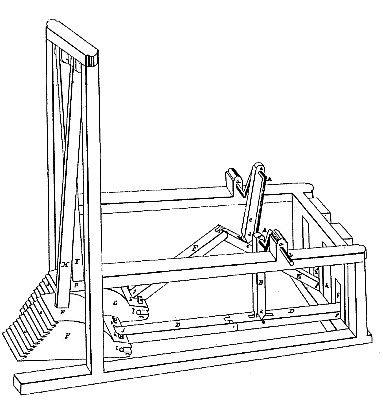
Anson Atwood's Patent Drawing for Fulling Mills and Power Looms

National Archives, Restored Patent Drawings (Record Group 241) · Full-size scan at the National Archives · Catalog record
Show the text on the drawing Hide (121 words)
Words on the drawing as machine-read by the National Archives; not checked. Useful mainly for searching.
ANSON ATWOOD. / DIV. 15 / $2- / Pulling / References. 6094-+ / Fulling Mills and Power Looms. / A.A. Crank / P atented 1st Oct 1830. / B&C. front of rear Pitman / D.D. Compound Zever n front / E.E. do / rear / F&G / the Hammers / HgI. / arms of the Hammers / a.a. loxes in nhich the crank turns / b. / where the power is applied to the crank / C.C. junetion of pitman and crank / d.e. / levers / fif / lever & frame by a moovable pinh / e. / rolling joint in lever / j. / unetion oflever & hummer / k.k. The motion in which the bever / upon a noddle pin. / LiLy / 70 / kj / 774
USPTO scan
The patent as scanned by the USPTO
-
 Page 1
-
 Page 2
-
 Page 3


U.S. Patent and Trademark Office · Google Patents
Show the transcription Hide (603 words)
Machine transcription (LightOnOCR) of the pages as scanned by the USPTO, most of them the handwritten copies made when the records were restored after the 1836 fire. Not checked; it can misread handwriting, so compare it with the scan.
Page 1.
TEXTILES. CLOTH FINISHING.
Draftsman
A. Airwood.
Fulling Machine.
No. 6094X Patented Oct. 1, 1830.
Page 2.
Oct. 1, 1830
Aaron Wood of Salem New York.
Letters Patent
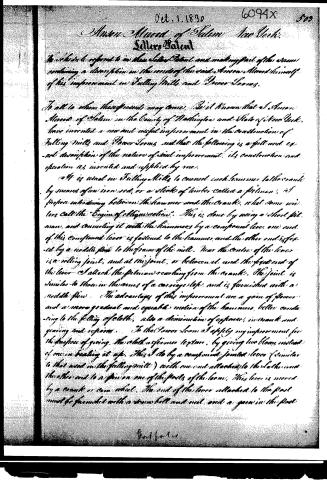
To which I refer to in the letter Patent and making part of the same, containing a description in the words of the said Aaron Wood himself of his improvement in Felling Mills and Power Looms.
To all to whom these presents may come, Be it known that I Aaron Wood of Salem in the County of Washington and State of New York, have invented a new and useful improvement in the construction of Felling Mills and Power Looms, and that the following is a full and exact description of the nature of said improvement, its construction and operation as invented and applied by me.
It is usual in Felling Mills to connect each hammer to the crank by means of an iron rod, or a stick of timber called a pitman; I propose introducing between the hammer and the crank, what some writers call the "Engine of oblique action". This is done by using a short pitman, and connecting it with the hammer by a compound lever, one end of this compound lever is fastened to the hammer, and the other end is fixed by a needle pin to the frame of the mill. Near the centre of the lever is a rolling joint, and at the joint, or between it and the fixed end of the lever I attach the pitman reaching from the crank. The joint is similar to those in the arms of a carriage top, and is furnished with a needle pin. The advantages of this improvement are a gain of power and a more gradual and equal motion of the hammer, better conducing to the felling of cloth, also a diminution of expense, in crank and gearing and repairs. To the Power Loom I apply my improvement for the purpose of giving the cloth a firmer texture, by giving two blows instead of one in beating it up. This I do by a compound jointed lever (similar to that used in the felling mill) with one end attached to the Lath, and the other end to a pin on one of the posts of the loom. This lever is moved by a crank or con wheel. The end of the lever attached to the post must be furnished with a stone bolt and nut, and a gear in the post
G. H. H.
Page 3.
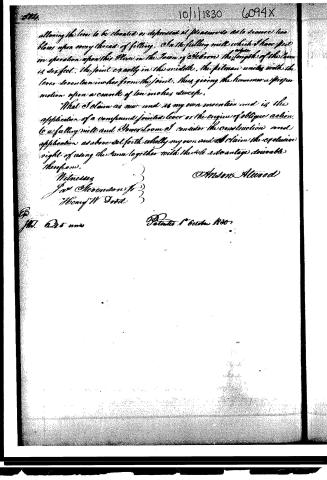
allowing the lever to be elevated or depressed at pleasure so as to secure two blows upon every thread of setting. In the fulling mill which I have just in operation upon this plan in the Town of Lebanon the length of the lever is six feet, the joint exactly in the middle, the fulcrum unites with the lever seventeen inches from the joint, thus giving the hammer a proper motion upon a crank of ten inches sweep.
What I claim as new and as my own invention and is the application of a compound jointed lever as the engine of oblique action to a fulling mill and Power Loom I consider the construction and application as above set forth wholly my own and I claim the exclusive right of using the same together with the sole advantage derivable therefrom.
Witnesses
Jas Henderson Jr
Henry W Ford
Patented 1st October 1830
Published accounts: journal notice
Notice in the monthly list of patents, with remarks
Journal of the Franklin Institute, new ser., vol. 6 (1830), p. 361 · View the page
1. For an improvement in the construction of Fulling Mills and Power Looms; Anson Atwood, Salem, Washington county, New York, October 1.
Remarks. The beaters, or hammers, of this fulling mill, are of the usual construction; are suspended, and swing, as in other fulling mills; but the lever, or rods, by which they are carried backwards and forwards, are not acted upon directly by a crank, but have a joint in them near their middles, working like a rule joint. Cranks placed above these rods, raise and depress them by means of pitmen, and thus cause the hammers to vibrate; one end of these compound levers is fastened to the hammer, and the other works upon a pin in the frame behind it. We do not perceive the advantage of this arrangement, but will let the patentee speak for himself; and he says, "the advantages of this improvement are a gain of power, and a more gradual and equable motion of the hammers, better conducing to the fulling of cloth; also a diminution of expense, in crank, and gearing, and repairs." The same kind of join joint he proposes to apply to the power loom to act on the lathe in beating up, which is to be advantageous, "by giving two blows, instead of one." The claim is to "the application of a compound jointed lever, or the engine of oblique action, to a fulling mill and power looms." VOL. VI.-No. 6. - DECEMBER, 1830.
DATAMP: illustration
Illustrations from DATAMP

DATAMP (Directory of American Tool and Machinery Patents), via the Internet Archive · Archived DATAMP page
About this record
- Patentee
- DATAMP
- Date
- the Name and Date index of patents, DATAMP, USPTO records
- Invention
- DATAMP
- Listed in
- the Name and Date index of patents, DATAMP, USPTO records, Jim Shaw's X-patent list, the Journal of the Franklin Institute, Burke's List of Patents (1847)
- Burke's 1847 Patent Office list gives the same patent.