

Drawings and documents
USPTO scan
The patent as scanned by the USPTO
-
 Page 1
-
 Page 2
-
 Page 3
-
 Page 4


U.S. Patent and Trademark Office · Google Patents
Show the transcription Hide (903 words)
Machine transcription (LightOnOCR) of the pages as scanned by the USPTO, most of them the handwritten copies made when the records were restored after the 1836 fire. Not checked; it can misread handwriting, so compare it with the scan.
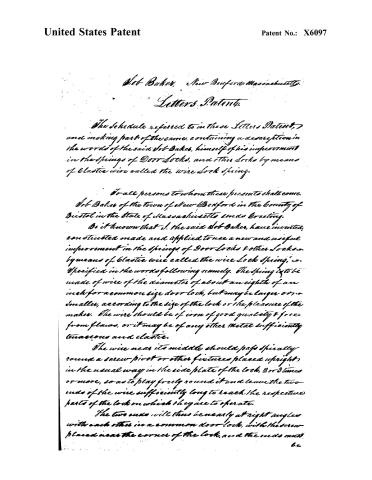
Page 2.
United States Patent
Patent No.: X6097
Job Baker, New Bedford, Massachusetts.
Letters Patent.
The Schedule referred to in these Letters Patent, and making part of the same, containing a description in the words of the said Job Baker, himself of his improvement in the springs of Door Locks, and other Locks by means of elastic wire called the wire Lock Spring.
To all persons to whom these presents shall come, Job Baker of the town of New Bedford in the county of Bristol in the state of Massachusetts sends Greeting.
Be it known that I, the said Job Baker, have invented, constructed made and applied to use a new and useful improvement in the springs of Door Locks & other Locks by means of elastic wire called the wire Lock Spring, as specified in the words following namely. The spring to be made of wire of the diameter of about an eighth of an inch for a common size door lock, but may be larger or smaller, according to the size of the lock or the pleasure of the maker. The wire should be of iron of good quality & free from flaws, or it may be of any other metal sufficiently tenacious and elastic.
The wire near its middle should pass spirally round a screw-pivot or other fixtures placed upright in the usual way in the side plate of the lock, 2 or 3 times or more, so as to play freely round it and leave the two ends of the wire sufficiently long to reach the respective parts of the lock on which they are to operate.
The two ends will thus be nearly at right angles with each other in a common door lock, with the screw placed near the corner of the lock, and the ends must be
Page 3.
United States Patent
Patent No.: X6097
be so fixed as to have a tendency to approach each other, so that when one end is pressed back the tendency of the other to press forward is thereby increased.
One end of the wire spring should pass behind and press upon the inner end of the latch or bar, which is forced back by the knob & works on a spring when the door is open or shut. The other end should pass in the direction of the bolt or bar which is propelled by the key and should be near to it, resting on the side of the lock, in which the new or pivot is fixed, and should pass by the key hole, forming within the reach of the key a curve like that of the common tumbler, presenting the external part of the curve to the action of the key and should be turned up at right angles at the end, so that the part turned up may fit in a niche in the bolt, to retain it in its position.
The spring must be so bent that the key may in its revolution before it removes the bolt, by its action on the end part of the wire move the extreme end so turned up out of the niche in which it rested, & keep it suspended until the bolt is removed to a position suited to receive the end in another niche in the bolt, whereby it may be retained in the position in which the key leaves it.
This end or part of the wire is intended to perform all the office of the common tumbler and steel spring thistle attached, & to act on the same principle, generally in connection with the key and bolt. The lock may be of any form or dimensions, & the size & form of the wire should be varied accordingly, the object chiefly to be attended to being that the wire should be of sufficient size to give the requisite spring and that while one passes on the end of the latch, the other should press on the side of the bolt, and the communication of elasticity be uninterrupted from end to end of the wire.
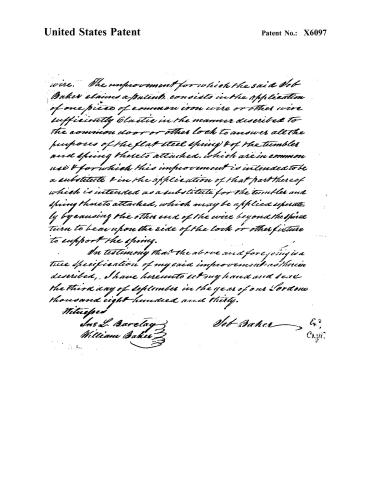
Page 4.
United States Patent
Patent No.: X6097
wire. The improvement for which the said Job Baker claims a patent, consists in the application of one piece of common iron wire or other wire sufficiently elastic in the manner described to the common door or other lock to answer all the purposes of the flat steel spring & of the tumbler and spring thereto attached, which are in common use & for which this improvement is intended to be a substitute & in the application of that part thereof which is intended as a substitute for the tumbler and spring thereto attached, which may be applied separately by causing the other end of the wire beyond the spiral turn to bear upon the side of the lock or other fixture to support the spring.
In testimony that the above and foregoing is a true specification of my said improvement as herein described, I have hereunto set my hand and seal the third day of September in the year of our Lord one thousand eight hundred and thirty.
Witnesses
Jno. L. Barclay
William Baker
Job Baker
Ex.
Cay.
Published accounts: journal notice
Notice in the monthly list of patents, with remarks
Journal of the Franklin Institute, new ser., vol. 6 (1830), p. 362 · View the page
3. For an improvement in the Springs of Door Locks, and pther Locks, by means of Elastic Wire, called "The Wire Lock Spring;" Job Baker, New Bedford, Bristol county, Massachusetts, October 1.
Remarks. A piece of iron, or other wire, which may be about one-eighth of an inch in diameter, is to be substituted for the flat steel springs now in use. This wire may have two, three, or more spiral turns, where the screw fixes it. It is proposed not only to substitute this for the common spring to the spring bolt, but also to make it act the part of the spring and tumbler to the lock bolt. For this purpose one end of the wire is to pass round the inside of the box of the lock, so as to bring it under those notches in the bolt into which the tumbler usually catches. To secure its falling into these notches, the wire is to be bent up at right angles. A part of the wire is to have a round bend, in order that the key, as it turns, may touch it, just as it does the curved edge of the common tumbler; the key will thus lift the wire out of the notch and allow the bolt to be advanced, or withdrawn. The claim is to the use of wire in the way above described. As respects the use of wire to act upon the spring bolt, although it may never have been patented, we know that it has been used, as we have employed it ourselves, in our domestic repairs, and we have no doubt that others have done the same. We apprehend that it is one of those contrivances to which any maker of mouse traps, or other worker in wire, would be apt to resort, should he undertake to repair the spring of his own door lock. We have for the same purpose used a piece of whalebone, which has continued to act well for years; we, however, have not taken a patent for it. For the spring and tumbler, the wire is a poor substitute, as the bolt may readily be forced back, because it is retained in its place merely by the bent wire, which acts only as a spring, and will easily give way.
About this record
- Patentee
- DATAMP
- Date
- the Name and Date index of patents, DATAMP, USPTO records
- Invention
- DATAMP
- Listed in
- the Name and Date index of patents, DATAMP, USPTO records, Jim Shaw's X-patent list, the Journal of the Franklin Institute, Burke's List of Patents (1847)
- Burke's 1847 Patent Office list gives the same patent.