

Drawings and documents
USPTO scan
The patent as scanned by the USPTO
-
 Page 1
-
 Page 2
-
 Page 3
-
 Page 4


U.S. Patent and Trademark Office · Google Patents
Show the transcription Hide (820 words)
Machine transcription (LightOnOCR) of the pages as scanned by the USPTO, most of them the handwritten copies made when the records were restored after the 1836 fire. Not checked; it can misread handwriting, so compare it with the scan.
Page 1.
UNITED STATES PATENT OFFICE
PTO – BOYERS, PA DUTY STATION
PAGE NOT AVAILABLE
PATENT NUMBER X6105 FOR THE ISSUE DATE 10/1/1830 HAS BEEN SCANNED/LOADED, BUT WITH MISSING PAGE(S). UPON RECEIPT OF THE MISSING PAGE(S), THE ENTIRE DOCUMENT WILL BE RESCANNED. THIS NOTICE IS FOR THE MISSING PAGE CONTAINING:
Missing All Drawings
DATA CONVERSION OPERATION
BOYERS, PA
Page 2.
550
10/1/1830 6105X
Matthew D. Brown
Letter Patent dated October 1st 1830
The Schedule referred to in these Letters Patent. & making part of the same, containing a description in the words of the said Matthew D. Brown himself, of his improvement in Ferry Boats
Be it known that I Matthew D. Brown of Mason County State of Virginia, have made an improvement in Ferry Boats, & in perfecting the same, which is described as follows:
This Ferry Boat, with the apparatus used in perfecting it, consist of the following principal parts;
1st. The Boat, 2nd. The lee board, 3rd. The uprights & rollers for regulating the depth of the lee board, 4th. The pulleys & windlasses for steering the boat, 5th. The Windlass for raising & lowering the lee board, 6th. The skiff or float for supporting the sway of the rope.
1st. The Boat is constructed in the ordinary manner of Ferry Boats, adapted to the purposes required.
2nd. The lee board is made of nearly the length of the boat about 6 feet deep, adapted to the current of the water — It has three standards, fastened to it & extending above & somewhat more than the depth of the lee board.
3rd. The uprights & rollers for regulating the depth to which the lee board shall enter the water. There are three uprights fastened to the sides of the Boat, one near each end & one near the middle on each of these uprights is a roller, turning on an axle, supported by two arms connected with the uprights.
Page 3.
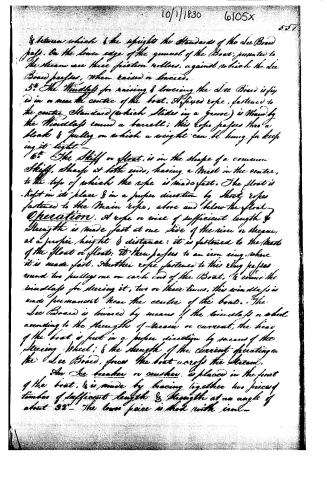
8 between which & the uprights the Standards of the Lee Board pass. On the lower edge of the gunnel of the Boat, presented to the stream are three friction rollers, against which the Lee Board passes, when raised or lowered.
5th. The Windlass for raising & lowering the Lee Board is fixed in or near the centre of the boat. A fixed rope, fastened to the centre Standard (which slides in a groove) is wound by the Windlass round a barrel; this rope passes thro a block & pulley on which a weight can be hung for keeping it tight.
6th. The Skiff or float, is in the shape of a common Skiff, sharp at both ends, having a Mast in the centre, to the top of which the rope is made fast. The float is kept in its place & in a proper direction by short ropes fastened to the Main rope, above and below the float.
Operation. A rope or wire of sufficient length & strength is made fast at one side of the river or stream, at a proper height & distance: it is fastened to the Mast of the float or floats: it then passes to an iron ring, where it is made fast. Another rope fastened to this ring passes round two pulleys one on each end of the Boat, & round the windlass for steering it, two or three times, this windlass is made permanent near the centre of the boat. The Lee Board is lowered by means of the windlass or wheel, according to the strength of stream or current, the head of the boat is kept in a proper direction by means of the Steering Wheel; & the strength of the current operating on the Lee Board, forces the boat across the stream.
The Lee breaker or cousther, is placed in the front of the boat, & is made by bracing together two pieces of timber of sufficient length & strength at an angle of about 32°. The lower piece is fixed with iron.
Page 4.
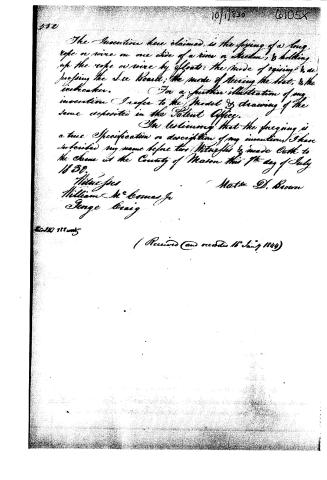
The invention here claimed, is the fixing of a long rope or wire on one side of a river or stream, & holding up the rope or wire by floats: the mode of raising & de-pressing the Ice Boats; the mode of steering the Boat, & the icebreaker.
For a further illustration of my invention I refer to the Model & drawing of the same deposited in the Patent Office.
In testifying that the foregoing is a true Specification or description of my invention, I have subscribed my name before two Notaries & made Oath to the same at the County of Mason this 7th day of July 1830.
Notaries
William M. Gomes Jr
George Craig
Matt D. Brown
(Received and recorded 16 July 1844)
Published accounts: journal notice
Notice in the monthly list of patents, with remarks
Journal of the Franklin Institute, new ser., vol. 6 (1830), p. 366 · View the page
15. For an improvement in Ferry Boats, and in Propelling the same; Matthew D. Brown, Mason county, Virginia, October 1.
Remarks. A rope, or wire, is to be stretched across a river, in the way common at many ferries. Skiffs are to be moored in the river, to support the rope or wire; each skiff is to have a mast in its centre for this purpose. The ferry boat has stancheons, and pulleys for the rope to pass over, and a rigging rope, with a ring, by which it is attached to the crossing wire, or rope, so that it may stand obliquely with the current. A lee board is to be lowered and raised by means of a windlass, according to the depth and strength of the current. "The invention here claimed is the fixing a long rope, or wire, on one side of a river or stream, and holding up the rope or wire by means of floats; the mode of raising and depressing the lee board; the mode of steering the boat; and the ice breakers." The general plan, if we understand the description, is a very old one; if there are any particular improvements rendering the mode of applying this principle more efficient or convenient, they are either very imperfectly described, or we so perfectly in the dark as to be unable to perceive them.
About this record
- Patentee
- DATAMP
- Date
- the Name and Date index of patents, DATAMP, USPTO records
- Invention
- DATAMP
- Listed in
- the Name and Date index of patents, DATAMP, USPTO records, Jim Shaw's X-patent list, the Journal of the Franklin Institute, Burke's List of Patents (1847)
- Burke's 1847 Patent Office list gives the same patent.