

Drawings and documents
National Archives restored drawings: drawing
William Coffin's Patent Drawing for a Machine for Flattening Window Glaze


National Archives, Restored Patent Drawings (Record Group 241) · Full-size scan at the National Archives · Catalog record
Show the text on the drawing Hide (290 words)
Words on the drawing as machine-read by the National Archives; not checked. Useful mainly for searching.
Sheet 1. William Coffin / DIV. 15 3 / Matteing window Glapup / Patented ОЛ.ред 1830. / 48. Annealing & Tempering. Hat labler / GLASS ANNEALING. / OF / FLATTENING TABLES, / OF / CLASSIFICATION / 6/13-+ X / DIVISION. / References to the drawing / The revolving wheel or table. / B. Both flattening and Cooling Stones. / C1. now a Cylinder in the flattened out on the stone on which it mas flattened in the flattening oven, / colling oven passed there by the revolving of the table or wheel. / D.-W Cylinder about to be placed on the flattening Stone by a cropper. / E Partition wall which divides the two overs. / E. Founda tion wall / G Mattening Oven. / H. Cooling or anealing oven.
Sheet 2. County of Thent / JS. / Hall of Mhacle Hand } / Cen this 11th clear of July / 1837 before the Lubsilien a Judge of the / bourt of Common brane Pleas pursonally affeared / Janathan of State brence of and East mack Grunwich Jolelm of the oath Caunty That / he is interested as receiver immention in n Pattent for the / bireular barn Menoven pueer to heir and & / clated Carth 1st 1830 and the Drawings / thereto are as he verrety believes / true deliviation as discrebed in Leuce / ters Pattent. / John / To the Have H.L. Ellsworth / In, I handly know have / I cause Aa mahu La great a bluncin as to / Luce on the Drawing of the Cercular Carr Mennew / without the surepary afficiant anomaning / above you have it - If it will / our
Sheet 3. auswin but on in this every will you / them attach it to the drawing- - / It it will not cusum the Lpaur will / you heare to siture the / I will here it and / most / Crane / breen / East quinnia / MAFA / July 11th 1837
USPTO scan
The patent as scanned by the USPTO
-
 Page 1
-
 Page 2
-
 Page 3


U.S. Patent and Trademark Office · Google Patents
Show the transcription Hide (669 words)
Machine transcription (LightOnOCR) of the pages as scanned by the USPTO, most of them the handwritten copies made when the records were restored after the 1836 fire. Not checked; it can misread handwriting, so compare it with the scan.
Page 1.
6113X
W. Coffin,
Glass Furnace.
Patented Oct. 1, 1830.

Page 2.
William Coffin junr.
Letters Patent Dated October 1st 1830
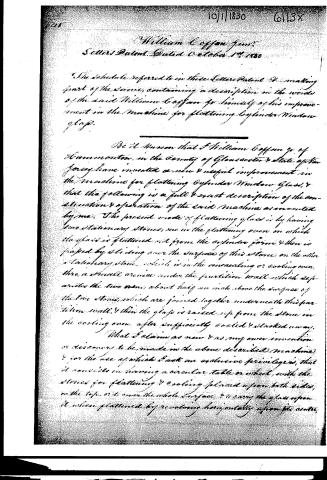
The schedule referred to in these Letters Patent & making part of the same, containing a description in the words of the said William Coffin for himself of his improvement in the machine for flattening cylinder window glass.
Be it known that I William Coffin jr. of Somerton, in the County of Gloucester & state of New Jersey have invented a new & useful improvement in the machine for flattening cylinder window glass, & that the following is a full & exact description of the construction & operation of the said machine as invented by me. The present mode of flattening glass is by having two stationary stones, one in the flattening oven, on which the glass is flattened out from the cylinder form, & then is passed by sliding over the surface of this stone, on the other stationary stone, which is in the annealing or cooling oven, thro a small orifice under the partition wall which separates the two ovens, about half an inch above the surface of the two stones, which are joined together underneath this partition wall, & then the glass is raised up from the stone in the cooling oven, after sufficiently cooled & stacked away.
What I claim as new & as my own invention or discovery to be made in the above described machine, & for the use of which I ask an exclusive privilege is, that it consists in having a circular table or wheel, with the stones for flattening & cooling placed upon both sides, in the top, or to cover the whole surface, & to carry the glass upon it when flattened by revolving horizontally upon its centre.
Page 3.
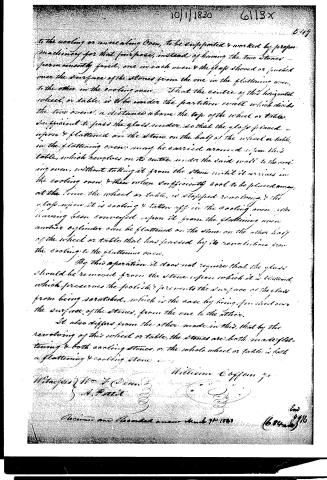
to the cooling or annealing Oven, to be supported & worked by proper machinery for that purpose, instead of having the two stones permanently fixed, one in each oven & the glass shoved or pushed over the surface of the stones from the one in the flattening oven, to the other in the cooling oven. That the centre of this horizontal wheel or table, is to be under the partition wall which divides the two ovens, a distance above the top of the wheel or table, sufficient to pass the glass under, so that the glass placed upon & flattened on the stone on the half of the wheel or table, in the flattening oven, may be carried around upon this table, which revolves on its centre, under the said wall, to the cooling oven, without taking it from the stone until it arrives in the cooling oven, & then when sufficiently cool to be placed away, at the time the wheel or table, is stopped revolving, & the glass upon it is cooling & taken off in the cooling oven, after having been conveyed upon it from the flattening oven another cylinder can be flattened on the stone on the other half of the wheel or table that has passed by its revolution from the cooling to the flattening oven.
By this operation it does not require that the glass should be removed from the stone upon which it is flattened, which preserves the polish, & prevents the surface of the glass from being scratched, which is the case by being pushed over the surface of the stones, from the one to the other.
It also differs from the other mode in this, that by the revolving of this wheel or table, the stones are both made flattening & both cooling stones, or the whole wheel or table is both a flattening & cooling stone.
William Coffam Jr
Witnesses: Wm. J. Dean
S. A. Farris
Received and Recorded among deeds 7th 1840
Published accounts: specification
Specification printed in the Journal of the Franklin Institute
Journal of the Franklin Institute, new ser., vol. 6 (1830), p. 378 · View the page
Text of the specification as printed in the Journal, from OCR; not proofread.
Specification of a patent for a machine for Flattening Cylinder Window Glass. Granted to WILLIAM COFFAN, Jr. Hammonton, Gloucester county, New Jersey, October 1. BE it known, that I, William Coffan, jr. have invented a new and useful improvement in the machine for flattening cylinder window glass, and that the following is a full and exact description of the construction and operation of the said machine as invented by me. The present mode of flattening glass, is, by having two stationary stones, one in the flattening oven, on which the glass is flattened out from the cylinder form, and then is passed, by sliding over the surface of this stone, on the other stationary stone, which is in the annealing, or cooling oven, through a small crevice under the partition wall which separates the two ovens, about half an inch above the surface of the two stones, which are joined together underneath this partition wall, and then the glass is raised up from the stone in the cooling oven, after sufficiently cooled, and stacked away. What I claim as new, and as my own invention or discovery, is an improvement made in the above described machinery, and for the use ELGAR'S Rail-road Car. of which I ask an exclusive privilege. This consists in having a circular table, or wheel, with the stones for flattening and cooling placed upon both sides, on the top, or to cover the whole surface; and to carry the glass upon it when flattened, by revolving horizontally upon its centre, to the cooling, or annealing oven; to be supported and worked by proper machinery for that purpose, instead of having the two stones permanently fixed, one in each oven, and the glass shoved, or pushed, over the surface of the stones from the one in the flattening oven, to the other in the cooling oven. The centre of this horizontal wheel, or table, is to be under the partition wall which divides the two ovens, at a distance above the top of the wheel, or table, sufficient to pass the glass under, so that the glass placed upon, and flattened on the stone, on the half of the wheel, or table, in the flattening oven, may be carried around upon this table which revolves on its centre, under the said wall, to the cooling oven, without taking it from the stone until it arrives in the cooling oven, and then, when sufficiently cool, to be placed away; at the time the wheel, or table, is stopped revolving, and the glass upon it is cooling and taken off in the cooling oven, after having been conveyed upon it, from the flattening oven, another cylinder can be flattened on the stone on the other half of the wheel, or table, that has passed by its revolution from the cooling to the flattening oven. By this operation it does not require that the glass should be removed from the stone upon which it is flattened, which preserves the polish, and prevents the surface of the glass from being scratched, which is the case when it is pushed over the surface of the stones, from the one to the other. It also differs from the other mode, in this, that by the revolving of this wheel, or table, the stones are both made flattening, and both cooling stones, or the whole wheel, or table, is both a flattening and cooling stone. WILLIAM COFFAN, Jr.
About this record
- Patentee
- DATAMP
- Date
- the Name and Date index of patents, DATAMP, USPTO records
- Invention
- DATAMP
- Listed in
- the Name and Date index of patents, DATAMP, USPTO records, Jim Shaw's X-patent list, Burke's List of Patents (1847)
- Burke's 1847 Patent Office list gives the same patent.