

Drawings and documents
National Archives restored drawings: drawing
John Elgar's Patent Drawing for an Improvement in Rail Road Cars

National Archives, Restored Patent Drawings (Record Group 241) · Full-size scan at the National Archives · Catalog record
Show the text on the drawing Hide (186 words)
Words on the drawing as machine-read by the National Archives; not checked. Useful mainly for searching.
$450 / an / agle vixes- / 04. JOUR.-BOXES, PULLEYS, SHAFTING, / Journal-Bexes, / CLASSIFICATION / John Elgar / 6124-4 / Improv in hail Road car. / Vol To his 495 / DIVISION / Patented act 1830, / Lis. se / Jig.2. / Sig.3 / On / Sig.1. / References. a the asle. bil wheels. C.C. journals. dd steel points. e Bearing of Castiron. Affribs. g backpart of Bearing Boxc, / i packing plate with flange h k packing. hub. / 7y.1. wheels and asle with one Bearing box. Fig.2. Tide view of the wheel & bearing box e. fy.3 a part of the hub & spocks also the journal c, with the plate i. / Fish. Section through festion the centre of boxe. Jy.s. Section of the lower part of boxe seen from the Sop. Jel Tyk dotted line xx.Ji.6 Iron toiou of journal f packing. Jis.7. Backview afboxe., / J.y. of boxe platec with packing.k. / Jy.5. / Jigy / clamse A Chilled cartion Box with / studes antre journal / Intent affice March 1842 / The of / of in formity with act of zed 1837 / 556ye / the / hist, / forts / dust / Id: / Commisioner of Patents.
USPTO scan
The patent as scanned by the USPTO
-
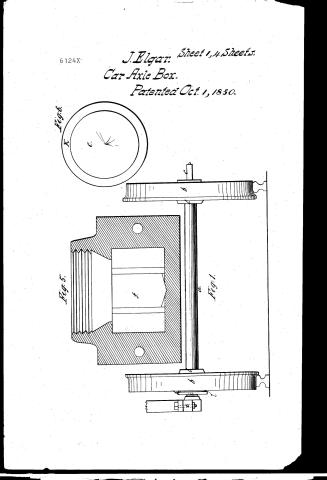 Page 1
-
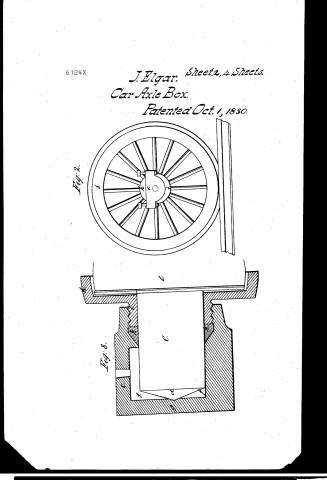 Page 2
-
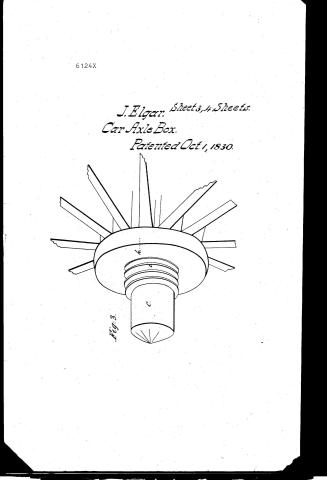 Page 3
-
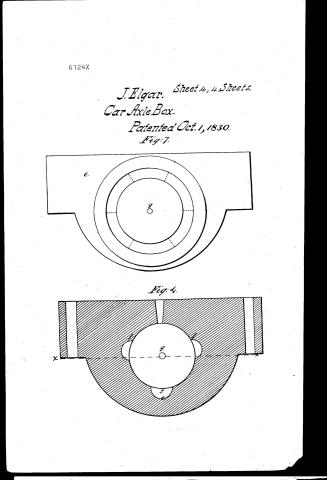 Page 4
-
 Page 5
-
 Page 6


U.S. Patent and Trademark Office · Google Patents
Show the transcription Hide (570 words)
Machine transcription (LightOnOCR) of the pages as scanned by the USPTO, most of them the handwritten copies made when the records were restored after the 1836 fire. Not checked; it can misread handwriting, so compare it with the scan.
Page 1.
6124X.
J. Elgar. Sheet 1, 4 Sheets.
Car Axle Box.
Patented Oct. 1, 1830.
Fig. 6.
Fig. 5.
Fig. 1.
Page 2.
6124X
J. Elgar. Sheets, 4 Sheets.
Car Axle Box.
Patented Oct. 1, 1830.
Fig. 2.
Fig. 8.
Page 3.
6124X
J. Elgar. Sheet 3, 4 Sheets.
Car Axle Box.
Patented Oct. 1, 1830.
Fig. 3.
Page 4.
6124X
J. Elgar. Sheet 4, 4 Sheets.
Car Axle Box.
Patented Oct. 1, 1830.
Fig. 7.

Fig. 4.

Page 5.
John Elgar
The schedule referred to in this Letter Patent and making part of the same, containing a description in the words of the said John Elgar himself of his Improvement in the rail road car.
To obtain a form and combination of substances that will reduce the friction in the rubbing parts of a Rail Way Car, to its lowest point, where the "friction wheel" is not used, I adopt the admirable plan of outside journals, introduced & patented by R. Hincks. The essential advantage of which is that the journals are reduced one third in diameter (of course the friction is equally reduced) still preserving the full size and strength of the axles between the wheels. The axles extending through the wheels about 1½ inches, are steels and turned to 2 inches diameter and hardened which forms the journal. To this journal I adapt a bearing or box of cast iron, either in two pieces, or one entire piece and to obtain an opening in the box, that shall at once combine a proper shape to fit the journal with a smooth and exceedingly hard surface it is cast upon a "chill", a piece of iron adapted to the size of the journal, but with three ribs upon it running lengthwise which divides the circular opening of the box into three parts, and reduces the bearing in the journal to ¾ of its circumference. In the contact of substances so hard this quantity of surface is sufficient and the friction is less. The back part of the box is at the same time chilled for the purpose of receiving against it the steel centre point of the journal, that the tendency to lateral motion may be grounded without the friction consequent upon shoulders. To exclude dust and confine the oil, I use a packing plate similar to that which is used at the piston stem of the steam engine. This plate passes on the journal in front of the box, and is secured to the latter with packing of hemp, leather or cork. The side or face of the plate toward the wheel has a projecting flange upon it, which embraces the hub and excludes the dust.
Page 6.
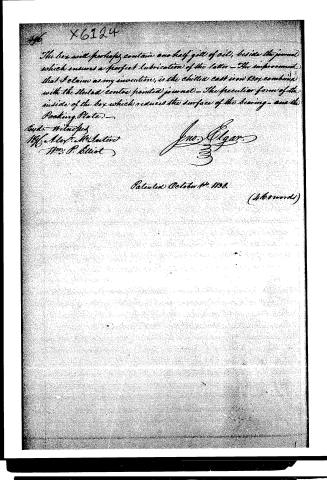
The box will perhaps contain one half gill of oil, beside the journal which ensures a perfect lubrication of the latter. The improvement that I claim as my invention, is the chilled cast iron Box combined with the stated centre pointed journal. The peculiar form of the inside of the box which reduces the surface of the bearing, and the Packing Plate.
Test: Witness
H. A. McEntire
Wm. P. Elliot
Jno. Alger
Patented October 4th, 1861.
(46 words)
Published accounts: specification
Specification printed in the Journal of the Franklin Institute
Journal of the Franklin Institute, new ser., vol. 6 (1830), p. 379 · View the page
Text of the specification as printed in the Journal, from OCR; not proofread.
Specification of a patent for a Rail-road Car. Granted to JOHN ELGAR, of Baltimore, Maryland, October 1, 1830. To obtain a form and combination of substances that will reduce the friction in the rubbing parts of a rail-way car, to its lowest point, where the "friction wheels" are not used, I adopt the admirable plan of outside journals, introduced and patented by R. Winans. The essential advantage of which, is, that the journals are reduced onethird in diameter (of course the friction is equally reduced) still preserving the full size and strength of the axles between the wheels. The axles extend through the wheels, about 4½ inches, are steeled, and turned to 2 inches diameter, and hardened, which forms the journal. To this journal I adapt a bearing, or box of cast iron, either in two pieces, or one entire piece; and to obtain an opening in the box that shall at once combine a proper shape to fit the journal, with a smooth and excessively hard surface, it is cast upon a "chill," or piece of iron dressed to the size of the journal, but with three ribs upon it, running lengthwise, which divides the circular BALDWIN'S Friction Rollers. opening of the box into three parts, and reduces the bearing on the journal to one-fourth of its circumference. In the contact of substances so hard, this quantity of surface is sufficient, and the friction is less. The back part of the box is at the same time chilled, for the purpose of receiving against it the steel centre point of the journal, that the tendency to lateral motion may be governed, without the friction consequent upon shoulders. To exclude dust, and confine the oil, I use a packing plate, similar to that which is used at the piston stem of the steam engine. This plate passes on the journal in front of the box, and is screwed up to the latter, with packing of hemp, leather, or cork. The side, or face of the plate toward the wheel, has a projecting flanch upon it, which embraces the hub and excludes the dirt. The box will perhaps contain one half gill of oil beside the journal, which insures a perfect lubrication of the latter. The improvement that I claim as my invention, is the chilled, cast iron box, combined with the steeled, centre pointed journal; the peculiar form of the inside of the box, which reduces the surface of the bearing, and the packing plate. JOHN ELGAR.
Published accounts: journal notice
Notice in the monthly list of patents, with remarks
Journal of the Franklin Institute, new ser., vol. 6 (1830), p. 368 · View the page
19. For a Rail-road Car; John Elgar, Baltimore, Maryland, October 1.
Remarks. (See the specification.)
About this record
- Patentee
- DATAMP
- Date
- the Name and Date index of patents, DATAMP, USPTO records
- Invention
- DATAMP
- Listed in
- the Name and Date index of patents, DATAMP, USPTO records, Jim Shaw's X-patent list, the Journal of the Franklin Institute, Burke's List of Patents (1847)
- Burke's 1847 Patent Office list gives the same patent.