

Drawings and documents
National Archives restored drawings: drawing
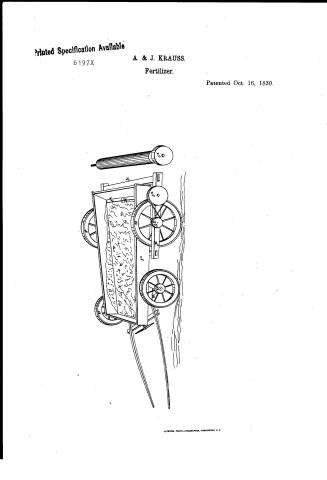
A. and J. Krauss' Patent Drawing for a Means of Spreading Lime Plaster, etc.

National Archives, Restored Patent Drawings (Record Group 241) · Full-size scan at the National Archives · Catalog record
Show the text on the drawing Hide (86 words)
Words on the drawing as machine-read by the National Archives; not checked. Useful mainly for searching.
Enter / A.8J. KRAUSS / Ipreading Sime Plaister &c / Palenled 16 "Oct 1830c / DIV ISION / 1st Waggon body / 6197 X / 2"Axle Trees, Wheels / 3" Frame / 4" Roller / pulleys / A Peice of Leather partly shown which is marted to the Bollorn of waggon- / Bottom extending aver the Roller / a. / Patent office Ded 15, /83j / Made under the direction of the Comminions / of Patents in conformity with act 3 March 1837 / Hungs sumoth / of Patents
USPTO scan
The patent as scanned by the USPTO
-
 Page 1
-
 Page 2
-
 Page 3
-
 Page 4


U.S. Patent and Trademark Office · Google Patents
Show the transcription Hide (847 words)
Machine transcription (LightOnOCR) of the pages as scanned by the USPTO, most of them the handwritten copies made when the records were restored after the 1836 fire. Not checked; it can misread handwriting, so compare it with the scan.
Page 1.
Printed Specification Available
6197X
A. & J. KRAUSS.
Fertilizer.
Patented Oct. 16, 1830.

H. PETERS, PHOTO-LITHOGRAPHER, WASHINGTON, D. C.
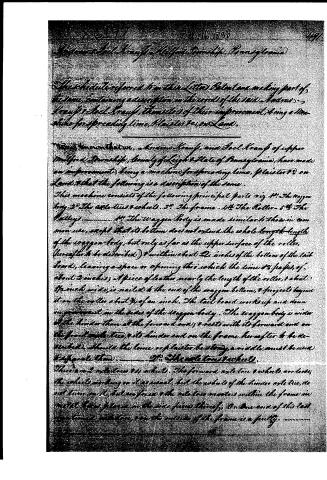
Page 2.
Filed Dec 16, 1830
Andrew & Joel Krauf, Medford Township, Pennsylvania
The schedule referred to in the Letter Patent one making part of the same, containing a description in the words of the said Andrew Krauf & Joel Krauf, the nature of their improvement, being a machine for spreading lime, plaster &c. on Land.
But known that we, Andrew Krauf, and Joel Krauf of upper Medford Township, County of Leigh & State of Pennsylvania, have made an improvement, being a machine for spreading lime, plaster &c. on Land; that the following is a description of the same.
This machine consists of the following principal parts viz: 1st. The wagon body. 2nd. The axle trees & wheels. 3rd. The frame. 4th. The Roller. 5th. The Tailley.
1st. The Wagon Body is made similar to those in common use, except that its bottom does not extend the whole length length of the wagon body, but only as far as the upper surface of the roller, (hereafter to be described) & within about 2 inches of the bottom of the said board, leaving a space or opening through which the lime or plaster, of about 2 inches, a piece of leather nearly the length of the roller, & about 1/4 inch wide, is nailed to the end of the wagon bottom, & projects beyond it on the roller about 1/4 of an inch. The tail board works up and down in grooves cut in the sides of the wagon body. The wagon body is wider at the hinder than at the forward end, & rests with its forward end on the front axle tree, & its hinder end on the frame hereafter to be described. Should the lime or plaster be sticky, a riddle must be used to separate them.
2nd. The axle trees & wheels.
There are 2 axle trees & 4 wheels. The forward axle tree & wheels are like the wheels working on it as usual, but the wheels of the hinder axle tree, do not turn on it, but are fixed to the axle tree mounted within the frame in metal boxes, placed in the side pieces thereof. On one end of this last mentioned axle tree, on the outside of the frame is a faculty.
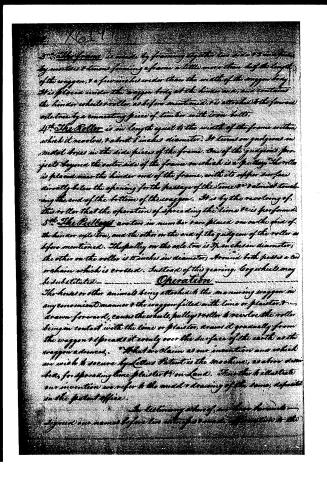
Page 3.
3rd. The frame is made by framing together two sides 8' in length, by mortise & tenons forming a frame a little more than half the length of the wagon, & a few inches wider than the width of the wagon body. It is placed under the wagon body at the hinder end, and contains the hinder wheel & roller, as before mentioned, & is attached to the frame of the tree by a connecting piece of timber with iron bolts.
4th. The Roller is in length equal to the width of the frame within which it revolves, & about 8 inches diameter. It turns on guides in metal boxes in the side pieces of the frame. One of the guides projects beyond the outer side of the frame on which is a pulley. The roller is placed near the hinder end of the frame, with its upper surface directly below the opening for the passage of the lime & so almost touching the end of the bottom of the wagon. It is by the revolving of this roller that the operation of spreading the lime &c is performed.
5th. The Pulleys are two in number & are placed one on the front of the hinder axle tree, and the other on the end of the guide on of the roller as before mentioned. The pulley on the axle tree is 7 inches in diameter, the other on the roller is 5 inches in diameter, around both passes a cord or chain which is crossed. Instead of this gearing, cog wheels may be substituted.
Operation
The horses or other animals being attached to the manning wagon in any convenient manner & the wagon filled with lime or plaster, & drawn forward, causes the wheels, pulleys & roller to revolve the roller being in contact with the lime or plaster, draws it gradually from the wagon & spreads it evenly over the surface of the earth as the wagon advances.
What we claim as our invention and which we wish to secure by Letters Patent is the machine, as above described, for spreading lime, plaster &c on Land. Therefor to illustrate our invention we refer to the model & drawing of the same, deposited in the patent office.
In testimony whereof, we have hereunto signed our names before two witnesses in our presence.
Page 4.
No 1471
Given under this twenty-first day of September A.D. 1820.
Witnesses:
James D. Woodward
John M. Thomas
Andrew Krauff
Joel Krauff
(868 wds)
Patented October 16, 1820.
Published accounts: journal notice
Notice in the monthly list of patents, with remarks
Journal of the Franklin Institute, new ser., vol. 7 (1831), p. 75 · View the page
98. For a Machine for Spreading Lime, Plaster, &c. on Land; Andrew Krauss and Joel Krauss, Upper Milford, Lehigh county, Pennsylvania, October 16.
Remarks. The lime, or plaster, in powder, is put into a wagon constructed for the purpose. Across the hinder part of the bed of the wagon, near the tail board, there is an opening extending from side to side. A roller fixed upon gudgeons, below the wagon bed, nearly fills up this opening. On the end of the axle of one of the hind wheels a pulley is placed, from which a band extends to another pulley on the axis of the roller, to cause it to revolve; the axis of the hind wheels revolves with them, for the purpose of communicating this motion. As the roller turns, it draws after it a portion of the article to be spread upon the land. The claim is to "the machine as above described, for spreading lime, plaster, &c. on land."
About this record
- Patentee
- DATAMP
- Date
- DATAMP, USPTO records, Burke's List of Patents (1847)
- Invention
- DATAMP
- Listed in
- the Name and Date index of patents, DATAMP, USPTO records, Jim Shaw's X-patent list, the Journal of the Franklin Institute, Burke's List of Patents (1847)
- The sources give different dates; the date shown is the one most of them agree on.
- The Franklin Institute's journal confirms the date shown.
- Burke's 1847 Patent Office list gives the same patent.