

Drawings and documents
National Archives restored drawings: drawing
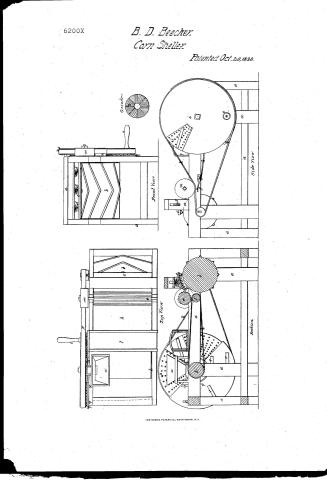
Benjamin D. Beecher's Patent Drawing for a Machine for Thrashing Grain, Shelling Corn, Cutting Straw, and Grinding Provender

National Archives, Restored Patent Drawings (Record Group 241) · Full-size scan at the National Archives · Catalog record
Show the text on the drawing Hide (143 words)
Words on the drawing as machine-read by the National Archives; not checked. Useful mainly for searching.
Entered / 130. THRASHING. / Corn Shellers. / to / or / Disk Action. / ach's / BenjaminDoBacher / CLASSIFICATION / 6200 X / Thrashing Grain, Shelling born butting Straw & / Irinding Provender. / Vol.io pg 515 / IV ISION. / Patented bet 20ᵗʰ 1830. / Irinder / to / Front-view. / Top-view. / Section / Side-view. view. / Preferences a a frame 6 cylinder. C. concave bed.ddd. spiral springs flutted Roller of apron roller g spring h feeding apron. i band wheel h band l shaft & cylinder for apron / pulley n whin 0 crank p toothed side of the wheel of semicircular toothed platerier springs. s. section with a straw cutter Knife. t box for the show to cutt. u castiron plate / conshelleraj tr with teeth w the happer. / Patent office December 7.1541. / made under the direction of the / a terformity with act of march 1837 / frair / n2 Sunverth / Commig of
USPTO scan
The patent as scanned by the USPTO
-
 Page 1
-
 Page 2
-
 Page 3


U.S. Patent and Trademark Office · Google Patents
Show the transcription Hide (624 words)
Machine transcription (LightOnOCR) of the pages as scanned by the USPTO, most of them the handwritten copies made when the records were restored after the 1836 fire. Not checked; it can misread handwriting, so compare it with the scan.
Page 1.
6200X
B. D. Beecher.
Corn Sheller.
Patented Oct. 20, 1830.

THE NORRIS PETERS CO., WASHINGTON, D.C.
Page 2.
Del. 20. 1830 6200X 575
Benjamin O. Beecher
Letters Patent
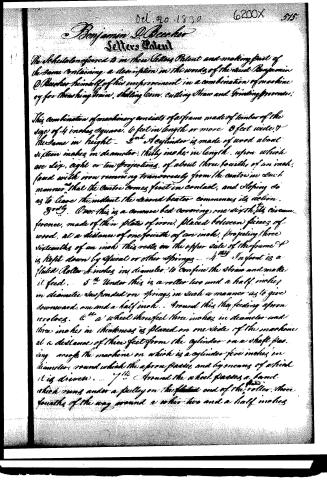
The Schedule referred to in these Letters Patent and making part of the same containing a description in the words of the said Benjamin O. Beecher himself of his improvement in a combination of machinery for threshing grain, shelling corn, cutting straw and grinding processors.
This combination of machinery consists of a frame made of timber of the size of 4 inches square, 6 feet in length or more, 8 feet wide, and the same in height. 2nd. A cylinder is made of wood about sixteen inches in diameter, thirty inches in length, upon which are six, eight or ten projections, of about three fourths of an inch, faced with iron running transversely from the centre in such manner that the centre comes first in contact, and sloping so as to leave the instant the second beater commences its action. 3rdly. Over this is a concave bed covering one sixth its circumference, made of thin plate of iron, placed between pieces of wood, at a distance of one fourth of an inch, projecting three sixteenths of an inch. This rests on the upper side of the frame and is kept down by spiral or other springs. 4th. In front is a fluted Roller 4 inches in diameter to confine the straw and make it feed. 5th. Under this is a roller two and a half inches in diameter suspended on springs in such a manner as to give downward, one and a half inch. Around this the feeding apron revolves. 6th. A wheel three feet three inches in diameter and three inches in thickness is placed on one side of the machine at a distance of three feet from the cylinder on a shaft passing across the machine on which is a cylinder five inches in diameter, round which the apron passes and by means of which it is driven. 7th. Around the wheel passes a band which runs under a pulley on the fluted end of the roller. Three fourths of the way around a wheel two and a half inches
Page 3.
8th. This wheel is put in motion by cranks or gear or a band wheel by hand, horse, water, or other power.
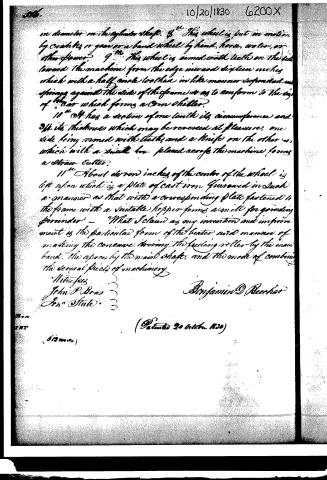
9th. This wheel is armed with teeth on the side toward the machine from the edge inward sixteen inches which with a half circle tooled in like manner suspended and springs against the side of the frame so as to conform to the edge of the car which forms a corn sheller.
10th. It has a section of one tenth its circumference and off its thickness which may be removed at pleasure; one side being armed with teeth and a knife on the other, which with a suitable box placed across the machine forms a straw cutter.
11th. About seven inches of the center of the wheel is left upon which is a plate of cast iron flanged in such a manner as that with a corresponding plate fastened to the frame with a suitable hopper forms a mill for grinding sorghum.
What I claim as my invention and improvement is the particular form of the beater and manner of making the concave, driving the feeding roller by the main band, the apron by the main shaft, and the mode of combining the several pieces of machinery.
Witnesses
John P. Boas
For State
Benjamin D. Beecher
(Patented 20 October 1830)
Published accounts: journal notice
Notice in the monthly list of patents, with remarks
Journal of the Franklin Institute, new ser., vol. 7 (1831), p. 77 · View the page
105. For a combination of machinery for Thrashing Grain, Shelling Corn, Cutting Straw, and Grinding Provender; Benjamin D. Beecher, Woodbury, Litchfield county, Connecticut, October 20.
Remarks. This is a sort of omnium machine, the novelty of which consists in uniting several different machines together. The claims made are to "the particular form of the beaters; the manner of making the concave; driving the feeding roller by the main band; the apron by the main shaft; and the mode of combining the several pieces of the machinery." The cylinder has iron beaters on it which are bent in the form of a V; that, in beating, the angular point may first meet the grain to be thrashed; the hollow segment, or concave, is formed of thin plates of iron, placed between strips of wood. The shelling part is made like the well known corn sheller, consisting of a circular disk with teeth on its side. Towards the centre of this wheel cutters are placed, for cutting straw; when thus used, a trough is added to feed from. Still nearer the centre is to be a furrowed, cast iron plate, running against a corresponding plate, for grinding provender. We have heard of instruments furnished with so many conveniences that it was quite inconvenient to use them; this objection, we suspect, will lie against the contrivance of which we have spoken, and it will not stand alone, as "the particular form of the beaters," and some other particulars named, are by no means new.
About this record
- Patentee
- DATAMP
- Date
- DATAMP, USPTO records
- Invention
- DATAMP
- Listed in
- the Name and Date index of patents, DATAMP, USPTO records, Jim Shaw's X-patent list, the Journal of the Franklin Institute, Burke's List of Patents (1847)
- The sources give different dates; the date shown is the one most of them agree on.
- The Franklin Institute's journal confirms the date shown.
- Burke's 1847 Patent Office list gives the same patent.