

Drawings and documents
National Archives restored drawings: drawing
Levi Disbrow's Patent Drawing for a Means of Boring Earth for Water


National Archives, Restored Patent Drawings (Record Group 241) · Full-size scan at the National Archives · Catalog record
Show the text on the drawing Hide (261 words)
Words on the drawing as machine-read by the National Archives; not checked. Useful mainly for searching.
Sheet 1. 166. ARTESIAN & OIL WELLS, / LEVI DISBROW / THE Earth Augers / Boring Earth for Water. / CLASSIFICATION / Patented November it 1830 / 6212-+ / NOIS / Ressued Oct. 20-1843-No-5}- / Side of Drill / Front of Drill. / Position of Drill upon Stock / with shape the shank face Drill / Stock / CT. ON / Oral / Water PiPr with Rook / Drill Kept the pipe by / Pecking carner Rock under pround / Tongs / Sand / out / Valve inside the Thief / Tools Section bring up parts / lost in lostin Tube / N*4 / Wrench to turn the Borers / Latch Ketch for the Pinion shall
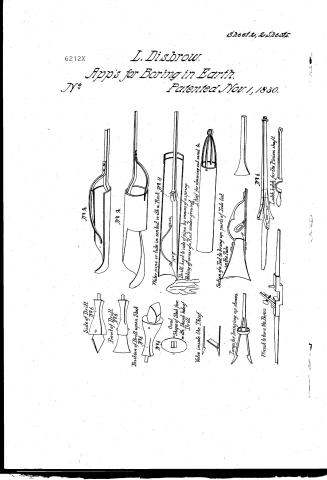
Sheet 2. 166. ARTESIAN & OIL WELLS, / 11 Earth Augcrs / [51] / Earth Augers. / (2Skeets) Sheet 1 / 5-52 / CLASSIFICATION / L. Disbrow / DIVISION 6212-X Boring Earth for Water / Patented Nov 1st1830 / 012 / №4 / N°3 / №3 / N:3 / N°1 / N°3
Sheet 3. 166. ARTESIAN & OIL WELLS, / if Earth Augers / Earth Augers. / CLASSIFICATION / L Disbrow / 6212-+ / DI / ISION Boring Earth for Water / Patented Nov ist1830 / 3, / INN / Latch Retch for the Pinion shaft / or tube in con tact contact with a Rock / Nº / №22 / N°2 / GoN / Drill Kept to side of the pipe by means of & spring / Pecking off the off the corner of a Rock under ground / Thief for drawing out Sand &e. / Section of a Toul to bring up parts / of Tools lost in the Tube. / 0,2 / Water PiPe / Side of of Drill / N. 0 / Front of Drill / Position of Drill upon Stock / Shape of Stock face / with the Shank hole / Tongs for bringing up stones / Wrench to turn the Borers / 9°N / of Drill / Oval / 9 N / N:6 / Value inside the Thief
USPTO scan
The patent as scanned by the USPTO
-
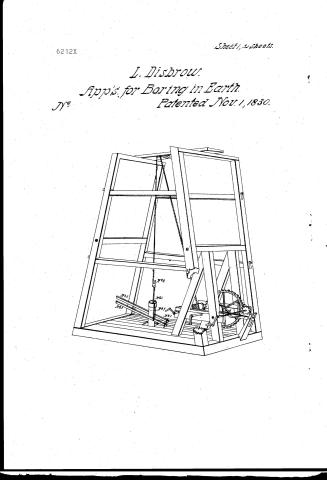 Page 1
-
 Page 2
-
 Page 3
-
 Page 4


U.S. Patent and Trademark Office · Google Patents
Show the transcription Hide (807 words)
Machine transcription (LightOnOCR) of the pages as scanned by the USPTO, most of them the handwritten copies made when the records were restored after the 1836 fire. Not checked; it can misread handwriting, so compare it with the scan.
Page 1.
6212X
Sheet 1, 2 sheets.
L. Dishrow.
App's. for Boring in Earth.
Patented Nov. 1, 1830.
No.

Page 2.
6212X
L. Disbrow.
App's for Boring in Earth.
Patented Nov. 1, 1830.
Sheet 2, 2 Sheets.
No.

- Side of Drill No. 6
- Front of Drill No. 6
- Position of Drill upon Stock No. 6
- Oval Shape of Stock face with Shank hole of Drill No. 6
- Valve inside the Thief
- Tong for bringing up stones.
- Wrench to turn the Borer.
- Water pipe or tube in contact with a Rock No. 4
- Drill kept to side of pipe by means of a spring. Tacking off corner of a Rock under ground. Thief for drawing out sand &c.
- Section of a Tool to bring up parts of Tools lost in the Tube.
- Latch lock for the Pinion shaft. No. 6
Page 3.
Nov. 1, 1830
Smithville City, New York.
Letters Patent Nov. 1, 1830.
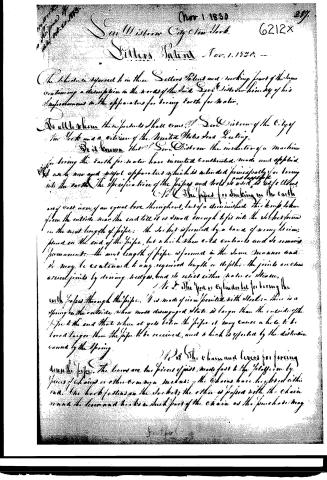
The subject referred to in these Letters Patent and making part of the same containing a description in the words of the said Sew Distorr himself of his improvements in the apparatus for boring Earth for Water.
To all to whom these presents shall come, I, Sew Distorr of the City of New York and a citizen of the United States, do declare.
Be it known that I, Sew Distorr the inventor of a machine for boring the Earth for water have invented, constructed, made and applied a new and useful apparatus which is intended principally for boring into the earth. The specification of the pipes and tools to be used is as follows:
1. The pipes for sinking in the earth are of an equal bore throughout, but of a diminished thickness taken from the outside near the end till it is small enough to fit into the sockets formed in the next length of pipe; the sockets are formed by a band of wrought iron placed on the end of the pipe, but which when cold contracts and becomes permanent; the next length of pipe is formed in the same manner and so may be continued to any required length or depth; the joints are also secured by driving wedges and so resist either water or steam.
2. The spear or cylinder for boring the earth passes through the pipe. It is made of iron provided with steel; there is a spring on the outside when most disengaged state is larger than the outside of the pipe to the end that when it gets below the pipe it may cause a hole to be bored larger than the pipe to be received, and a hole is effected by the dislocation caused by the spring.
3. The chains and levers for forcing down the pipe. The levers are two pieces of iron made fast to the spoffe on by means of chains or other common means; the chains have hooks at either end. One hook fastens on the sockets; the other is passed with the chain round the lever and hooks on such part of the chain as the purchaser may
Page 4.
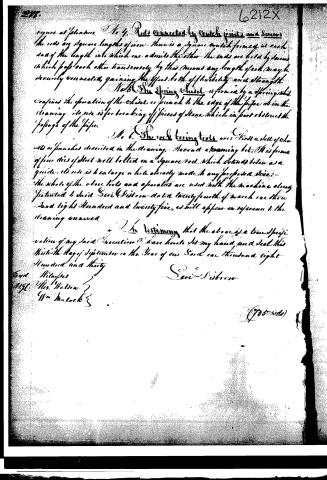
No 4. Rods connected by Swivel joints and Screws
The rods are square lengths of iron. There is a square swivel formed at each end of the length into which one admits the other. The ends are held by screws which pass each other transversely. By this means any length of rod may be securely connected, gaining the effect both of flexibility and strength.
No 5. The Spring Chisel is formed by a spring which confines the operation of the chisel or punch to the edge of the pipe as in the drawing. Its use is for breaking off pieces of stone which in part obstruct the passage of the pipes.
No 6. The rod boring tools are: First a shell of chisels or punches described in the drawing. Second, a screwing bit. It is formed of four dies of steel well bolted on a square rod, which extends below as a guide. Its use is to enlarge a hole already made in any proposed size. The whole of the above tools and apparatus are used with the machine along patented to said Levi Dibborn dated twenty-fourth of March one thousand eight hundred and twenty-five, as will appear on reference to the drawing annexed.
In testimony that the above is a true specification of my said invention I have hereunto set my hand and seal this thirtieth day of September in the year of our Lord one thousand eight hundred and thirty.
Levi Dibborn
Test:
T. Milnes
M. Watson
Wm. Mullock
(705 words)
Published accounts: specification
Specification printed in the Journal of the Franklin Institute
Journal of the Franklin Institute, new ser., vol. 7 (1831), p. 92 · View the page
Text of the specification as printed in the Journal, from OCR; not proofread.
Specification of a patent for improvements in the apparatus for Boring the Earth for Water. Granted to Levi DISBROW, City of New York, November 2, 1830. MR. DISBROW has a former patent for boring apparatus. One particular object in the present patent, appears to be the employment of bits with springs attached to them, to cause them to bore a hole larger than that of the tube through which they are passed down. The parts described are as follows. No. 1. The pipes for sinking in the earth, are of cast iron, of an equal bore throughout, but of a diminished thickness, taken from the outside near the end, till it is small enough to fit into the socket formed on the next length of pipe-the socket is formed by a band of wrought iron, placed on the end of the pipe, but which, when cold, contracts, and so remains permanent. The next length of pipe is formed in the same manner, and so may be continued to any required length or depth. The joints are closed as iron joints, by driving wedges, and so resist either water or steam. No. 2. The pod or cylinder bit for boring the earth, passes through the pipe. It is made of iron, pointed with steel; there is a spring on the outside, whose most disengaged state is larger than the outside of the pipe, to the end that when it gets below the pipe, it may cause a hole to be bored larger than the pipe to be received; and which is effected by the distension caused by the spring. No. 3. The chain and levers for forcing down the pipe. The levers are two pieces of joist made fast to the platform by pieces of chains, or other common means. The chains have hooks on either end. One hook fastens on the socket; the other is passed with the chain round the lever, and hooks in such part of the chain, as the purchase may require, at pleasure. The rods are No. 4. Rods connected by crutch joints and screws. square lengths of iron; there is a square crutch formed at each end of the length, into which one admits the other. The ends are held by screws which pass each other transversely; by this means any length of rod may be securely connected, gaining the effect both of flexibility and strength. No. 5. The spring chisel is formed by a spring which confines the operation of the chisel, or punch, to the edge of the pipe. Its use is for breaking off pieces of stone which in part obstruct the passage of the pipe. No. 6. The rock boring tools are, first, a set of chisels, or punches; second, a riming bit. It is formed by four dies of steel well bolted on a square rod, which extends below as a guide; its use is to enlarge a hole already made to any proposed size. The whole of the above tools and apparatus are used with the machine already patented to said Levi Disbrow, dated twenty-fourth March, one thousand eight hundred and twenty-five. LEVI DISBROW. Observations on a patent obtained by Lieut. BELL, for a Percussion Lock and Vent for Cannon; and an assertion of the original claim to that invention. By JOSHUA SHAW. Philadelphia, January 27, 1831. TO THE EDITOR OF THE JOURNAL OF THE FRANKLIN INSTITUTE. SIR, In the last December number, just received, is a notice of a patent granted to Lieut. W. H. Bell, for a percussion lock and vent for cannon. There never was a more striking instance of the natural propensity which one man has to disregard the rights of another, than is exhibited in the conduct of this gentleman, and in the use and application of the machine in question, which is not in any essential degree, or particular, different from one patented on the 24th day of October, 1828. You have observed that, excepting in the mere arrangement of the parts, you do not think it new. And again in speaking of the countersinking of the vent to receive the primer, which stands as conspicuously as any other part of the arrangement, you ask, is this new. Now it would extremely oblige one who is much interested in this matter, to be permitted to inquire if there be any thing new in this specification, or which did not originate with some other person, and which was not communicated to Lieut. Bell long previous to his application for a patent. The author of these remarks was the first to discover the process of firing cannon by the means here employed, and the power of the fulminating matter to penetrate through the cavity of the vent, and to ignite the charge without the assistance of the priming wire, priming materials, or other priming powder, by the means of a machine acting upon it in precisely the same manner as in Lieut. Bell's apparatus, which is the same in principle with mine, without a single advantage being gained; except it be contended that the contracting of the vent, and the placing it on one side, constitute any; and if such be the case, the claim should be exclusively confined to them. However, it is doubtful if the first could be sustained, as a vent is only such, and has been drilled of every dimension, without any fixed rule. With respect to its location on the side, it is a very important point gained, where a lock of any kind is employed, whether it be on the percussion or the flint lock principle. But it is believed that Lieut. Bell never intended to claim these as his invention; they are, however, introduced, and that in a way very well calculated to serve a lame purpose, by qualifying a machine otherwise useless, as it would be impossible to apply it to the guns now in the United States' service. To have been consistent, this specification ought to have gone further, and have laid claim to the cannon also, since, if a mere change in the arrangement of the parts of a machine will suffice in the first case, it must apply with equal certainty in the second instance. On first reading the account of Lieut. Bell's patent, I confess that I felt my indignation rising, and was disposed to be very angry; but SHAW's Observations on BELL'S Percussion Lock. my charity for human failings has prevailed over the less kindly feelings of our nature, and has induced me to conclude that the Lieutenant did not comprehend the law on patents, and acted under the impression that the right of invention was a sort of debateable property, a something like waste lands, on which any person who felt disposed, might locate himself without asking any questions, break up the soil, and work it for his own purposes and benefit. If this be not the view taken of it by the gentleman, it will be impossible to account for his conduct in any other way, especially when the following particulars shall be made known. In 1828, or 1829, Lieut. Bell called on the subscriber for the purpose, as he said, of making inquiries respecting the various modes of preparing and applying the fulminating powders to the best advantage, as a priming for cannon. I communicated all that I knew, freely and unreservedly, and pointed out to him the various advantages and disadvantages attending its application, observing that the vents as now made were in general too large to apply it advantageously; that the reaction upon the cock at the moment of discharge was one of the principal objections, as it required the addition of a safety spring. This difficulty, I observed to him, could be easily removed, when new castings should be required, by merely drilling the vents of about half their present diameter, and that a further advantage could then be secured by making it on the side, which would free the sight. I then exhibited to Lieut. Bell one mode of doing this, not by mere explanation, but I produced and exhibited to him a working model complete, and which he examined carefully, and with manifest interest. He said it was excellent, and one of the most valuable improvements he had heard of. He expressed his surprise that I should be so ready to show it, and said that it could be taken advantage of to my prejudice. I told him that I did not think so, as I believed my specification covered the principle, and that with respect to the mere arrangement of the parts, the same thing could be done in many different ways; that the numerous guns in the American service were very differently formed at the breech, and required the arrangements to be varied accordingly, so as to render the invention applicable to them, and useful to the government; that so long as the principle was the same, any mere variation of form would be an invasion of my patent, especially where the change, or variation, was the consequence of necessity or convenience. He, perhaps, thought otherwise. I had also in my possession at the same time, a lock mounted on a skeleton cannon, with the vent contracted, and placed on the side of the vent field; this, if my recollection serves me, was standing in the room at the time; of this, however, I will not be certain, but it is certain that I described it, and some other modes, which I had reduced to practice. Of these facts, and the conversation which passed at the time, I have the most unimpeachable evidence. Now as these observations involve something more than a mere statement of isolated facts, your attention to them by an insertion in the Journal of the Franklin Institute, will oblige one, at least, who has benefitted his country by the introduction of a valuable discovery, On SMITH'S Improvement in Compass Needles. (not a contrivance,) through years of expensive experimental labour, but whose lot it may be, like many others, to be deprived of his just reward. It is, however, to be hoped, that the time has come, when a simple change in the arrangement of the parts of a valuable instrument, will not entitle the speculator to a preference, and leave the original inventor destitute. I am, sir, very respectfully, your obedient servant, JOSHUA SHAW, Christian street, Philadelphia. On Mr. M. SMITH's improvement in Compass Needles. TO THE EDITOR OF THE JOURNAL OF THE FRANKLIN INSTITUTE. City of Washington, February 10th, 1831. SIR,-In the remarks which you appended to the specification of my patent for an improvement on surveyors' and mariners' compass needles, published in your last volume, p. 238, allow me to say that the remarks which you make on the theory upon which I have proceeded, are liable, and likely to prejudice the minds of most of your readers against the needle itself, or the improvement which I believe that I have made in it. The greater number of persons are incapable of abstracting the theory from the fact, and are apt to think that if the former is impugned, the latter must fall with it. I really have not the arrogance to pretend to form a theory upon subjects where those who are greatly my superiors in learning are at a loss. I am a mere practical man; the earlier period of my life was spent in the service of my country, in the revolutionary war; and since that time, I have been much engaged in practical surveying. This first led me to pay particular attention to the compass needle, and to a desire to remove some of those difficulties which often baffle the surveyor and the mariner, and not unfrequently endanger the safety of the latter. I think I have now, in the eve of my life, something to offer to my country, which will be found to be a valuable practical improvement. Leaving, therefore, the discussion of the theories to others, and abandoning every thing in my specification which is merely theoretical, I will merely ask you to state to the public the facts which I have recently exhibited to you, as I think by so doing you may do an essential service to society, and perhaps benefit an humble individual. If I have done something more than other mere practical men, it may be fairly attributed to a degree of persevering industry, which has always kept my eyes open to those facts which have come under their notice, and a disposition to endeavour to turn them to advantage. That you are as much a friend to truth as I am, and that it is your wish to disseminate it, I am fully convinced. You will, therefore, I am sure, insert this letter in the next number of your Journal, with such other matter as you may think calculated to place my claims in their proper light. Very respectfully, &c. MOSES SMITH.
Editor's remarks. After receiving the foregoing letter from Mr. Smith, we should think it not only unkind, but unjust, to say any thing further respecting the theory of what he calls his electric rods; and more particularly as we are convinced, from what we have ourselves seen, that Mr. Smith has actually made one important discovery as regards the magnetic needle. It is well known that from the firing of cannon, and violent concussions of other kinds, the magnetism of the compass needle, becomes deranged, or confused, in which state it will be generally found to have several, instead of only two poles; and its directive power is consequently destroyed. In the experiments exhibited to us by Mr. Smith, he took a needle, the directive power of which was perfect; he struck it a moderate blow at each end, longitudinally, and it became deranged; on striking it transversely on each side of its centre, its power was instantaneously, and perfectly restored: this he repeated several times. He then placed it upon a table, held it firmly down, in the manner described in his specification, and by striking the table, produced effects analogous to those which resulted from striking the needle itself. This instantaneous mode of restoring the magnetic power, which was new to us, may, it is manifest, be of incalculable importance, particularly at sea, where the safety of all on board a vessel frequently depends upon the good order of the compass needle. Mr. Smith avers, that in all cases of accidental disturbance of the magnetic power, his method is effectual, and he appeared to be borne out by his experiments. With respect to what he calls his feeders, he believes himself justified by long continued observation, in concluding that they protect the needle from foreign attractions, and increase its directive power. They are now in a fair way of being tested, as there are some of them on board of our ships of war. Hasler, whose judgment in such cases is well known to every man of science, is very favourably impressed with regard to their operation, and has given a testimonial to that effect; and several other gentlemen conversant with this subject, anticipate much advantage from Mr. Smith's inquiries. Mr. FRANKLIN INSTITUTE. Monthly Meeting. THE stated monthly meeting of the Institute was held at their Hall on Thursday evening, January 27, 1831. Mr. ISAAC B. GARRIGUES, was appointed chairman. The minutes of the last meeting were read and approved. The following donations were presented to the Institute, viz. By Mr. A. B. Hutton. Historical and Descriptive Anecdotes of the Steam Engine, and of their inventors and improvers, by Robert Stuart. By Mr. John Ronaldson. Elements of Natural Philosophy, by John Leslie, Esq. Vol. 1. (including Mechanics and Hydrostatics.) By the Board of Managers of the Institute, for 1830. Observations sur la Physique, sur l'Histoire Naturelle et sur les Arts, Vol. 1 to 27, and 32 to 40. By C. C. Biddle, Esq. A series of the National Gazette and Literary Register, from November, 1820, to June 30, 1830. By Mr. A. Ramage. A medal issued on the opening of the Liverpool and Manchester Rail-road. By James Dundas, Esq. A medal issued on the proclamation of William IV. king of Great Britain. By Mr. James Harper. The Report of the Managers of the Schuylkill Navigation Company, for 1830. The corresponding secretary laid on the table the following works, received in exchange for the Journal of the Institute, viz. Journal of the Philadelphia College of Pharmacy, Nos. 1, 2, 3, Vol. 2. The Mechanics' Magazine, and Journal of Public Internal Improvements, for December. London Journal of Arts and Sciences, for November and December. The Register of Arts and Journal of Patent Inventions, for November and December. The Repertory of Patent Inventions, for November and December. Professor A. D. Bache, from the committee on explosions of steam engines, reported that the
Published accounts: journal notice
Notice in the monthly list of patents, with remarks
Journal of the Franklin Institute, new ser., vol. 7 (1831), p. 80 · View the page
2. For an improvement in the Apparatus for Boring the Earth for Water; Levi Disbrow, City of New York, November 1.
Remarks. (See the specification.)
Published accounts: journal notice
Notice in the monthly list of patents, with remarks
Journal of the Franklin Institute, new ser., vol. 7 (1831), p. 91 · View the page
GEORGE SHAW & CO. Specification of a patent for improvements in the apparatus for Boring the Earth for Water. Granted to Levi DISBROW, City of New York, November 2, 1830.
Remarks. MR. DISBROW has a former patent for boring apparatus. One particular object in the present patent, appears to be the employment of bits with springs attached to them, to cause them to bore a hole larger than that of the tube through which they are passed down. The parts described are as follows. No. 1. The pipes for sinking in the earth, are of cast iron, of an equal bore throughout, but of a diminished thickness, taken from the outside near the end, till it is small enough to fit into the socket formed on the next length of pipe-the socket is formed by a band of wrought iron, placed on the end of the pipe, but which, when cold, contracts, and so remains permanent. The next length of pipe is formed in the same manner, and so may be continued to any required length or depth. The joints are closed as iron joints, by driving wedges, and so resist either water or steam. No. 2. The pod or cylinder bit for boring the earth, passes through the pipe. It is made of iron, pointed with steel; there is a spring on the outside, whose most disengaged state is larger than the outside of the pipe, to the end that when it gets below the pipe, it may cause a hole to be bored larger than the pipe to be received; and which is effected by the distension caused by the spring. No. 3. The chain and levers for forcing down the pipe. The levers are two pieces of joist made fast to the platform by pieces of chains, or other common means. The chains have hooks on either end. One hook fastens on the socket; the other is passed with the chain round the lever, and hooks in such part of the chain, as the purchase may require, at pleasure. The rods are No. 4. Rods connected by crutch joints and screws. square lengths of iron; there is a square crutch formed at each end of the length, into which one admits the other. The ends are held by screws which pass each other transversely; by this means any length of rod may be securely connected, gaining the effect both of flexibility and strength. No. 5. The spring chisel is formed by a spring which confines the operation of the chisel, or punch, to the edge of the pipe. Its use is for breaking off pieces of stone which in part obstruct the passage of the pipe. No. 6. The rock boring tools are, first, a set of chisels, or punches; second, a riming bit. It is formed by four dies of steel well bolted on a square rod, which extends below as a guide; its use is to enlarge a hole already made to any proposed size. The whole of the above tools and apparatus are used with the machine already patented to said Levi Disbrow, dated twenty-fourth March, one thousand eight hundred and twenty-five.
About this record
- Patentee
- DATAMP
- Date
- the Name and Date index of patents, DATAMP, USPTO records
- Invention
- DATAMP
- Listed in
- the Name and Date index of patents, DATAMP, USPTO records, Jim Shaw's X-patent list, the Journal of the Franklin Institute, Burke's List of Patents (1847)
- Burke's 1847 Patent Office list gives the same patent.