

Drawings and documents
National Archives restored drawings: drawing
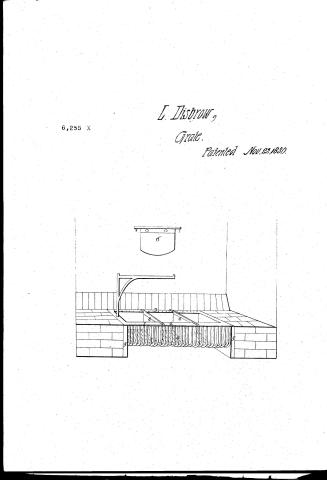
L. Disbrow's Patent Drawing for a Kitchen Grate

National Archives, Restored Patent Drawings (Record Group 241) · Full-size scan at the National Archives · Catalog record
Show the text on the drawing Hide (39 words)
Words on the drawing as machine-read by the National Archives; not checked. Useful mainly for searching.
Gue / STOVES & FURNAUES. TO / Pots & Linings, / egges / pl- / DISBROW'S / CLASSIFICATION / Patented 22 Nov 1830. / 6255-+ / DIVISION. / KITCHEN GRATE. / 6. / slide or division plated
USPTO scan
The patent as scanned by the USPTO
-
 Page 1
-
 Page 2
-
 Page 3


U.S. Patent and Trademark Office · Google Patents
Show the transcription Hide (646 words)
Machine transcription (LightOnOCR) of the pages as scanned by the USPTO, most of them the handwritten copies made when the records were restored after the 1836 fire. Not checked; it can misread handwriting, so compare it with the scan.
Page 1.
6,255 X
L. Disbrow,
Grate.
Patented Nov. 22, 1830.

Page 2.
Nov 22, 1850
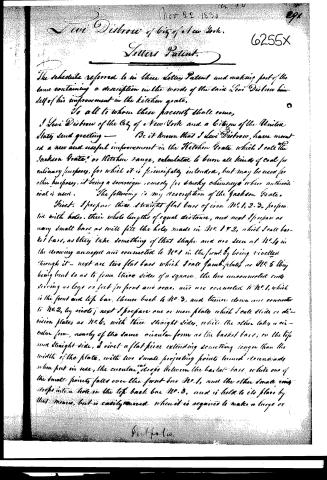
Levi Dibrow of the City of New York.
Letters Patent.
The schedule referred to in these Letters Patent and making part of the same containing a description in the words of the said Levi Dibrow himself of his improvement in the kitchen grate.
To all to whom these presents shall come,
I Levi Dibrow of the City of New York and a citizen of the United States send greeting — Be it known that I Levi Dibrow have invented a new and useful improvement in the Kitchen Grate, which I call the "Jackson Grate," or Kitchen Range, calculated to burn all kinds of coal for culinary purposes, for which it is principally intended, but may be used for other purposes, it being a sovereign remedy for smoky chimneys where anthracite coal is used. The following is my description of the Jackson Grate.
First. I prepare three straight flat bars of iron No. 1, 2, 3, proportioned with holes, their whole lengths of equal distance, and next I prepare as many small bars as will fill the hole, made in No. 1 & 2, which I call basket bars, as they take something of that shape and are seen at No. 4 in the drawing annexed and connected to No. 1 in the front by being rivelled through it — next are two flat bars which I call jamb plates or No. 5 they being bent so as to form three sides of a square, the two unconnected ends serving as legs or feet for front and rear, and are connected to No. 1, which is the front and left bar, thence back to No. 3, and thence down are connected to No. 2, by rivets; next I prepare one or more plates which I call slide or division plates as No. 6, with three straight sides, while the other takes a circular form, nearly of the same circular form as the basket bars; on the left and straight side, I rivet a flat piece extending something longer than the width of the plate, with two small projecting points turned downwards when put in use, the circular piece between the basket bars, while one of the small points falls over the front bar No. 1, and the other small point drops into a hole in the left back bar No. 3, and is held to its place by that means, but is easily moved when it is required to make a large or
Part for two.
Page 3.
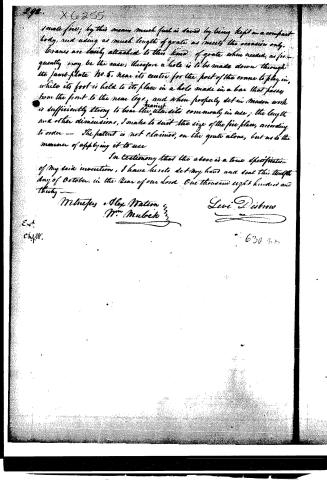
small fire; by this means much fuel is saved by being kept in a compact body, and using as much length of grate as meets the occasion only. Grates are easily attached to this kind of grate when needed, as frequently may be the case; therefore a hole is to be made down through the jamb-plate No. 5, near its centre for the foot of the crane to play in, while its foot is held to its place in a hole made in a bar that passes from the front to the rear legs, and when properly set in mason work is sufficiently strong to bear the heaviest utensils commonly in use; the length and other dimensions, I make to suit the size of the fire place, according to order. The patent is not claimed, on the grate alone, but as to the manner of applying it to use.
In testimony that the above is a true specification of my said invention, I have hereunto set my hand and seal this twentieth day of October, in the year of our Lord One thousand eight hundred and thirty.
Witnesses: Alex Watson & Wm Mulock
Levi Dibrow
630
Published accounts: journal notice
Notice in the monthly list of patents, with remarks
Journal of the Franklin Institute, new ser., vol. 7 (1831), p. 167 · View the page
45. For a Kitchen Grate; Levi Disbrow, City of New York, November 22.
Remarks. This, which the inventor calls the JACKSON GRATE, is for burning anthracite coal, and is made exactly like the grates most commonly used for that purpose, but of greater length. To regulate the size of the fire he uses partitions of iron which are moveable, and extend from the front to the back of the grate. We are told that there may be an oven attached, if required, and that the crane should be strong enough to bear what is hung on it, which is certainly very proper. "The patent is not claimed on the grate alone, but as to the manner of applying it to use." This is all that appears in the form of a claim, and as we do not clearly understand what is meant by it, we leave it to the judgment of our readers.
About this record
- Patentee
- DATAMP
- Date
- the Name and Date index of patents, DATAMP, USPTO records
- Invention
- DATAMP
- Listed in
- the Name and Date index of patents, DATAMP, USPTO records, Jim Shaw's X-patent list, the Journal of the Franklin Institute, Burke's List of Patents (1847)
- Burke's 1847 Patent Office list gives the same patent.