

Drawings and documents
USPTO scan
The patent as scanned by the USPTO
-
 Page 1
-
 Page 2
-
 Page 3


U.S. Patent and Trademark Office · Google Patents
Show the transcription Hide (874 words)
Machine transcription (LightOnOCR) of the pages as scanned by the USPTO, most of them the handwritten copies made when the records were restored after the 1836 fire. Not checked; it can misread handwriting, so compare it with the scan.
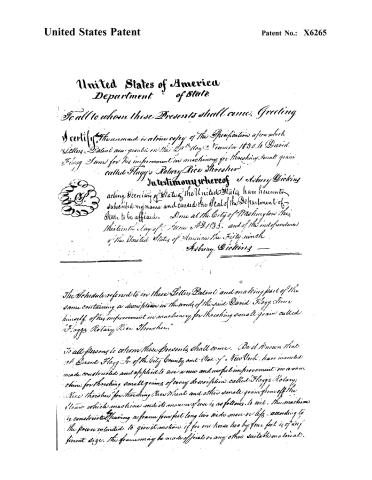
Page 2.
United States Patent
Patent No.: X6265
United States of America
Department of State
To all to whom these Presents shall come, Greeting.
I certify that the annexed is a true copy of the Specification upon which Letters Patent were granted on the 24th day of November 1830 to David Flagg, Jr., for his improvement in machinery for threshing small grain called Flagg’s Rotary Rice Thresher.
In testimony whereof, I, Asbury Dickins, acting Secretary of State of the United States, have hereunto subscribed my name and caused the Seal of the Department of State to be affixed. Done at the City of Washington this thirteenth day of June A.D. 1835, and of the independence of the United States of America the Fifty-ninth.
Asbury Dickins
The Schedule referred to in these Letters Patent and making part of the same containing a description in the words of the said David Flagg, Jr., himself of his improvement in machinery for threshing small grain called “Flagg’s Rotary Rice Thresher.”
To all persons to whom these Presents shall come. Be it known that David Flagg, Jr., of the City County and State of New York, have invented, made, constructed and applied to use a new and useful improvement in a machine for threshing small grains of every description, called “Flagg’s Rotary Rice Thresher” for threshing the Wheat and other small grains from off the straw, which machine and its manner of use is as follows, to wit: The machine is constructed having a frame four feet long two wide more or less, according to the power intended to give it motion, if for one horse two by four feet is of sufficient size. The frame may be made of posts or any other suitable material.
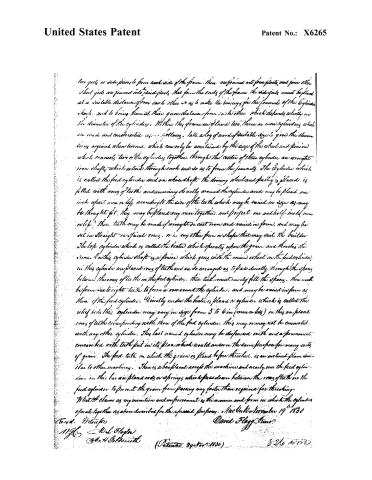
Page 3.
United States Patent
Patent No.: X6265
two gussets or side pieces to form each side of the frame. These are joined not four plates, and join other short gussets are joined into side pieces that form the ends of the frame. The side gussets must be placed at a suitable distance from each other so as to make the bearings for the journals of the cylinder shafts, and to bring them at their given distance from each other, which depends wholly on the diameter of the cylinders. Within this frame are placed two, three or more cylinders which are made and constructed as follows. Take a log of wood of suitable size to give the dimensions required when turned, which can only be ascertained by the size of the wheel and pinion which connects two of the cylinders together. Through the centre of these cylinders are wrought iron shafts which extend through each end so as to form the journals. The cylinder which is called the feed cylinder and on whose shaft the driving wheel and pulley is placed, is fitted with rows of teeth and running directly around the cylinder and may be placed one inch apart now or else according to the size of the teeth which may be varied in size as may be thought fit. They may be placed very near together, and if feet one and half inch (in one roll), these teeth may be made of wrought or cast iron and varied in form, and may be set in straight or spiral rows, or in any other form or shape that may suit the builder. The top cylinder which is called the beater which operates upon the grain and threshes the same. On this cylinder shaft is a pinion which gears with the main wheel on the feed cylinder. In this cylinder are placed rows of teeth and are so arranged as to pass directly through the spaces between the rows of teeth in the feed cylinder. These teeth must nearly fill the spaces. There must be from six to eight teeth to form a row round the cylinder, and may be varied in form as those of the feed cylinder. Directly under the beater is placed a cylinder which is called the relief cylinder. This cylinder may vary in size from 5 to 6 in (minimum) in this are placed rows of teeth corresponding with those of the feed cylinder. This may or may not be connected with any other cylinder. This last named cylinder may be dispensed with and a permanent, round bed with teeth put in its place which would answer the same purpose for many sorts of grain. The feed teeth on which the grain is placed before threshing, is an inclined plane similar to other machines. There is a back plane across the machine and nearly over the feed cylinder. In this back plane rods or springs which pass down between the rows of teeth on the feed cylinder to prevent the grain from passing any faster than required for threshing.
What I claim as my invention and improvement is the manner and form in which the cylinders operate together as above described for the aforesaid purposes.
David Flagg
Filed: November 19, 1830
Patented 29 Nov 1830
826 words
Published accounts: journal notice
Notice in the monthly list of patents, with remarks
Journal of the Franklin Institute, new ser., vol. 7 (1831), p. 170 · View the page
56. For a Thrashing Machine, called Flagg's Rotary Thrashing Machine; David Flagg, jr. City of New York, November 29.
Remarks. There are two, or more, cylinders with rows of teeth upon them; WHITING'S Saw Set. the teeth of one cylinder being made to pass in the spaces between the teeth of its antagonist. We are told, however, that a hollow bed with teeth, may, in some cases, be substituted for one of the rollers. The claim is to "the manner and form in which the cylinders operate together, as above described, for the aforesaid purposes."
About this record
- Patentee
- the Journal of the Franklin Institute, Journal
- Date
- the Name and Date index of patents, USPTO records, Jim Shaw's X-patent list
- Invention
- the Name and Date index of patents
- Listed in
- the Name and Date index of patents, USPTO records, Jim Shaw's X-patent list, the Journal of the Franklin Institute, Burke's List of Patents (1847)
- The patentee's full name comes from the Franklin Institute's journal.
- The residence comes from the Franklin Institute's journal.
- Burke's 1847 Patent Office list gives the same patent.