

Drawings and documents
National Archives restored drawings: drawing
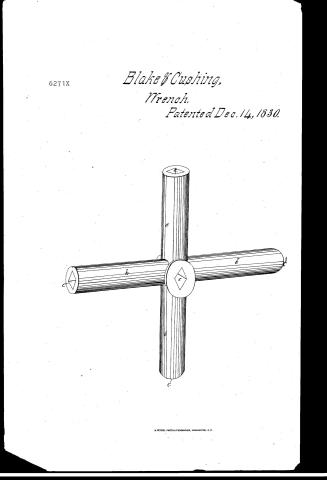
Hudson Blake and Daniel Cushing's Patent Drawing for an Improvement in the Bed Key

National Archives, Restored Patent Drawings (Record Group 241) · Full-size scan at the National Archives · Catalog record
Show the text on the drawing Hide (81 words)
Words on the drawing as machine-read by the National Archives; not checked. Useful mainly for searching.
WORKING TOOLS, / OT weinches, / M Sochet / Axle Sudson Blake I. Daniel bushing / Improvement in the "Bed Key. / 50 / CLASSIFICATION / 6271-+ / Vol.io. ps. 351. / Patented Dec.M. 1830 / DIVISION. / need. a. the centre. / b.bb.b. arms. / C.C.C.C. openings 02 sockets. / Patent affice March 11. 1842. / made under the direction of of / Patents in confor mity with act of 3rd March 1837. / N.L.Surworth / Commification of Patents.
USPTO scan
The patent as scanned by the USPTO
-
 Page 1
-
 Page 2
-
 Page 3


U.S. Patent and Trademark Office · Google Patents
Show the transcription Hide (428 words)
Machine transcription (LightOnOCR) of the pages as scanned by the USPTO, most of them the handwritten copies made when the records were restored after the 1836 fire. Not checked; it can misread handwriting, so compare it with the scan.
Page 1.
6271X
Blake & Cushing,
Wrench.
Patented Dec. 14, 1830.

Page 2.
Patent No. 1,000
Filed Dec. 16, 1852
337
Letters Patent
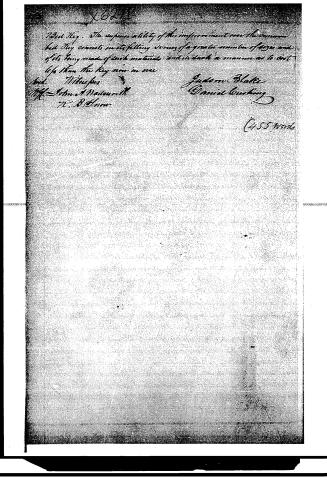
The Schedule referred to in this Letter Patent and making part of the same containing a description in the words of the said Letters Patent, and I will binding themselves of their improvement in the Bed Key.
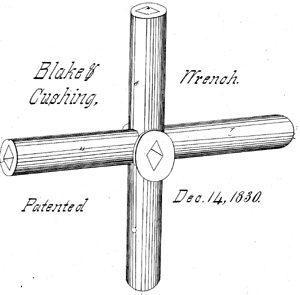
The improved Bed Key is a substitute for the common Bed Key and is made of the following or similarly appropriate substance form and dimensions Fig. The material or substance of which the improved Bed Key is made is cast iron, but Brass, Copper or the like may be substituted. The form is somewhat changed in different keys according to the number of sizes of Bed screws, which the Keys respectively are calculated to fit. But a singly made key consists of a centre and four arms or shafts extending from the centre at right angles and in the same line with each other. The centre is flat and each arm or shaft is round and has a square opening in the extremity of it being a socket for the reception of the head of the screw. The general dimensions of the improved Bed Key will admit of much variation. A convenient size however may be as follows Fig. The centre being one and a half inch in diameter and one inch thick, each arm being four inches long and one inch in diameter. The openings or sockets half an inch square and some of them more and some of them less. Each opening or socket differing in size from any other in the same Key. The number of arms is not confined to four, but may be one, two, three, four, or more at pleasure a square hole is made through the centre from side to side of a different size from any in the arms, and this adds to the number of sockets, or the centre may be oblong instead of square too, having several square holes through it, to accommodate screws of different sizes. This little instrument is to be cast after a flat, then in the usual manner of making iron brass and copper ware and the mode of using it is the same as that of using the common
Published accounts: journal notice
Notice in the monthly list of patents, with remarks
Journal of the Franklin Institute, new ser., vol. 7 (1831), p. 241 · View the page
5. For a Bed Key; Judson Blake, and Daniel Cushing, Providence, Providence county, Rhode Island, December 14.
Remarks. This bed key is to be of cast iron or other metal, and is to have two, three, four, or more, arms, each having a socket in it of different sizes, to fit different screw heads. There are five different forms represented, in which the key may be made, and fifty might be given. "The superior utility of this improvement over the common bed key, consists'in its fitting screws of a greater number of sizes, and in its being made of such materials, and in such a manner, as to cost less than the key now in use. To be able to trace the successive steps by which an inventor of some complex machine arrives at the final result, would, in many cases, be highly interesting, but the task would be one of great diffi culty. Although the invention before us, is not one of great complexity, it would still be no easy thing to assign to each of the heads VOL. VII. No. 4. -APRIL, 1831. 31 which have been engaged in maturing the plan, their respective shares of the merit due to them. Would not a common iron brace, with two or three bits, having sockets of different sizes, answer the purpose intended better than the patented machine? We think it would, and are very sure that it would not interfere with this new and original discovery.
DATAMP: illustration
Illustrations from DATAMP

DATAMP (Directory of American Tool and Machinery Patents), via the Internet Archive · Archived DATAMP page
About this record
- Patentee
- DATAMP
- Date
- the Name and Date index of patents, DATAMP, USPTO records
- Invention
- DATAMP
- Listed in
- the Name and Date index of patents, DATAMP, USPTO records, Jim Shaw's X-patent list, the Journal of the Franklin Institute, Burke's List of Patents (1847)
- Burke's 1847 Patent Office list gives the same patent.