

Drawings and documents
USPTO scan
The patent as scanned by the USPTO
-
 Page 1
-
 Page 2
-
 Page 3
-
 Page 4


U.S. Patent and Trademark Office · Google Patents
Show the transcription Hide (859 words)
Machine transcription (LightOnOCR) of the pages as scanned by the USPTO, most of them the handwritten copies made when the records were restored after the 1836 fire. Not checked; it can misread handwriting, so compare it with the scan.
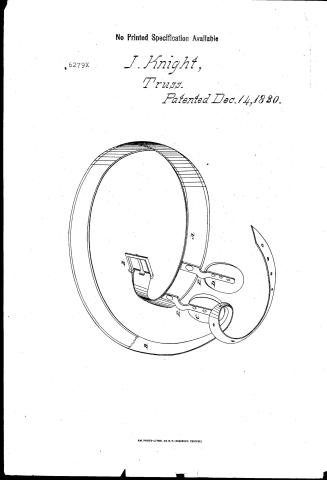
Page 1.
No Printed Specification Available
6279X
J. Knight,
Truss.
Patented Dec. 14, 1830.

AM. PHOTO-LITHO. CO. N. Y. (OSBORNE'S PROCESS)
Page 2.
X6279 Dec. 14, 1830 291
James Knight, of Baltimore, Maryland
Letters Patent.
The Schedule referred to in these Letters Patent, and making part of the same, containing description in the words of the said James Knight himself, of his improvement in Tissues.
To all to whom these presents shall come.
Be it known that J. James Knight of the city of Baltimore, in the county of Baltimore and state of Maryland have invented a new and useful improvement in tissues, and that the following is a full and exact description of the construction and operation of the said Machine as invented or improved by me.
I shall first give a description of it in G. Thelle Patent hinge and pivot tissues in order to point out clearly the nature of my improvement. The construction is as follows; Two concave pads are attached to one elastic steel spring by means of a hinge and pivot; this spring passes from one groin over the other and around to the spine where one of the pads is placed and the other in the groin over the rupture. This tissue is attended with many disadvantages and inconveniences among which is the pressure on the spine in young people; this pressure which must necessarily be considerable in order to keep the instrument in its place, bears on certain points of the spine and on the rupture, and is frequently on its first application so painful as to be insupportable for more than a few hours at a time when the rupture is bad. The hinge and pivot in the centre allow the pad to have motion in any direction and in certain attitudes of the body the irritation may be increased and great pain produced. In order to overcome this inconvenience he applies two of his springs, one on the other and when then the object cannot always be accomplished. I have endeavored to overcome these difficulties and shall now give a description of my
Page 3.
my truss; no pad is necessary upon the back; the pad over the rupture is one ear so as to correspond with the slight convexity of the abdomen and is sustained over the rupture by means of a small steel spring which is also moved to suit the convexity of the abdomen and is riveted fast to the metallic plate in the back of the pad; the other one of this spring is attached to an elastic steel main spring by means of a joint with a large head which allows a lateral motion to the small spring. The main spring is covered with leather and buckles around the hips when it is fixed. In applying this truss the spring must be brought round the body in the same manner as in the application of A.G. Bullo's truss, the small spring will form an angle with the main spring and the pad will be in perfect coaptation with the hernial parietes. As the end of the main spring which is above the rupture extends a small distance from the abdomen, when the truss is buckled perfectly tight the pad will keep sufficiently to keep up the intestine in the most difficult cases of hernia without producing pain, and the pressure is by this means rendered equal around the body; this circumstance is of great importance in the treatment of hernia in labouring people and in infants as the truss can be kept on with ease whilst they are in the recumbent position. A.G. Bullo's truss on the contrary cannot be worn while the patient is lying down in consequence of the pain caused by the pressure of the back pad on the spine. In my truss the pad is kept in perfect coaptation with the hernial parietes under every possible inflection or altitude of the body by the elasticity of a steel spring and not by a hinge and pivot as in A.G. Bullo's truss. This latter arrangement allowing of too much motion whilst the elastic spring having a permanent irritation yields to all motions required but always maintains an equal pressure.
What I claim as my invention and improvement is a truss which is made to keep equally round the body by means of an additional spring and fixed ear on one pad; the pressure being
Page 4.
being graduated by means of a strap and buckle by which the hip is permanently fastened around the body, making it different in principle from all other trousers; my hip can be worn, sitting, lying or standing with so little inconvenience as to be worn by the youngest infants.
Witnesses
Galeb Jones M.D.
Mrs. Revil. M.D.
James Knight, M.D.
(804 words)
(Patented 14 December 1836)
Published accounts: journal notice
Notice in the monthly list of patents, with remarks
Journal of the Franklin Institute, new ser., vol. 7 (1831), p. 248 · View the page
25. For an improvement in Trusses for Hernia or Rupture; James Knight, Baltimore, Maryland, December 14.
Remarks. We shall merely give the claim of the patentee to what he deems his improvement upon Hull's truss. "What I claim as my invention and improvement, is a truss which is made to press equally around the body, by means of an additional spring and fixed concave pad, the pressure being graduated by means of a strap and buckle, by which the truss is permanently sustained around the body, making it different in principle from all other trusses. My truss can be worn sitting, lying, or standing, with so little inconvenience as to be worn by the youngest infant." The additional spring is a short elastic strip of metal, by which the pad is attached to the principal spring.
About this record
- Patentee
- DATAMP
- Date
- the Name and Date index of patents, DATAMP, USPTO records
- Invention
- DATAMP
- Listed in
- the Name and Date index of patents, DATAMP, USPTO records, Jim Shaw's X-patent list, the Journal of the Franklin Institute, Burke's List of Patents (1847)
- Burke's 1847 Patent Office list gives the same patent.