

Drawings and documents
National Archives restored drawings: drawing
David Stein's Patent Drawing for a Saw Mill


National Archives, Restored Patent Drawings (Record Group 241) · Full-size scan at the National Archives · Catalog record
Show the text on the drawing Hide (121 words)
Words on the drawing as machine-read by the National Archives; not checked. Useful mainly for searching.
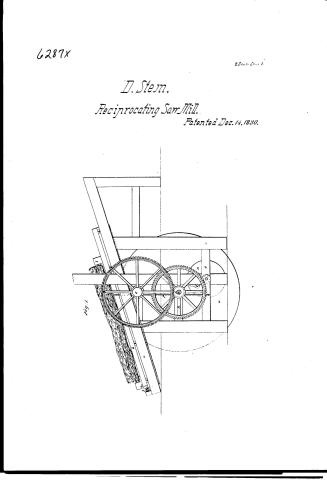
Sheet 1. SA WS. / 143. WOOD SAWING, / SAWING MACRINES / Ready / ocating / David Saw Mills Reciprocating Saw: Ium / Val.10. / 48 / Patented / Saw Mill / 18 / CLASSIFICATION / 6287-+ / DIVISION. / WHOM / YOU / Puferences. a large beams inalination feetin Unfect length / small / Patent office Dee / 2.d / the / c wallowers. shaft / Amadiunder of / stepiohed. / Patents in confor with with ast's / weift / shaft / sweet / wheel. / Jenny / saw. / Comminioner of / flywheel movember / timber / x leaer.p / fender posts / 2. the carriage / Jry.1. / Lide villev. / to / hadblock / th / v.thilog.
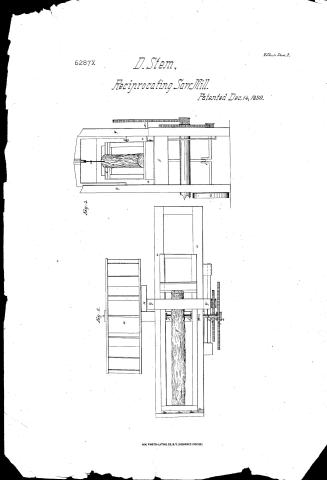
Sheet 2. 143, WOOD SAWING, / David Stem / Plate 2 / SAWING Machines MILLING / Reciprocating Sawa / Patented 14 Dec 1830 / 110. SAWS. / [130] Recip ocating Saw Mills / Patcuted Dec. 14. 1830 / CLASSIFICATION / 6287-1 / DIV ISION / Trant view / Top vew.
USPTO scan
The patent as scanned by the USPTO
-
 Page 1
-
 Page 2
-
 Page 3
-
 Page 4


U.S. Patent and Trademark Office · Google Patents
Show the transcription Hide (703 words)
Machine transcription (LightOnOCR) of the pages as scanned by the USPTO, most of them the handwritten copies made when the records were restored after the 1836 fire. Not checked; it can misread handwriting, so compare it with the scan.
Page 1.
6287x
D. Stern.
Reciprocating Saw Mill.
Patented Dec. 14, 1830.
2 Sheets Sheet 1.
Fig. 1.
Page 2.
6287X
D. Stem,
Reciprocating Saw Mill.
Patented Dec. 14, 1880.
2 Sheets Sheet 2.
Fig. 1.
Fig. 2.
AM. PHOTO-LITHO. CO. N.Y. (OSBORNE'S PROCESS)
Page 3.
Dec. 14, 1859
David Utton, et al., citizens of,
Letters Patent.
The schedule referred to in these Letters Patent and making part of the same, containing a description in the words of the said David Utton, himself of his improvement in the art of sawing timber.
To all to whom these presents shall come.
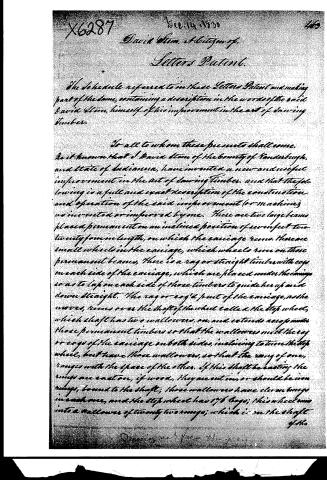
Be it known that I David Utton of the county of Vanderburgh, and state of Indiana, have invented a new and useful improvement in the art of sawing timber, and that the following is a full and exact description of the construction and operation of the said improvement (or machines) as invented or improved by me. There are two large beams placed permanent on an inclined position of seven feet to twenty-four in length, on which the carriage runs. There are small wheels in the carriage, which wheels run on those permanent beams. There is a rag or straight timber with cogs on each side of the carriage, which are placed under the carriage so as to lap on each side of those timbers to guide her up and down straight. The rag or cog'd part of the carriage, as she moves, runs over the shaft of the wheel called the stop wheel, which shaft has two wallows on, and extends across under those permanent timbers so that the wallows meet the rag or cogs of the carriage on both sides, inclining to turn the stop wheel, but have those wallows, so that the way of one, ranges with the space of the other. If this shaft be casting the rings are cast on, if wood, they are cut in, or should be iron rings, bound to the shaft; those wallows have clear bungs in each one, and the stop wheel has 178 Bogs; this wheel runs into a wallower of twenty-two rings; which is on the shaft of the
Page 4.
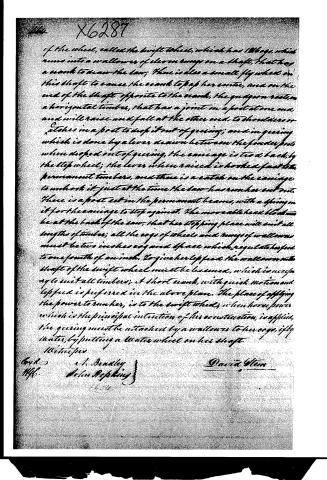
of the wheel, called the swift wheel, which has 120 cogs, which runs into a wallower of eleven cogs on a shaft, that has a crank to draw the saw. There is also a small fly wheel on this shaft to cause the crank to pop her center, and on the end of the shaft opposite to the crank, the quidgown rests on a horizontal timber, that has a joint in a post at one end and will raise and fall at the other end to shoulder or stoops in a post to drop it out of gearing; and in gearing which is done by a lever drawn between the ponderous when dropped out of gearing, the carriage is tied back by the stop wheel; the lever when raised is hooked fast to permanent timbers, and there is a catch on the carriage to unhook it just at the time the saw has room her cut out. There is a post set in the permanent beams, with a spring on it for the carriage to stop against. The movable head block must be at the back of the saw, that her stopping place will suit all lengths of timber; all the cogs of wheels and cogs of wallower must be two inches or and space which regulates her feed to one fourth of an inch. To give her life from the wallower the shaft of the swift wheel must be loosened, which is necessary to suit all timbers; it short crank, with quick motion and life feed is performed in the above plan. The place of applying the power to run her, is to the swift wheel, when horse power which is the principal intention of her construction, is applied, the gearing must be attached by a wallower to her cogs, if by water, by putting a water wheel on her shaft.
Witnesses
David Allen
L. Bradley
John Daphin
Published accounts: journal notice
Notice in the monthly list of patents (listed with a different spelling or date)
Journal of the Franklin Institute, new ser., vol. 7 (1831), p. 246 · View the page
For an improvement in the Art of Sawing Timber; David Stern, Venderburgh county, Indiana, December 14.
About this record
- Patentee
- the Name and Date index of patents, Burke's List of Patents (1847)
- Date
- the Name and Date index of patents, USPTO records, Jim Shaw's X-patent list
- Invention
- the Name and Date index of patents
- Listed in
- the Name and Date index of patents, USPTO records, Jim Shaw's X-patent list, the Journal of the Franklin Institute, Journal, Burke's List of Patents (1847)
- The name conflict was settled by Burke's 1847 list.
- The National Archives' catalog gives the name differently.
- Also listed in a contemporary journal or list under a different spelling or date; the record shown follows the standard lists.
- Burke's 1847 Patent Office list gives the same patent.