

Drawings and documents
National Archives restored drawings: drawing
Ebenezer Lester's Patent Drawing for a Washing Machine

National Archives, Restored Patent Drawings (Record Group 241) · Full-size scan at the National Archives · Catalog record
Show the text on the drawing Hide (110 words)
Words on the drawing as machine-read by the National Archives; not checked. Useful mainly for searching.
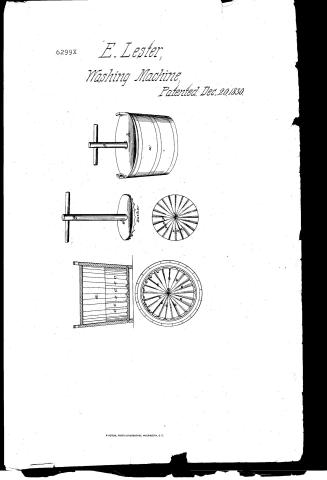
68. LAUNDRY. / [91] Washing Mach's / NOTARY RUBBER. / R.R.R.R / 1150 / Ebenezer Lester / Washing Nachine / 6299-* / DIVISION. / vol.ie pg. 307 / Patented Dec. 20. 1830. / g. / e' / fection / h. / dasher / Bottomof dasher. / Preference athe vessel. blb M. the flutes one the side of the versel / e The bottom. dd the flute on the bottom e the dasher / fifthe flutes on the dasher. the standard and crofs piece. / h. the cover / Patent affice Deer the / made under the direction after Commiproner / of Patent in conformity with act of 3 El March1857 / ML Scemorth / ch. L. fleischmann fait / Commitions if Patents.
USPTO scan
The patent as scanned by the USPTO
-
 Page 1
-
 Page 2
-
 Page 3


U.S. Patent and Trademark Office · Google Patents
Show the transcription Hide (596 words)
Machine transcription (LightOnOCR) of the pages as scanned by the USPTO, most of them the handwritten copies made when the records were restored after the 1836 fire. Not checked; it can misread handwriting, so compare it with the scan.
Page 1.
6299X
E. Lester,
Washing Machine,
Patented Dec. 20, 1830.

Page 2.
Ebenizer Lester, of Killingworth, Connecticut.
Letters Patent.
The schedule referred to in these Letters Patent and making part of the same containing a description in the words of the said Ebenezer Lester himself of his improvement in the washing machine.
To all to whom these presents shall come.
Be it known that I Ebenezer Lester of Killingworth in the County of Windham and State of Connecticut, have invented a new and useful improvement in the construction of Washing machines, adapted to the washing of clothes, sheets, blankets, curtains, and other articles of like kind. And that the following is a full and exact description of the construction and operation of the said machine as invented or improved by me. This improvement consists in, First, a vessel which may be circular, octagonal, or square on the outside, but upon the inside should be always circular. The inside of this vessel should be fluted all round, or lined with fluted work, from the bottom upwards, six inches or more as may be found convenient. The diameter of the inside of this vessel on the bottom may be from one foot to two feet or more, as may be found necessary for family use, and the height of the vessel may be of from fourteen inches to three feet as may be found convenient. The bottom of this vessel on the inside, should be fluted, or covered with fluted work. The fluting should diverge from the center of the bottom increasing in width or diameter proportionally, and extending to the upright fluting upon the inner periphery. Second, a circular stasher fitted to the diameter of the vessel, the underside of which stasher should be fluted, or fluted work, may be fastened upon its under side, and in either case the fluting should be constructed so as to correspond with the fluting in the bottom of the vessel. Rolling may be substituted in the place of a part of the fluted work, if found more convenient.
A standard or upright pipe should be fastened or secured to the center of the circular stasher, and should be as much longer than the depth of the vessel as may be convenient and should pass through a hole of equal the same diameter in the cover. The cover should be secured in its place upon the top of the vessel. On the top or upper end of the standard should be fastened a rope.
Page 3.
6299X
be in an right angle with the standard, of convenient length, the ends of which should be properly shaped for handles. (The clothes or things to be washed, should be placed in the circular dasher, with a sufficient quantity of water, and then the machine may be operated by a person turning the dasher, horizontally, half, or quite round and back. By this means a great saving of time and labour will be effected without injury to the articles washed, as experiment has amply demonstrated. The machine may be made of suitable wood, fastened in the usual way. The inventor does not thereby claim as his invention, vessels, fluted work, or rollers, but merely the manner of improving them, by uniting their operation in the mode above mentioned.
Witnesses
John H. Bolles
Austin Olcott
George Lester
560 words
Published accounts: journal notice
Notice in the monthly list of patents, with remarks
Journal of the Franklin Institute, new ser., vol. 7 (1831), p. 250 · View the page
32. For a Washing Machine; Ebenezer Lester, Killingworth, Middlesex county, Connecticut, December 20.
Remarks. This washing machine differs in its structure and mode of operation from all those which we have hitherto described. It consists of a cylindrical vessel, the bottom of which is to be fluted on the inside, the flutes proceeding in radii from the centre; the sides are also to be fluted a few inches up. There is to be a dasher, consisting of a block of wood, with a shaft attached to it like that of a churn. The lower side of the dasher is to be fluted like the bottom of the vessel. The clothes are to be put into the vessel, with a sufficient quantity of water, and the dasher placed upon them; its shaft is to pass through a lid or cover. On the top of the dasher is a cross bar, or handle. "The machine may be operated by a person turning the dasher, horizontally, half, or quite, round and back. By this means a great saving of time and labour will be effected, without injury to the articles washed, as experiment has amply demonstrated." "The inventor does not hereby claim as his invention, vessels, fluted work, or rollers, but merely the manner of improving them by uniting their operations in the mode above mentioned."
About this record
- Patentee
- the Journal of the Franklin Institute, Journal
- Date
- the Name and Date index of patents, USPTO records, Jim Shaw's X-patent list
- Invention
- the Name and Date index of patents
- Listed in
- the Name and Date index of patents, USPTO records, Jim Shaw's X-patent list, the Journal of the Franklin Institute, Burke's List of Patents (1847)
- The patentee's full name comes from the Franklin Institute's journal.
- Burke's 1847 Patent Office list gives the same patent.