

Drawings and documents
National Archives restored drawings: drawing
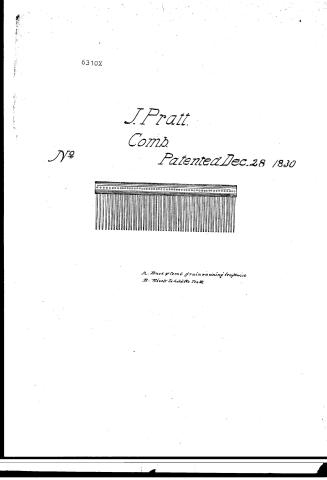
J. Pratt's Patent Drawing for the Manufacture of Combs

National Archives, Restored Patent Drawings (Record Group 241) · Full-size scan at the National Archives · Catalog record
Show the text on the drawing Hide (62 words)
Words on the drawing as machine-read by the National Archives; not checked. Useful mainly for searching.
138. ТОП ET / Combs. / J.PRATT / CLASSIFICATION / 6310-+ / Manufacture of Combs / DIVISION. / Patented 28"Dec" 1830 / Strickland I'l / A. Back gComb grain running lengthwise / B. Riversto hold The Teeth / Patent Office / Made under the direction of the Commuysrour of hatents / in conformity with act 3 3 March) 1837- / Commissioner
USPTO scan
The patent as scanned by the USPTO
-
 Page 1
-
 Page 2
-
 Page 3


U.S. Patent and Trademark Office · Google Patents
Show the transcription Hide (640 words)
Machine transcription (LightOnOCR) of the pages as scanned by the USPTO, most of them the handwritten copies made when the records were restored after the 1836 fire. Not checked; it can misread handwriting, so compare it with the scan.
Page 1.
6310X
J. Pratt.
Comb.
Patented Dec. 28 1830
No

A. Back of comb grain running lengthwise
B. Rivets to hold the Teeth
Page 2.
Patented Dec. 28, 1830
Julius Pratt
Letters Patent X 6310
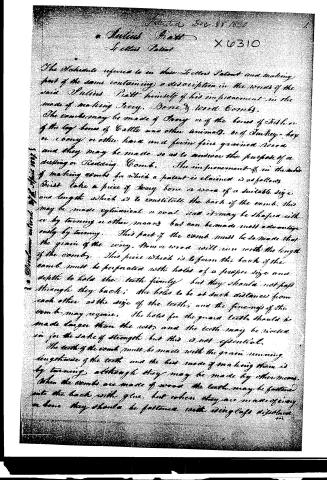
The Schwanke referred to in these Letters Patent and making part of the same containing a description in the words of the said Julius Pratt himself of his improvement in the mode of making Ivory, Bone & Wood Combs.
The combs may be made of Ivory or of the bones of Fish or of the leg bones of Cattle and other animals, or of Turkey-boy or ebony or other hard and finely fine grained wood and they may be made so as to answer the purpose of a dressing or Redding Comb. The improvement of in the mode of making combs for which a patent is claimed is as follows:
First take a piece of Ivory bone or wood of a suitable size and length which is to constitute the back of the comb. This may be made cylindrical or oval and it may be shaped either by turning or other means but can be made most advantageously by turning. This part of the comb must be so made that the grain of the ivory, bone or wood will run with the length of the comb. This piece which is to form the back of the comb must be perforated with holes of a proper size and depth to hold the teeth firmly but they should not pass through they back; the holes to be at such distances from each other as the size of the teeth and the fineness of the comb may require. The holes for the guard teeth should be made larger than the rest and the teeth may be riveted in for the sake of strength but this is not essential.
The teeth of the comb must be made with the grain running lengthwise of the teeth and the best mode of making them is by turning although they may be made by other means. When the combs are made of wood the teeth may be fastened into the back with glue, but when they are made of ivory or bone they should be fastened with wingclips or similar.
Page 3.
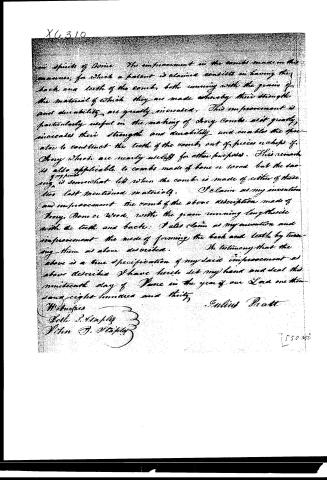
in Spirits of Wine. The improvement in the combs made in this manner, for which a patent is claimed, consists in having the back and teeth of the combs, both running with the grain of the material of which they are made whereby their strength and durability are greatly increased. This improvement is particularly useful in the making of Ivory combs, as it greatly increases their strength and durability and enables the operator to construct the teeth of the combs out of pieces or chips of Ivory which are nearly useless for other purposes. This remark is also applicable to combs made of bone or wood but the saving is somewhat less when the comb is made of either of these two last mentioned materials. I claim as my invention and improvement the comb of the above description made of Ivory, Bone or Wood, with the grain running lengthwise with the teeth and back. I also claim as my invention and improvement the mode of forming the back and teeth by turning them as above described. In testimony that the above is a true specification of my said improvement as above described I have hereunto set my hand and seal this nineteenth day of June in the year of our Lord one thousand eight hundred and thirty.
Witnesses
Helle S. Stapley
John B. Stapley
Julius Pratt
Published accounts: journal notice
Notice in the monthly list of patents, with remarks
Journal of the Franklin Institute, new ser., vol. 7 (1831), p. 254 · View the page
45. For an improvement in the mode of Making Ivory, Bone, and Wood Combs; Julius Pratt, Minden, New Haven county, Connecticut, December 28.
Remarks. The back of the comb is to be made in a separate piece, and it is recommended to form it by turning. This piece is to be drilled to receive the teeth, which are also to be in separate pieces, and are to be formed by turning, or otherwise. Both the back and the teeth are to have the grain of the material running lengthwise. "This improvement in the combs made in this manner, for which a patent is claimed, consists in having the back and teeth of the comb both running with the grain of the material of which they are made, whereby their strength and durability are greatly increased. This improvement is particularly useful in the making of ivory combs, as it greatly increases their strength and durability, and enables the operator to construct the teeth of the comb out of pieces, or chips of ivory, which are nearly useless for other purposes." "I claim as my invention and improvement the comb of the above description, made of ivory, bone, or wood, with the grain running lengthwise with the teeth and back. I also claim as my invention and improvement, the mode of forming the back and teeth by turning them, as above described." The present patentee, if he is "the true and original inventor," has been rather tardy in asserting his claims. On the 14th of April 1829, Nathaniel Bricknell of Connecticut obtainedja patent, in which it is stated that "this improvement consists in forming the back of a comb in a separate piece, or separate pieces of wood, so fastened to the back of the comb blade as that the grain will run at right angles with the grain of the wood forming the comb blade and comb teeth." On the 11th of June in the same year, a patent issued to John Brown, of Providence, Rhode Island, for making small toothed combs out of small scraps, by connecting such pieces to pieces of hard wood, horn, or any other suitable substance. The interference of these claims is perfectly manifest, and either one or the other of these patents must be untenable.
About this record
- Patentee
- the Journal of the Franklin Institute, Journal
- Date
- the Name and Date index of patents, USPTO records, Jim Shaw's X-patent list
- Invention
- the Name and Date index of patents
- Listed in
- the Name and Date index of patents, USPTO records, Jim Shaw's X-patent list, the Journal of the Franklin Institute, Burke's List of Patents (1847)
- The patentee's full name comes from the Franklin Institute's journal.
- Burke's 1847 Patent Office list gives the same patent.