

Drawings and documents
National Archives restored drawings: drawing
J. Reed's Patent Drawing for a Method of Constructing a Furnace for Generating Steam for Culinary Purposes

National Archives, Restored Patent Drawings (Record Group 241) · Full-size scan at the National Archives · Catalog record
Show the text on the drawing Hide (101 words)
Words on the drawing as machine-read by the National Archives; not checked. Useful mainly for searching.
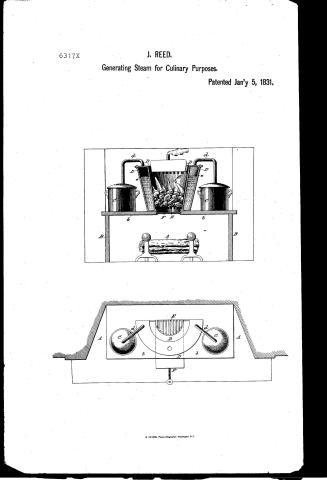
Patented 5" Ian. / $350 / 126, STOVES & FURNACES / Domestic Boilers, Steamers. / J.REED / CONST G FURNACE FOR GENERA TIN G STEAM FOR CULINARY PURPO SES / classification / 6317 X / DIVISION. / the culinar 2 / health / Front plate removed sleawing / fireplace / Patent Office July 30 30th 1841 / A Fire place / Made under the disclion of the commpouner of / B. Verticalplates- b. HorizontalPlale / C2 Cooking Kettles.d. Steampipes to D° / patents in conformity with act of 3 March 1837 / D. Inside and Outside Kettles.e e Boiler / Ellmorth / E. Cerates / Commysiour of ha its / F. Studing damper
USPTO scan
The patent as scanned by the USPTO
-
 Page 1
-
 Page 2
-
 Page 3
-
 Page 4


U.S. Patent and Trademark Office · Google Patents
Show the transcription Hide (1,153 words)
Machine transcription (LightOnOCR) of the pages as scanned by the USPTO, most of them the handwritten copies made when the records were restored after the 1836 fire. Not checked; it can misread handwriting, so compare it with the scan.
Page 1.
6317X
J. REED.
Generating Steam for Culinary Purposes.
Patented Jan'y 5, 1831.

N. PETERS. Photo-Lithographer, Washington, D. C.
Page 2.
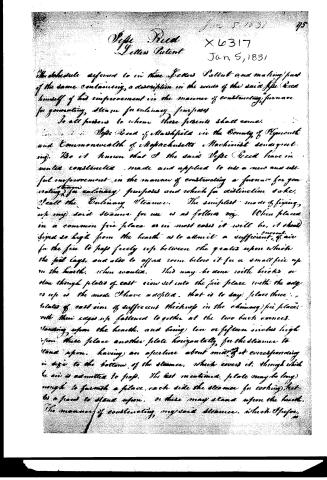
Vespé Reed
Letter Patent
Jan. 5, 1831
The schedule referred to in these Letters Patent and making part of the same containing, a description in the words of the said Vespé Reed himself of his improvement in the manner of constructing furnaces for generating steam for ordinary purposes.
To all persons to whom these presents shall come.
Vespé Reed of Marshfield in the County of Plymouth and Commonwealth of Massachusetts Machinist hereby greeting.
Be it known that I the said Vespé Reed have invented constructed made and applied to use a new and useful improvement in the manner of constructing a furnace for generating for ordinary purposes and which for distinction sake, I call the Ordinary Steamer. The simplest mode of fixing, up my said steamer for use is as follows viz. When placed in a common fire place as in most cases it will be, it should fixed so high from the hearth as to admit a sufficient current of air for the fire to pass freely up between the grates upon which the fuel lays, and also to afford room below it for a small fire up in the hearth, when wanted. This may be done with bricks or stone though plates of cast iron set into the fire place with the edges up as the mode I have adopted, that is to say, place three plates of cast iron of sufficient thickness in the chimney fire place, with their edges up fastened together at the two back corners, standing upon the hearth, and being ten or fifteen inches high from these places another plate horizontally for the steamer to stand upon, having an aperture about mid of it corresponding in size to the bottom of the steamer, which covers it, through which the air is admitted to pass. The last mentioned plate may be long enough to furnish a place each side the steamer for cooking, but to a stand to stand upon, or there may stand upon the hearth.
The manner of constructing my said steamer which I propose
Page 3.
is by fastening together by means of screws, and into two cylindrical flanges—cast iron bottles or pans of equal height place one within the other and a little flaring from the bottom inwards. The diameter across the bottom of the outside kettle is about ten inches. The diameter across the top is about fifteen inches. The height eleven inches or the dimensions may be varied, as also the form if so preferred. The diameter of the inside kettle is about one third less than the other whereby a circular space between them is afforded for the water. The outer kettle has a rim or flange around the bottom projecting inwards, nearly at right angles with the sides and broad enough to extend to the inner surface of the inside kettle, with which its edge forms an angle and is made perfectly tight, and by means of which a bottom is formed to the space intended to contain the water. Upon the upper surface of this flange and within said space a lip is cast to support the lower end of the inner kettle against which it bears. This kettle has also a rim or flange about three inches wide extending from the top edge outwards, over the outside rim of the other kettle covering said circular space at the top and by means of cyclets or flanges both edges are firmly secured and screwed together. The kettle being thus fastened the central cavity within the inner one is intended for the fire, at the lower end of which is the grate to sustain the fuel and when the steam is in its place over the aperture of the horizontal plate the air is freely admitted to pass up through the fire. To the under side of the last mentioned plate a sliding sampler of cast iron is fixed to regulate the draft as occasion may require. Another grate is placed within said central cavity over the fire for the ordinary purposes of heating and cooking, over the fire as in common clay furnaces, a hole of an inch in diameter is perforated through the upper flange through which the water is conveyed into the boiler. This hole answers also for the safety valve. I make two smaller perforations through said flange.
Page 4.
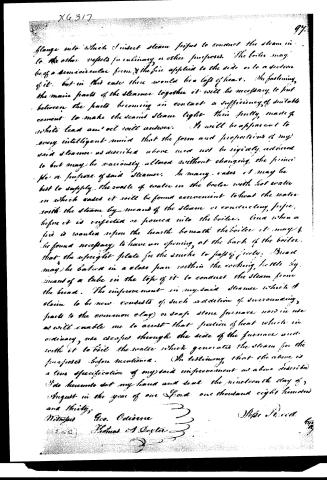
glange into which I insert steam pipes to conduct the steam into the other vessels for culinary or other purposes. The boiler may be of a semicircular form if the fire applied to the side or to a section of it, but in this case there would be a loss of heat. In fastening the main parts of the steamer together it will be necessary to put between the parts becoming in contact a sufficiency of suitable cement to make the seams steam tight. Thin putty, made of white lead and oil will answer. It will be apparent to every intelligent mind that the form and proportions of my said steamer as described above need not be rigidly adhered to but may be variously altered without changing the principle or purpose of said steamer. In many cases it may be best to supply the waste of water in the boiler with hot water in which cases it will be found convenient to heat the water with the steam by means of the steam or conducting pipes before it is injected or poured into the boiler. And when a fire is wanted upon the hearth beneath the boiler it may be found necessary to have an opening at the back of the boiler that the upright plate for the smoke to pass freely. Bread may be baked in a close pan within the cooking kettle by means of a tube in the top of it to conduct the steam from the bread. The improvement in my said steamer which I claim to be new consists of such addition of surrounding parts to the common clay or soap stone furnace now in use as will enable me to arrest that portion of heat which in ordinary use escapes through the side of the furnace and with it to boil the water which generates the steam for the purposes before mentioned. In testimony that the above is a true specification of my said improvement as above described I do hereunto set my hand and seal the nineteenth day of August in the year of our Lord one thousand eight hundred and thirty.
Witness Geo. Odiorne
Thomas A. Deeter
Nephe D. Scott
Published accounts: journal notice
Notice in the monthly list of patents, with remarks
Journal of the Franklin Institute, new ser., vol. 7 (1831), p. 301 · View the page
4. For a Furnace for generating Steam for Culinary Purposes; Jesse Reed, Marshfield, Plymouth county, Massachusetts, January 5.
Remarks. This furnace may be made of cast iron. It is to consist of two vertical, cylindrical vessels, one placed within the other, a space being left between their sides to contain water. The inner vessel is to form the fire place, the bottom of it is formed of bars, and upon them the fuel is to be placed, and is consequently surrounded by the double cylinders which contain the water. A close cover forms a steam tight connexion between these cylinders, and has in it perforations for steam pipes to lead into other vessels, and for a safety valve. Above the fire, there is a grate to sustain a kettle, or other vessel, in the manner of the common clay furnaces. "The improvement in my said steamer, which I claim as new, consists of such additions of surrounding parts to the common clay or soap stone furnace now in use, as will enable me to arrest the portion of heat which in ordinary use, escapes through the side of the furnace, and with it to boil the water which generates the steam for the purpose before mentioned." All this may be very intelligible to some folks, but such is not the case with us. We are at a loss to discover in what way the heat which escapes through a clay, or soap stone, furnace, is to be saved, where neither of the materials are employed; and furthermore, we apprehend, putting both clay and soap stone out of the question, that this contrivance will not be found either very convenient or useful.
About this record
- Patentee
- DATAMP
- Date
- the Name and Date index of patents, DATAMP, USPTO records
- Invention
- DATAMP
- Listed in
- the Name and Date index of patents, DATAMP, USPTO records, Jim Shaw's X-patent list, the Journal of the Franklin Institute, Burke's List of Patents (1847)
- Burke's 1847 Patent Office list gives the same patent.